 Sign In









 Ubersuggest
  AnswerThePublic
Key Takeaways
- Traffic: Listicles rank when they nail search intent. You don’t need a 5,000-word guide, just the fastest, clearest answer to the query.
- Links: People link to listicles when they don’t want to recreate the work. Give them stats, quotes, visuals, and legit sources. Make it easier to cite you than compete with you.
- Shares: Nobody shares generic tips. They share things that surprise them, help them, or make them look smart. Organize your list for speed, add a hook, and lead with something unexpected.
- Quick rule: Each item should deliver standalone value. That means it should offer a clear takeaway, even without the rest of the list.
Most listicles suck.
They’re lazy, bloated, and packed with filler.
But a well-done listicle? It ranks. It earns backlinks. It gets passed around.
Let me show you how to write one that actually performs.
What is a Listicle?
A listicle is a blog post organized as a list.
Each item covers part of the topic, and together they give the full picture.
It’s not about slapping numbers on random tips. A good listicle is a fast, structured way to deliver value.
The best ones do three things:
- Answer a specific question
- Help readers make a decision
- Make every item useful on its own
They’re easy to scan, easy to share, and easy to cite.
If someone can screenshot one item and get value, that’s a real listicle. If they have to read the whole thing to understand anything, you’ve missed the mark.
Listicles work when every piece earns its spot.
If it’s filler, cut it.
The 7 Steps to Writing a Listicle That Performs
There’s no one-size formula.
But if your goal is traffic, links, and shares, the process starts with the right topic and ends with a structure that delivers value fast.
Whether you’re writing for a landing page, a blog post, or social media, the right list format can boost clicks and performance across the board.
Step 1: Choose the Right Topic and Format
Not every topic should be a list.
Listicles work best when people are comparing options or looking for quick takeaways. If the searcher is asking “what’s the best,” “how to fix,” or “top tools,” that’s your green light.
Here’s when a list format makes sense:
- People are comparing or choosing
- Featured snippets on the SERP are list-style
- Competing posts use numbers in the title
- You’re organizing tips, examples, or tools
If you’re building a content strategy that targets competitive terms, check the SERP. If most of the top results are lists, follow the format. If they’re guides, frameworks, or opinion pieces, go in that direction instead.
Pro tip: Listicle-style headlines convert better. Anyword found that 70% of listicle headlines had higher click-through rates than non-listicle ones. Adding a number to a Facebook headline alone improved performance. Structure matters at the headline level.
Step 2: Pick the Right Number and Structure
There’s no perfect number, but odd numbers still get more attention. “Top 11” often beats “Top 10.”
What matters more is the depth and structure. Don’t stretch a weak list to hit 25. Keep it clean and focused.
Use one of these formats:
- Short and deep: 5–7 fully explained tactics
- Grouped: 12 tools, organized by category or use case
- Ranked: 10 items scored with pros and cons
Here’s what that looks like in action:
- 5 SEO tactics that are each 200+ words with examples
- 12 design tools split into beginner, advanced, and AI-powered
- 9 hiring mistakes grouped by stage: sourcing, screening, and onboarding
Each item should offer something useful, even out of context. If it can’t stand alone, it doesn’t belong.
How do you know if a list item stands alone? Ask yourself:
- If you removed the rest of the post, would this item still teach something useful?
- Could someone screenshot this section and get immediate value without reading anything else?
Example: Ahrefs’ top SEO Chrome extensions list has 14 tools, grouped by type, with screenshots and use cases. Tight and skimmable.
Pro tip: A 1,500-word list with 5 well-developed items will beat a bloated 3,000-word post. Focus on clarity, not count.
Step 3: Front-load the value
Most readers won’t get past the first few list items. The top 3–4 carry the most weight for clicks, shares, and rankings.
So start strong.
Here’s how to front-load effectively:
- Lead with something unexpected
- Drop a useful stat or example right away
- Start with the tactic most people skip or mess up
This isn’t about saving the best for last. It’s about grabbing attention fast, then earning trust with every scroll.
Pro tip: Eye-tracking studies show the top half of your list gets up to 3x more engagement. That’s where the value needs to hit hardest, especially if you’re sharing it on social media or using it to support a landing page.
Step 4: Make it Link-Worthy
If someone can cite your list instead of writing their own, you win. That’s how listicles pick up backlinks and keep showing up in roundups, forums, and newsletters.
Make your post linkable by adding real substance:
- Include original visuals, frameworks, or charts
- Drop in stats with source links (don’t fake it—cite real data)
- Add expert quotes or quick takes from credible voices
- Use internal links to related blog posts or tools
- Add unique insights to every list item, not just filler copy
In content marketing, the easiest way to earn links is to create something people don’t want to rebuild.
Example: Backlinko’s Google ranking factors list is built for citations. It’s long, sourced, and organized to be reused.
Step 5: Format for Readability and Shares
Listicles are easy to skim, which means formatting matters more than length.
Here’s your checklist:
- Use H2 or H3 headings for every list item
- Bold the takeaway or main point in each one
- Keep list items short—3 to 5 sentences max
- Drop in screenshots, visuals, or short videos
- Stick to a consistent structure: Problem → Fix → Tool or Tip → Why It Matters → Example
Quick rule: If someone screenshots a single list item, it should still be useful without context. This makes your content easier to share across social media or embed into a landing page for repurposing.
Example: Zapier’s AI productivity tools list nails this. Each tool has a short description, bolded features, and a visual. You can copy and share any section and still get value.
Step 6: Optimize for SEO (and AI Summaries)
Listicles are perfect for winning featured snippets if you set them up right.
They’re also showing up more in AI-generated summaries across Google’s new search features.
We analyzed over 2,000 prompts in Google’s AI Mode. Blog posts were the most frequently surfaced content type, leading at 49%.
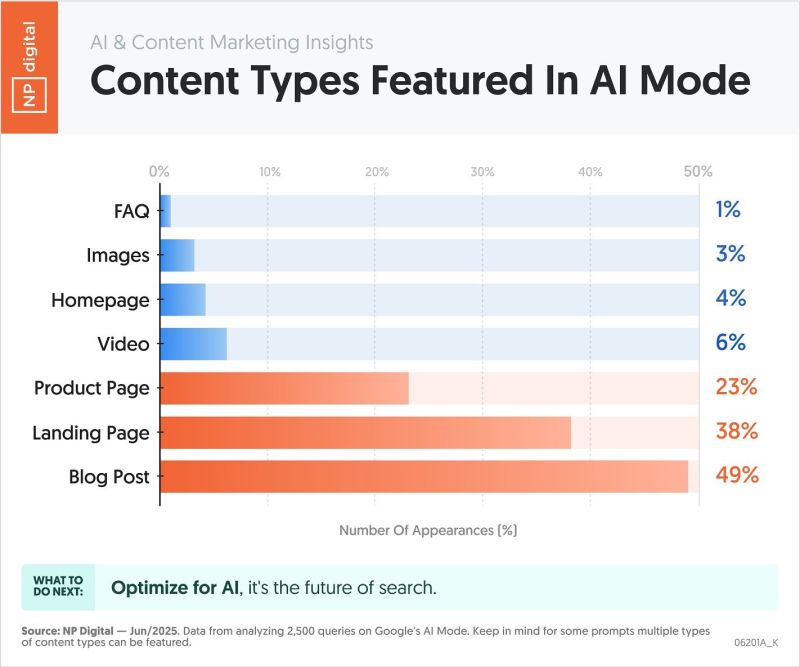
That’s a big signal. If your blog is structured cleanly and packed with useful, cited info, AI is more likely to pull from it.
Here’s how to optimize your listicle for both SEO and AI visibility:
- Start with a lead-in line: “Here are 11 [tools/tactics/examples]…”
- Use H2s or H3s for every list item
- Add itemList or FAQPage schema when it fits
- Include alt text with your images (use real keywords, not fluff)
- Write a clear meta description with the number of items and value promise
- Use tight, cited, factual language, especially in the intro and top items
Pro tip: Add anchor links to each item or a quick recap list at the end. This gives you a second shot at a featured snippet and makes it easier for readers to navigate.
Step 7: Write a CTA that Doesn’t Kill Momentum
Don’t end with “leave a comment below.” That’s lazy, and it doesn’t move the reader anywhere useful.
The right CTA keeps the flow going. It should feel like a bonus, not a pitch.
Try these:
- Ask a question like: Which tactic are you going to test first?
- Offer a checklist version of the list to download
- Drop a quick prompt: Send this to your team so everyone’s on the same page
- Link to your next-level guide, tool, or video if they want more depth
Pro tip: Your CTA should feel like the reader got something extra, not like they’re being sold to. Example: Grab this [Blog Post Checklist] if you want to turn your draft into something link-worthy.
Before You Publish: Avoid These Listicle Mistakes
Common listicle mistakes to avoid:
- Repeating the same point with slightly different wording
- Including tools or examples you haven’t actually used or vetted
- Writing a long intro that delays the list
- Using generic tips with no context, proof, or examples
FAQs
What is a listicle?
A listicle is a blog post that’s structured as a list. Each item covers a specific part of the topic, and together, they give readers the full picture. But don’t confuse it with lazy content.
A real listicle doesn’t just slap numbers on random tips. It delivers value fast.
The best listicles:
- Answer a specific question
- Help readers make a decision
- Make each item useful on its own
Think of it like this: If someone can screenshot just one item and get something out of it, that’s a good listicle.
Want yours to get links and shares? Make it skimmable, cite legit sources, and lead with real insight, not filler fluff.
How do you write a listicle that actually performs?
Most listicles fail because they’re built to check a box, not to provide value.
Here’s how to write one that drives traffic, earns backlinks, and gets shared:
- Pick the right topic. If people are comparing, choosing, or searching for “top” or “best,” a listicle works.
- Use the right structure. Keep it tight. 5 to 7 strong items are better than 25 weak ones.
- Front-load the value. The first few list items matter most for engagement.
- Make it link-worthy. Add stats, quotes, visuals, and insights that are hard to replicate.
- Format for readability. Use headers, bold text, and short paragraphs. Add images or screenshots where possible.
- Optimize for SEO. Use H2s for list items, add schema, and keep your language clear and cited.
- Use a CTA that adds value. Skip the “leave a comment” stuff. Offer a checklist, tool, or follow-up resource.
Pro tip: Every list item should stand alone and still make sense. If it can’t do that, cut it.
Conclusion
Google’s AI results are changing, but the content that performs is staying the same.
Structured, skimmable, high-quality blog posts rise to the top.
Here’s the playbook:
- Pick a topic that makes sense as a list
- Get to the point
- Make every item worth scanning, citing, or sharing
Do that, and your listicle won’t just rank. It’ll drive traffic, earn backlinks, and keep getting shared.
Most people write listicles to take a shortcut. You’re doing it to get results. Keep it structured, keep it clear, and your next post will outperform half the content on the internet.