 Sign In





 Ubersuggest
  AnswerThePublic
 Is Price the Biggest Factor in Purchase Decisions? No, Social Proof Is.
Info
-
Source: NP Digital
-
Date: July 2026
-
Category: Ecomm & User Behavior
-
Study Methodology: Source: NP Digital, June 2026. Survey of 100 businesses generating $10M+ annual revenue, investing in both CRO and traffic generation.
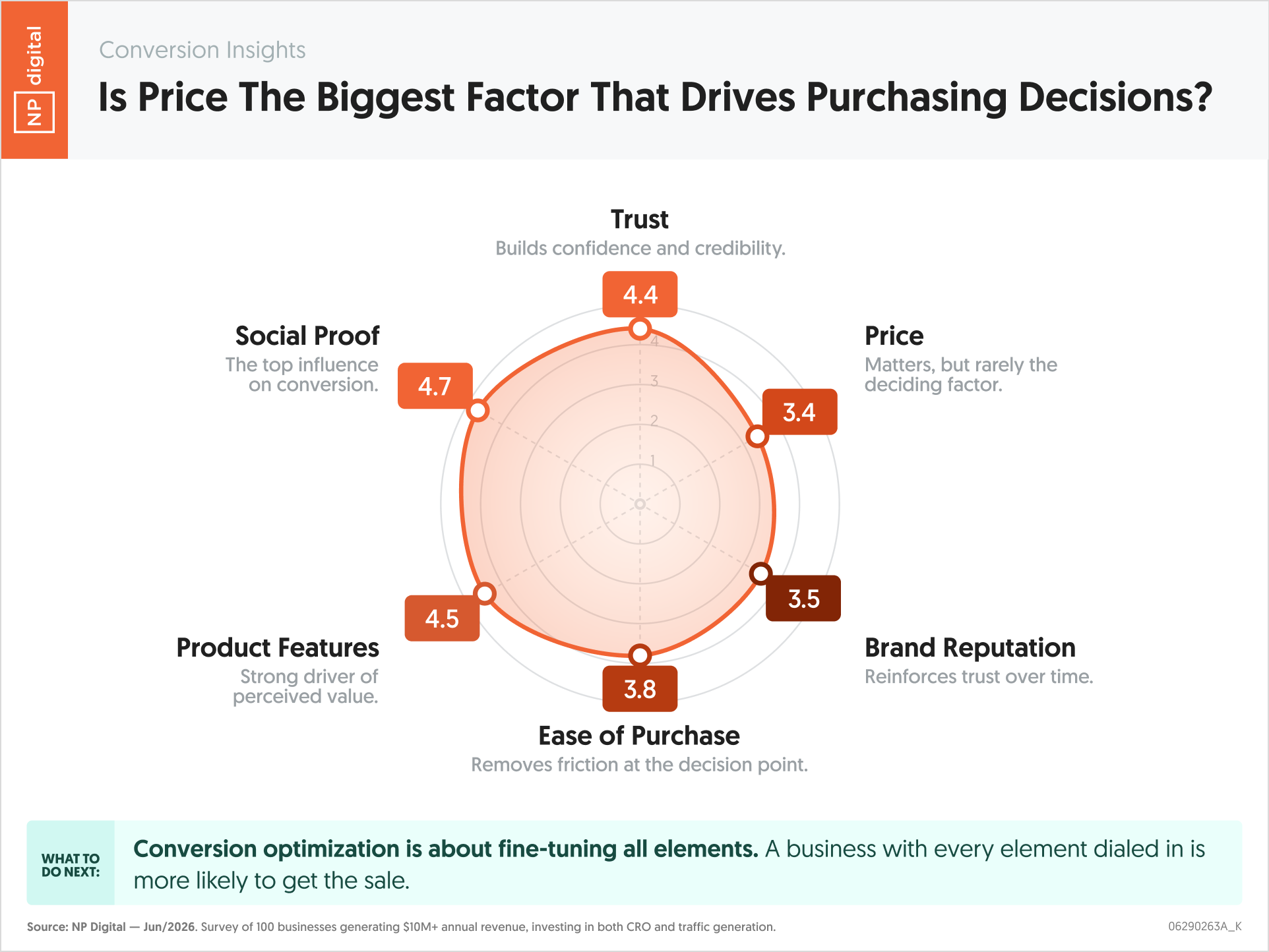
Price is often assumed to be the primary driver of purchase decisions. The data from 100 businesses generating more than $10 million annually tells a different story. Social proof rates highest among all purchase factors, followed by product features and trust. Price ranks fourth, described in the chart’s legend as something that matters but is rarely the deciding factor. For marketers who have been competing primarily on price, this data provides the rationale for investing in the conversion factors that buyers report weighting more heavily.
Essential Statistics
- Social proof scores 4.7 out of 5 on purchase influence, the highest rating in the dataset, described as the top influence on conversion.
- Product features score 4.5 out of 5, described as a strong driver of perceived value.
- Trust scores 4.4 out of 5, described as building confidence and credibility.
- Ease of purchase scores 3.8 out of 5, described as removing friction at the decision point.
- Brand reputation scores 3.5 out of 5, described as reinforcing trust over time.
- Price scores 3.4 out of 5, the lowest-rated factor in the dataset, described as mattering but rarely the deciding factor.
Key Takeaways
- Social proof leading at 4.7 reflects the fundamental human behavior of looking to others to validate purchase decisions. Reviews, ratings, testimonials, and social validation reduce the perceived risk of buying by demonstrating that others have purchased and found value. For high-consideration purchases, social proof often resolves the remaining doubt that product features and pricing cannot address alone.
- Product features at 4.5 ranking above trust and ease of purchase confirms that buyers prioritize understanding what they are getting before they evaluate whether they trust the seller or how easy the purchase is. Feature clarity and differentiation are prerequisites for conversion that trust and UX optimization build on top of.
- Trust at 4.4, just below product features, reflects the role of credibility signals in reducing purchase risk. Trust is built through consistent brand presentation, transparent policies, security signals, and third-party validation sources like certifications and press coverage. Its near-equal ranking with features confirms that buyers are evaluating both what they get and whether they can trust the seller simultaneously.
- Price at 3.4, lower than social proof, features, trust, ease of purchase, and brand reputation, challenges the default assumption that price is the primary purchase lever. Price matters, but these 100 businesses report that buyers are more heavily influenced by validation, product clarity, and trust before price enters the decision equation for most purchases.
- The ranking is consistent across the businesses surveyed, all of which invest actively in both CRO and traffic generation. These are not businesses that have neglected price optimization. They are businesses with data on what actually moves buyers, and the consistent answer places price last among the six factors measured.
Actionable Insights
- Audit your current landing pages for social proof density before changing pricing. The 4.7 social proof rating means that adding or improving social proof on your highest-traffic conversion pages is likely to produce a larger conversion rate improvement than a price reduction. Identify your three highest-traffic landing pages and assess whether they display recent reviews, rating counts, specific testimonials, and social proof from recognizable customers or segments relevant to the buyer viewing the page.
- Invest in product feature clarity as a CRO priority rather than treating feature pages as static information architecture. The 4.5 product features score means buyers are heavily influenced by how well they understand what they are getting before they buy. Clearer feature descriptions, benefit-focused copy, comparison tables, and demo experiences that make features tangible all address the second-most important purchase driver without requiring price changes.
- Build trust signals into every conversion path rather than treating them as design elements. The 4.4 trust score means credibility signals belong in the conversion flow, not just on an about page or in the footer. Security badges at checkout, return policy summaries near CTAs, and third-party certifications in product descriptions address the trust factor at the moment it most affects conversion.
- Improve ease of purchase before testing price optimization. At 3.8, ease of purchase ranks above brand reputation and price in purchase influence. Friction reduction at the checkout or form submission stage, including fewer fields, guest checkout options, and preferred payment methods, addresses a higher-impact conversion lever than discounting.
- Use the price ranking to make the internal case for investing in CRO rather than margin-reducing price cuts. When leadership proposes a price reduction to drive conversion, the data from these 100 $10 million-plus businesses shows that social proof, features, trust, and ease of purchase all outrank price as purchase drivers. A CRO investment that improves social proof and reduces checkout friction produces conversion improvement without sacrificing margin.
”Social proof scores 4.7. Price scores 3.4. If your default response to a conversion problem is a price reduction, you are optimizing for the sixth-most-important purchase factor. Fix the social proof first, clarify the features, build the trust signals, remove the checkout friction, and then look at price if the other four still are not moving the needle.” – Neil Patel