 Sign In










Which SEO Investments Deliver the Most Long-Term Value?
Info
-
Source: NP Digital
-
Date: August 2026
-
Category: SEO & Keyword Strategy
-
Study Methodology: Data from 1,000 marketers surveyed.
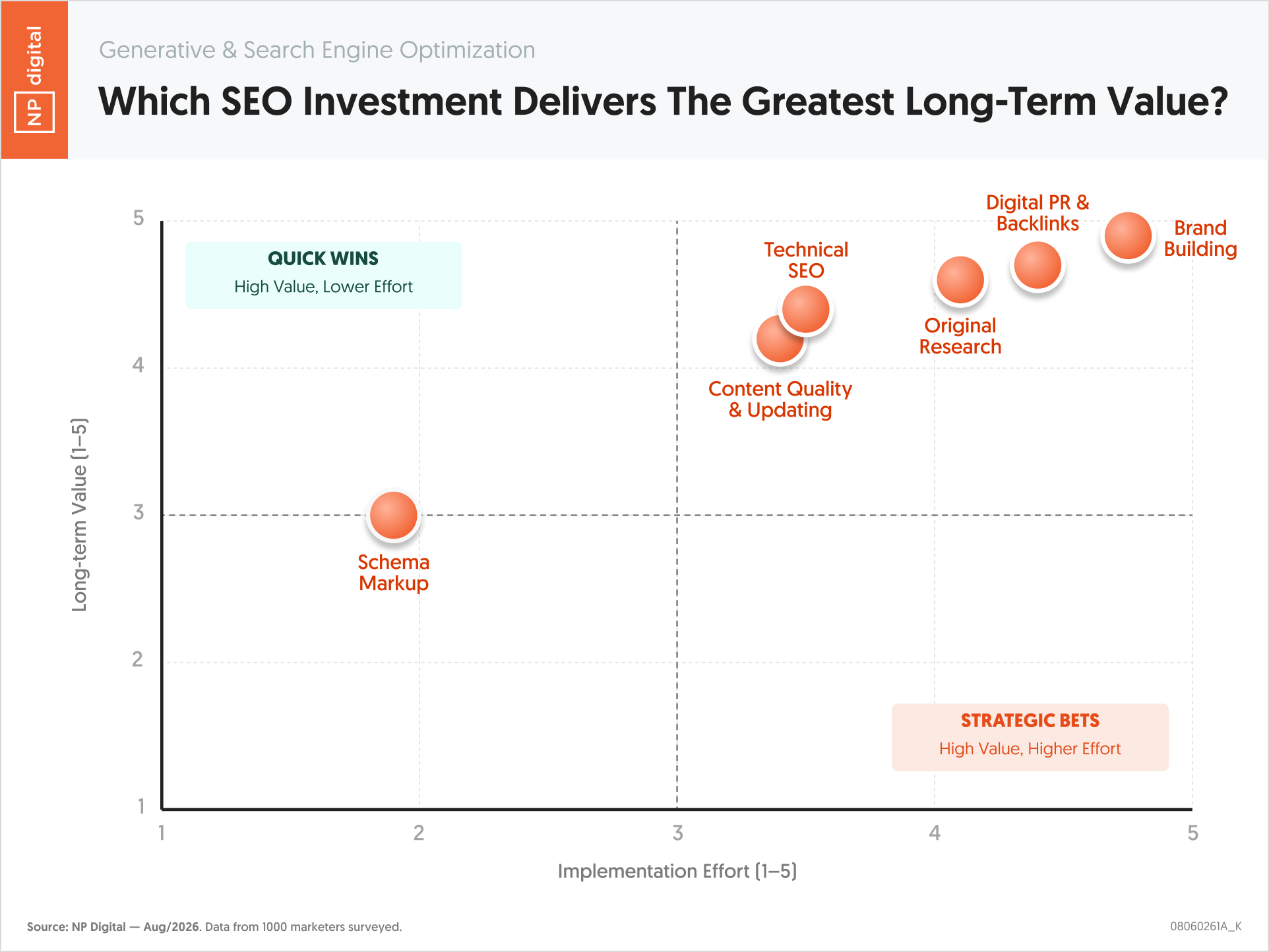
Not all SEO investments age equally. This effort-versus-value matrix from 1,000 marketers plots six SEO tactics on long-term value and implementation effort, producing a framework for prioritizing where to invest. The results suggest that the highest long-term value investments, brand building and digital PR with backlinks, also require the most effort, while schema markup offers lower effort but also lower long-term value. The matrix is a useful orientation tool, though individual results will vary by category, domain authority, and competitive context.
Essential Statistics
- Brand building scores the highest on long-term value at approximately 5 out of 5 and the highest on implementation effort at approximately 5 out of 5, placing it in the strategic bets zone.
- Digital PR and backlinks score near 5 on value and approximately 4.5 on effort, adjacent to brand building in the high-value, high-effort space.
- Technical SEO and content quality and updating cluster near 4.3 on value at moderate-to-high effort levels of approximately 3 to 3.5.
- Original research scores approximately 4.4 on value and 4.2 on effort, landing in the strategic bets quadrant alongside brand building.
- Schema markup scores approximately 3 on value at approximately 2 on effort, the only tactic in the low-effort zone but also the lowest long-term value score in the dataset.
- The quick wins zone, defined as high value at lower effort, contains no named tactics in this dataset, suggesting that high-value SEO generally requires meaningful effort investment.
Key Takeaways
- The absence of any tactic in the quick wins zone is itself a finding. According to the 1,000 marketers surveyed, there is no low-effort, high-value SEO investment available. Every tactic that scores well on long-term value requires significant implementation effort, which challenges the premise of shortcut-based SEO strategies.
- Brand building and digital PR clustering at the top of the value scale reflects a shift in what SEO practitioners believe drives durable results. These are reputation-building activities that compound over time, which is consistent with how AI systems weight authority and third-party validation in citation decisions.
- Schema markup scoring lowest on long-term value despite being a commonly recommended tactic suggests a recalibration in practitioner beliefs. This aligns with the AI citation data showing structured data has limited impact on AI citation rates across most platforms.
- The proximity of technical SEO and content quality confirms that these remain foundational investments, though not the highest-ceiling tactics. They are prerequisites for the higher-value activities above them in the matrix rather than primary value drivers on their own.
- This data reflects practitioner opinion, not measured outcomes. Long-term SEO value is difficult to isolate empirically, and individual results will vary significantly based on domain authority, competitive intensity, and content quality.
Actionable Insights
- Use the matrix as a sequencing guide rather than a budget allocation formula. The most practical application is confirming that technical SEO and content quality serve as a foundation, while brand building and digital PR are the activities that produce the highest long-term returns once that foundation is in place.
- Evaluate your current SEO investment distribution against the value positions shown and identify whether your highest-effort activities are in the highest-value zones. If the majority of your team’s time goes toward schema markup and technical maintenance rather than content quality, original research, or digital PR, the matrix suggests a rebalancing toward higher-value activities is worth considering.
- Do not deprioritize schema markup entirely based on its lower value score. Its low effort requirement means the cost of maintaining it is minimal, and it still provides some value for Google rich results and local SEO applications even if it is not a primary long-term value driver.
- Build brand building and digital PR into your SEO planning as distinct activities with dedicated resources rather than treating them as byproducts of content creation. The high effort scores for these tactics reflect that they require relationship building, outreach strategy, and sustained investment that does not happen automatically alongside standard SEO workflows.
- Treat this matrix as a conversation starter for your team’s investment priorities rather than a definitive ranking. The 1,000-marketer sample reflects aggregate practitioner opinion, which may not match your specific category’s dynamics. Calibrate against your own performance data before making significant budget changes.
The quick wins zone is hard to fill, without high-value, low-effort SEO investments according to a thousand marketers. That is either discouraging or clarifying, depending on how you look at it. The discouraging reading is that good SEO is hard. The clarifying reading is that if you are willing to do the hard work on brand building and digital PR, you are working in territory that most competitors avoid.’ – Neil Patel