 Sign In




 Ubersuggest
  AnswerThePublic
 What Customer Data Do Marketers Use for Email Personalization?
Info
-
Source: NP Digital
-
Date: July 2026
-
Category: Email Marketing
-
Study Methodology: Source: NP Digital, July 2026. Data from 193 companies and survey results of 820 marketers.
Email personalization is only as good as the data feeding it. This survey of 193 companies and 820 marketers maps which customer data types are used for email personalization and how consistently each type is applied across campaigns. The results reveal a hierarchy dominated by behavioral engagement and transaction history, with more sophisticated data sources like predictive AI scores and declared preferences significantly underutilized relative to their potential to improve personalization relevance.
Essential Statistics
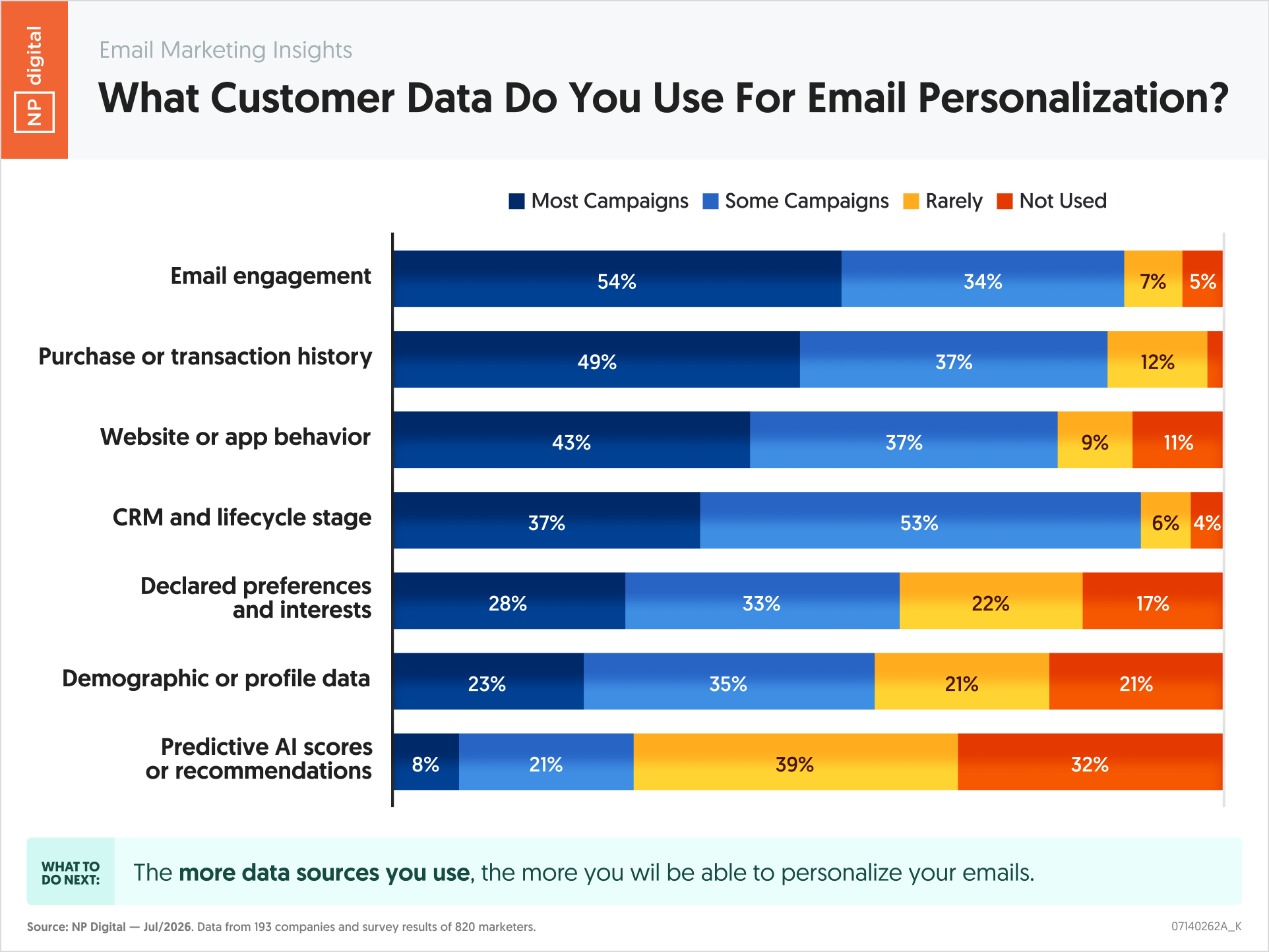
- Email engagement data is used in most campaigns by 54 percent of marketers and in some campaigns by 34 percent, making it the most consistently applied personalization data source.
- Purchase or transaction history is used in most campaigns by 49 percent and in some campaigns by 37 percent, the second most widely applied data type.
- Website or app behavior is used in most campaigns by 43 percent and in some campaigns by 37 percent, though 11 percent report not using it at all.
- CRM and lifecycle stage is used in most campaigns by 37 percent and in some campaigns by 53 percent, the most balanced application across frequency levels.
- Declared preferences and interests are used in most campaigns by only 28 percent and not used at all by 17 percent, the second least applied data type.
- Predictive AI scores or recommendations are used in most campaigns by only 8 percent, rarely by 39 percent, and not used at all by 32 percent, the least consistently applied personalization data source.
Key Takeaways
- Email engagement and purchase history dominating personalization data usage reflects the accessibility of those data types within email platforms. Open and click history is built into every email platform’s segmentation tools, and purchase data is typically the first external data source integrated with email. These are the path-of-least-resistance personalization inputs, not necessarily the highest-performing ones.
- Website and app behavior at 11 percent not used at all despite being one of the richest intent signals available indicates a data integration gap rather than a lack of awareness. Most marketing teams know that website behavior is valuable for personalization but have not completed the technical integration between their web analytics or CDP and their email platform needed to use it consistently.
- CRM and lifecycle stage used in most campaigns by only 37 percent reveals that the majority of email programs do not consistently reflect where subscribers are in the customer journey. Sending the same email to a new prospect and a loyal customer produces poor relevance for both, but this is what happens when lifecycle stage is applied inconsistently or not at all.
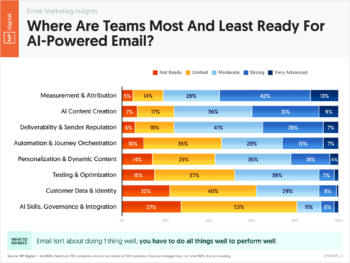
- Predictive AI scores at 8 percent most campaigns and 32 percent not used at all reflects the data maturity gap identified across the companion AI email readiness chart. AI recommendation and scoring systems require clean behavioral data, model training, and platform integration that most teams have not yet built. The low application rate is a readiness problem, not a demand problem.
- Declared preferences and interests at 17 percent not used reflects an underutilized zero-party data opportunity. Subscribers who have actively stated their preferences are the highest-intent segment for personalized content, yet fewer than one in three marketers apply this data consistently across campaigns.
Actionable Insights
- Integrate website and app behavior into your email personalization stack as the highest-return data connection most teams have not made. At 11 percent not using it at all, most teams recognize the value but have not built the integration. A CDP or a direct integration between your web analytics platform and your email tool using event tracking produces a behavioral data stream that dramatically improves segment relevance and trigger accuracy without requiring new data collection.
- Build a lifecycle stage segmentation into every major campaign send before adding any other personalization layer. The 37 percent most-campaigns rate for CRM and lifecycle data means the majority of sends are not adapted to subscriber lifecycle position. Adding a simple lifecycle segment, new subscriber, active buyer, lapsed buyer, to your campaign structure produces immediate relevance improvements that outperform more sophisticated personalization applied to an undifferentiated list.
- Implement a preference center to generate declared preference data before investing in predictive AI recommendation systems. Declared preferences are simpler to collect and apply than predictive scores, yet they are underused at 17 percent not using them. A preference center that asks subscribers to specify content interests, product categories, or communication frequency gives you high-quality zero-party data that improves personalization immediately without requiring AI infrastructure.
- Build your AI personalization roadmap around the behavioral data sources you already collect before acquiring new data. Predictive AI scores require training data. The email engagement and purchase data that 88 to 100 percent of teams collect is the primary training input for AI personalization models. Connecting those existing data sources to an AI personalization engine is faster and lower-risk than collecting new data types from scratch.
- Audit which data sources your email platform can access natively versus which require integration. Many teams underuse available data not because it does not exist but because the integration between the data source and the email platform was never completed. A 30-day technical audit of your current data connections will identify which high-value data types, particularly website behavior and CRM lifecycle stage, are available but not yet connected to your personalization workflow.
”The gap between email engagement data at 54 percent most-campaigns and predictive AI scores at 8 percent most-campaigns represents the full spectrum of email personalization maturity. Most teams start where the data is easiest. The highest-performing programs build toward where the data is most predictive. Start with website behavior and lifecycle integration before you think about AI scoring.” – Neil Patel