 Sign In





What Practitioners Say Is Actually Driving Their AI Visibility
Info
-
Source: NP Digital
-
Date: August 2026
-
Category: AI In Marketing
-
Study Methodology: Data from 1,000 marketers surveyed.
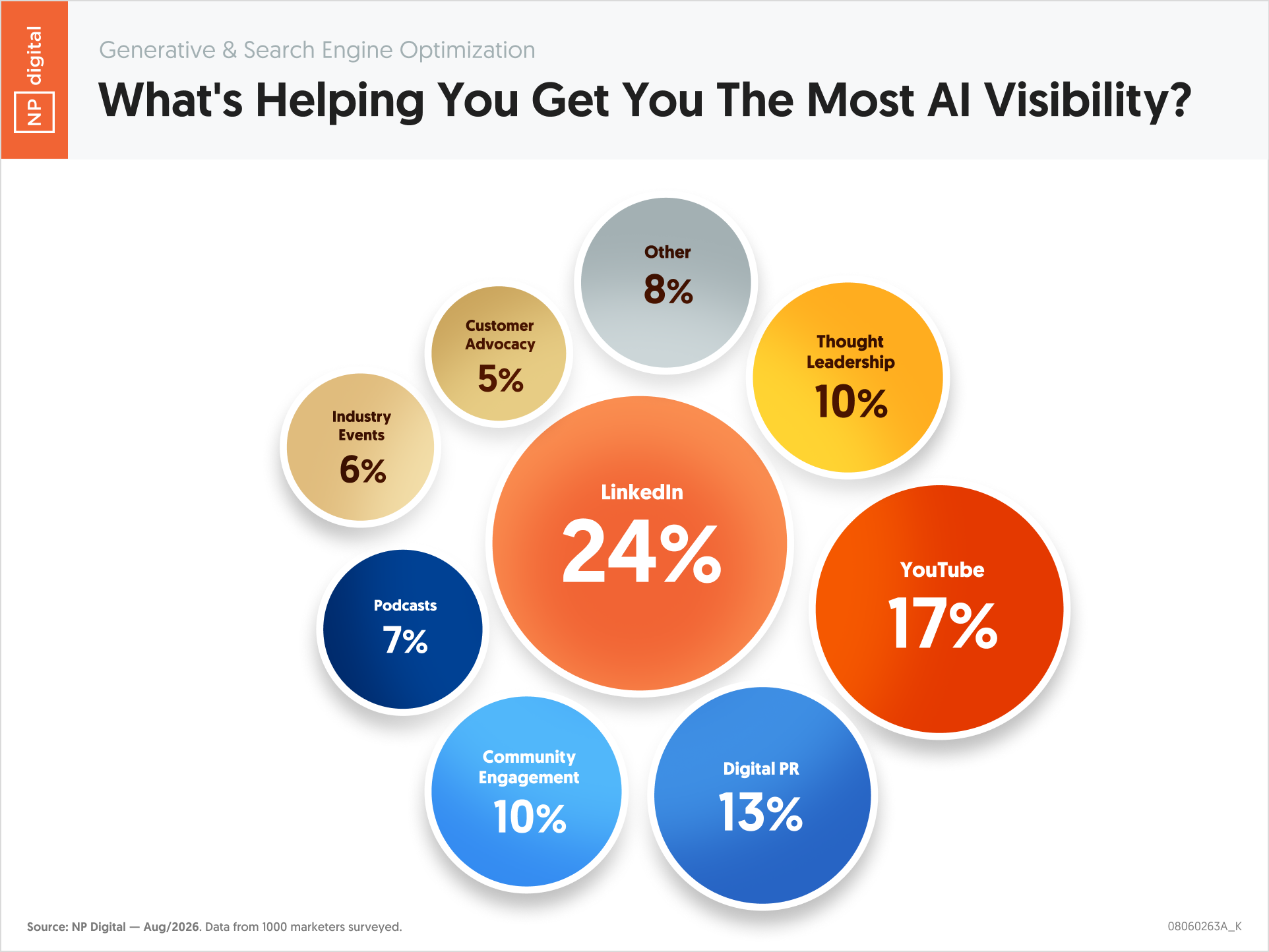
When asked what is actually helping them earn AI visibility, practitioners point first to LinkedIn and YouTube. This survey of 1,000 marketers ranks eight channels and activities by their reported contribution to AI visibility gains, and the distribution is a useful gut-check against conventional GEO wisdom. LinkedIn leads at 24 percent, followed by YouTube at 17 percent and digital PR at 13 percent. The results suggest that practitioner-perceived AI visibility is driven more by platform presence and professional content than by technical optimization alone.
Essential Statistics
- LinkedIn is credited by 24 percent of respondents as the most helpful channel for AI visibility, the top-ranked channel in the dataset.
- YouTube is credited by 17 percent of respondents as the most helpful channel.
- Digital PR accounts for 13 percent of credited AI visibility contribution.
- Community engagement and thought leadership are each credited by 10 percent of respondents.
- Podcasts are credited by 7 percent, industry events by 6 percent, and customer advocacy by 5 percent.
- Other channels account for the remaining 8 percent.
Key Takeaways
- LinkedIn leading AI visibility attribution may reflect that LinkedIn content is indexed and cited by AI platforms, particularly for professional and B2B queries. It may also reflect that LinkedIn activity generates the secondary brand mentions and citations that AI systems pick up from other sources. The mechanism is worth investigating rather than assuming.
- YouTube at 17 percent is consistent with broader data showing that AI platforms, particularly Google AI Overviews, have increased their citation of YouTube content as LLMs become better at processing video and transcript data. This finding is more likely to reflect a real AI citation dynamic than some of the other channels in this list.
- Digital PR at 13 percent aligns well with the signal importance data showing brand mentions and brand authority as top-rated AI visibility signals. Earned media placements generate both the mentions and the authority signals that practitioners believe AI systems weight most heavily.
- This is self-reported attribution data, meaning practitioners are crediting channels that they associate with visibility gains rather than channels that are demonstrably causing those gains. Correlation between a channel activity and visibility improvement does not establish causation.
- Community engagement and thought leadership each at 10 percent suggest that participation in professional conversations, whether through community platforms or published perspectives, is perceived as contributing to AI visibility. This is plausible given how AI training data weights frequently mentioned and discussed entities.
Actionable Insights
- Increase LinkedIn publishing frequency if you are not already treating it as a GEO channel. The 24 percent credit from practitioners warrants treating LinkedIn as part of your AI visibility strategy rather than purely a social media or lead generation channel. Publishing structured, expert-attributed content on LinkedIn creates an indexable content surface that may contribute to brand mention signals.
- Optimize existing YouTube content for AI extractability with chapters, transcripts, and structured descriptions before creating new videos. The 17 percent YouTube credit aligns with external data on AI citation growth for YouTube. If you have existing video content, adding chapters and transcripts retroactively is a lower-cost improvement than producing new content.
- Build digital PR into your GEO investment as a dedicated activity with its own budget and output targets rather than treating it as a byproduct of content creation. At 13 percent credited AI visibility contribution and high alignment with the top-rated signal data, earned media placements are worth investing in systematically rather than opportunistically.
- Test community engagement as an AI visibility activity by establishing a consistent presence in two or three relevant forums, communities, or discussion platforms where your category is discussed. The 10 percent credit for community engagement is modest but consistent with broader data showing UGC and forums rate very high for AI citation frequency.
- Track the correlation between your activity on each credited channel and your AI citation rate over a rolling 90-day period before committing to major channel investment changes based on this data alone. Self-reported attribution from 1,000 practitioners is useful for hypothesis generation but needs validation against your own brand’s citation patterns.
LinkedIn at 24 percent and YouTube at 17 percent are the two channels practitioners credit most for AI visibility. Whether those channels are the actual cause or just correlated with other brand-building activities is worth investigating before doubling your LinkedIn content budget. The more reliable finding is probably that consistent, expert-attributed content across multiple surfaces compounds into AI visibility over time.’ – Neil Patel