 Sign In





 Ubersuggest
  AnswerThePublic
 How AI Is Affecting Organic Traffic and Sales: Most Feel the Traffic Hit
Info
-
Source: NP Digital
-
Date: August 2026
-
Category: AI In Marketing
-
Study Methodology: August 2026. Data from 1,000 people surveyed. Numbers rounded to the closest whole number.
AI is affecting organic traffic and attributed sales in very different ways. This survey of 1,000 respondents maps the distribution of AI impact on both metrics, and the divergence between the two is the central finding. The gap suggests that while AI search is clearly intercepting organic clicks, the revenue impact is more complex and varies significantly based on how sales are attributed and how well-adapted each business is to the AI search environment.
Essential Statistics
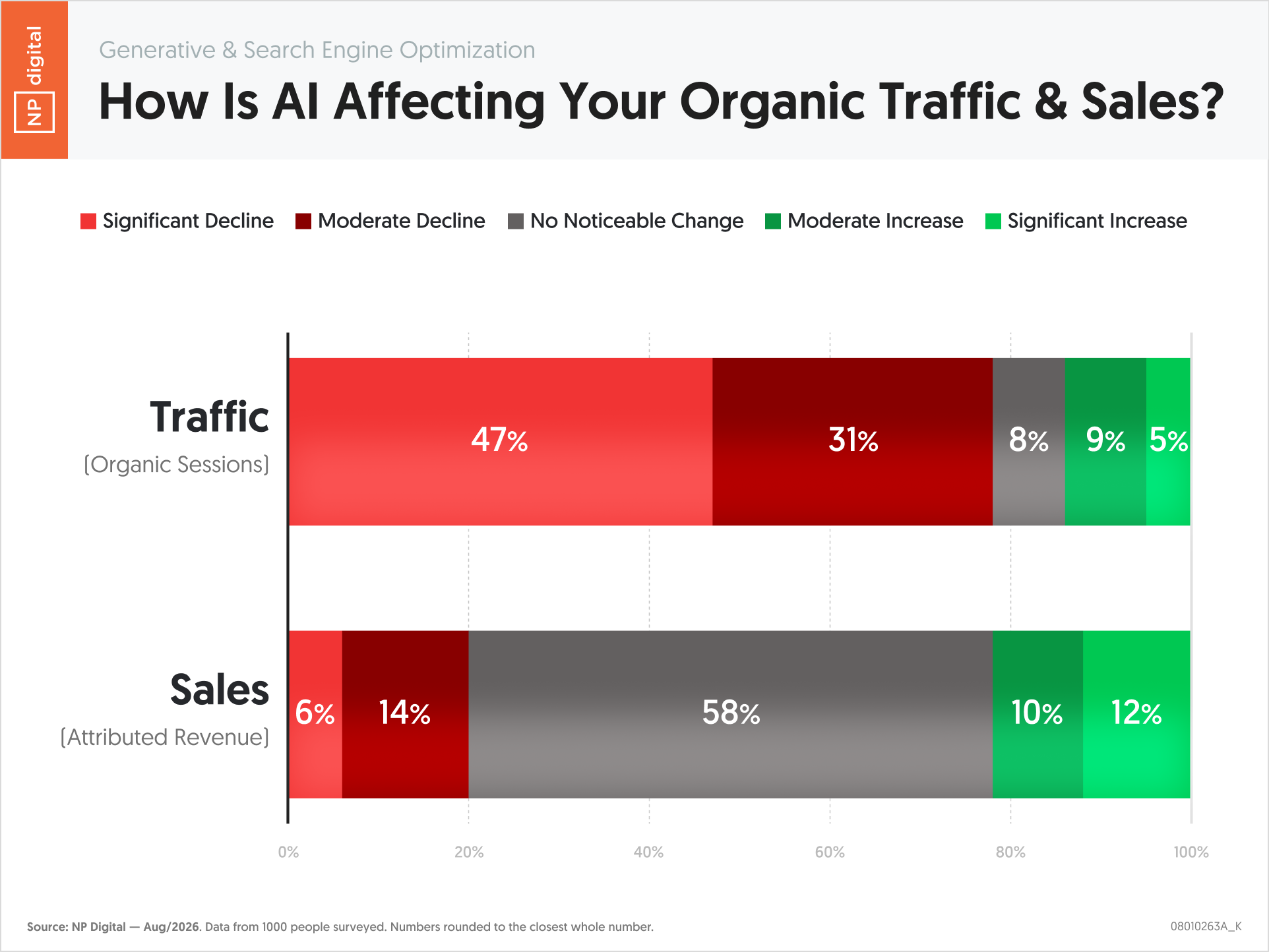
- 47 percent of respondents report a significant decline in organic traffic from AI, the largest single response category for traffic impact.
- 31 percent report a moderate decline in organic traffic, bringing the combined decline rate to 78 percent.
- 8 percent report no noticeable change in organic traffic, 9 percent report a moderate increase, and 5 percent report a significant increase.
- For attributed sales revenue, 58 percent report no noticeable change, the most common response by a wide margin.
- 20 percent report sales decline from AI effects, while 22 percent report some form of sales increase from AI.
- The divergence between 78 percent traffic decline and 20 percent sales decline suggests that traffic loss is not translating to equivalent revenue loss for the majority of respondents.
Key Takeaways
- The 78 percent organic traffic decline rate is a significant finding but should be interpreted carefully. Traffic decline is measured through analytics, which captures session counts but not all forms of brand exposure. AI Overviews and zero-click searches that generate brand impressions without clicks would show as traffic decline without representing an equivalent loss of brand influence or purchase intent.
- The 58 percent no noticeable sales change despite widespread traffic decline is the most important finding for strategic planning. It suggests that either the traffic being lost was already low-commercial-intent traffic, that AI-driven brand discovery is compensating for click loss through other paths, or that attribution models are not capturing the full revenue impact of AI-intercepted traffic.
- The 22 percent reporting some form of sales increase from AI suggests that a meaningful minority of businesses are benefiting commercially from AI search, likely those that have earned strong AI citation presence and are benefiting from the higher conversion rates associated with AI-referred traffic.
- Self-reported impact data on a question this complex is subject to significant variation based on how respondents define and measure traffic and sales changes. The 1,000-person sample captures general directional sentiment rather than precise measurement across comparable businesses.
- Category, content type, and the degree to which a business has invested in GEO will all influence where any individual company falls in these distributions. The aggregate data is useful for framing the question but should not be applied directly to any single business’s planning.
Actionable Insights
- Separate organic traffic measurement from organic revenue measurement in your reporting before drawing conclusions about AI’s impact on your business. The divergence in this dataset between traffic and revenue impact suggests these are distinct dynamics. If your organic traffic is declining but revenue is stable or growing, investigate whether the decline is concentrated in low-commercial-intent informational queries where AI Overviews are intercepting clicks without meaningful revenue impact.
- Audit which specific query types and page categories are driving your organic traffic decline before making content strategy changes. A 47 percent significant decline aggregate masks the fact that traffic decline is highly concentrated in informational and how-to content. If your revenue-driving transactional and evaluation-stage pages are maintaining traffic while informational pages decline, the impact on your business is much less severe than the aggregate traffic number suggests.
- Build AI citation tracking to assess whether you are in the 22 percent benefiting commercially from AI search. If you have invested in GEO and are receiving AI-referred traffic, those visitors convert at significantly higher rates than traditional organic traffic. Knowing your AI-referred revenue contribution tells you whether you are in the declining or growing segment of this distribution rather than assuming you fall in the majority no-change group.
- Use the 58 percent no-noticeable-sales-change finding as context when presenting organic traffic declines to leadership. Traffic decline without equivalent revenue decline is not necessarily a crisis. Reframing the conversation around revenue impact rather than traffic volume helps leadership understand that AI search is changing the nature of organic traffic rather than uniformly destroying its value.
- Develop a specific response plan for the query types where your traffic decline is most concentrated. If your traffic decline is primarily in informational content, the strategic options include optimizing that content for AI citations rather than direct clicks, redirecting production investment toward commercial-intent content that retains traffic, or building paid presence on the queries where organic click loss is most significant. The right response depends on the revenue importance of the affected traffic, not on the traffic volume alone.
Seventy-eight percent of respondents report organic traffic decline from AI, but 58 percent report no change in attributed sales. That gap is worth sitting with before making dramatic strategy changes. Traffic and revenue are not the same thing, and AI search appears to be reorganizing how traffic flows without uniformly destroying the commercial value of organic search presence for most businesses.’ – Neil Patel