 Sign In







Which Signals Drive AI Visibility? Marketers Rank What Works.
Info
-
Source: NP Digital
-
Date: August 2026
-
Category: AI & GEO Optimization
-
Study Methodology: Data from 1,000 marketers surveyed. Average rating 1-5.
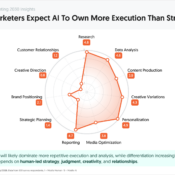
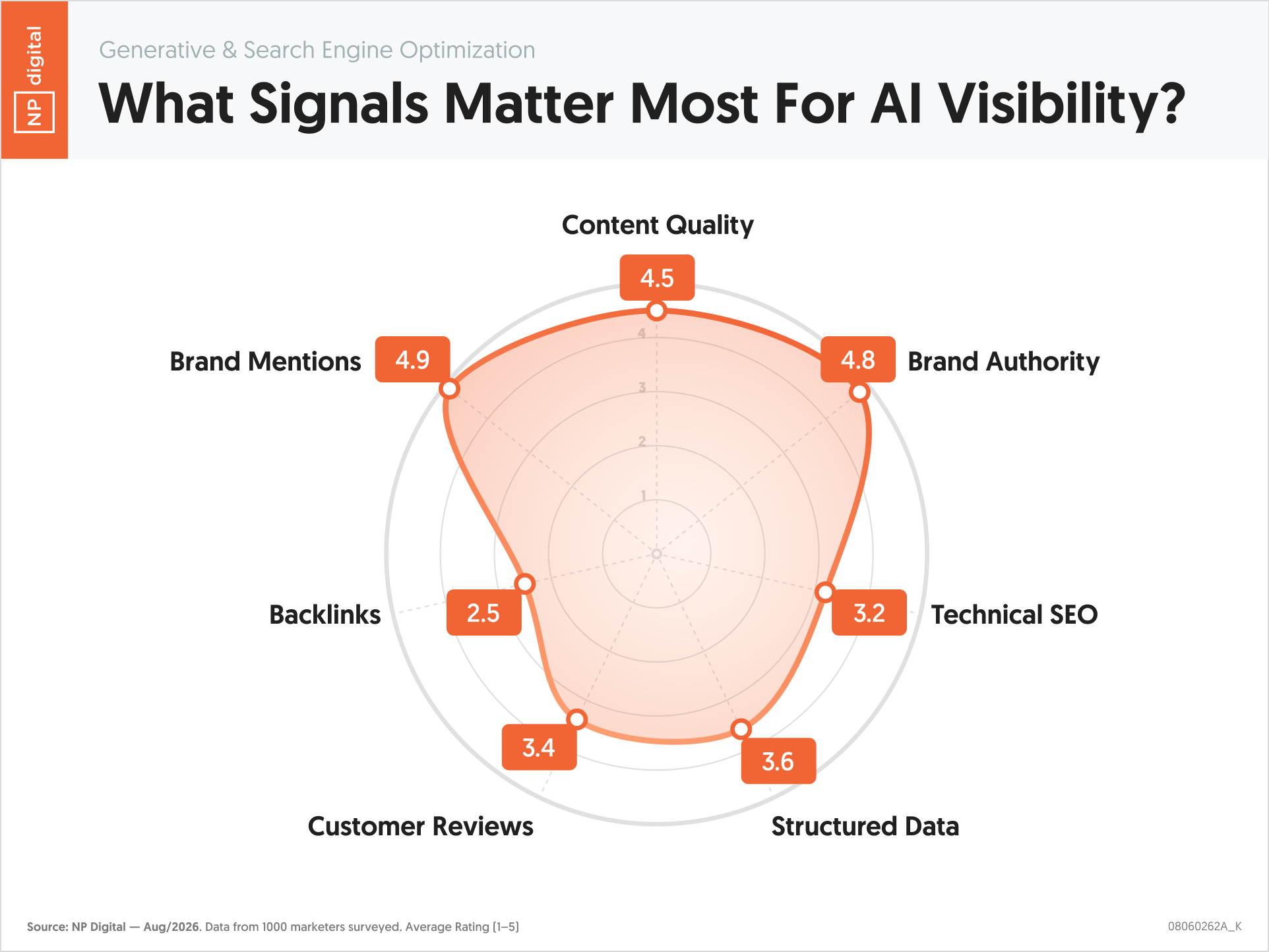
Not all traditional SEO signals carry equal weight in AI visibility. This radar chart from 1,000 marketers scores six signals on their perceived impact on AI citation and visibility, and the distribution differs meaningfully from classic search ranking factor surveys. Brand mentions and brand authority rate highest, while backlinks, long the dominant SEO signal, score lowest in this dataset. The results suggest that practitioners believe AI platforms weight reputation and authority signals more heavily than link-based signals.
Essential Statistics
- Brand mentions score 4.9 out of 5, the highest-rated AI visibility signal in the dataset.
- Brand authority scores 4.8 out of 5, the second-highest signal.
- Content quality scores 4.5 out of 5, the third-ranked signal.
- Structured data scores 3.6 and customer reviews score 3.4 out of 5, occupying the middle range.
- Technical SEO scores 3.2 and backlinks score 2.5 out of 5, the lowest-rated signals in the dataset.
- The spread between the highest signal at 4.9 and the lowest at 2.5 represents a meaningful perception gap between what practitioners believe drives AI visibility versus traditional SEO.
Key Takeaways
- Brand mentions and brand authority leading the rankings reflects practitioner belief that AI systems are trained to weigh real-world reputation signals, including where a brand is mentioned and how it is described across the web, more heavily than link graph signals. This is consistent with how large language models process training data.
- Backlinks scoring lowest at 2.5 is a significant departure from traditional SEO signal rankings. While backlinks remain important for Google search rankings, practitioners appear to believe they carry less weight in AI citation decisions. This perception aligns with observed citation behavior across platforms like ChatGPT and Perplexity, which cite based on content relevance and source credibility rather than link equity alone.
- These are practitioner perceptions, not empirically measured signal weights. AI systems do not publish their ranking factors, so this data reflects informed professional judgment rather than verified algorithmic behavior.
- Content quality at 4.5 confirms that creating genuinely useful, well-structured content is still considered foundational, even as brand-level signals take on greater importance. The two signals likely compound: high-quality content earns brand mentions, which reinforces brand authority.
- Structured data scoring 3.6, higher than technical SEO and backlinks, may reflect practitioners accounting for both traditional search and AI use cases. Schema markup helps Google’s rich results even if it has limited direct AI citation impact, which may produce a moderate composite score.
Actionable Insights
- Invest in activities that generate brand mentions as a direct GEO strategy rather than treating mentions as a byproduct of other marketing. The top-rated signal in this dataset is brand mentions, which points toward digital PR, community engagement, media coverage, and social presence as high-priority visibility inputs. Identify which channels and publication types generate mentions in your category and build a systematic outreach program around them.
- Build brand authority signals into your content strategy by connecting content output to identifiable experts and authoritative perspectives. High-quality content that can be attributed to named subject matter experts earns authority signals that generic brand publishing does not. Even a consistent author attribution policy across your blog and resource center adds to the brand authority signal stack.
- Do not abandon backlink building, but recalibrate its priority in your GEO investment relative to brand mention and authority activities. Backlinks still matter for Google SEO and provide some AI signal value. The finding here is about relative priority, not abandonment. If your current investment is heavily concentrated in link building, shifting some of that effort toward digital PR that earns both mentions and links addresses both the traditional and AI visibility dimensions simultaneously.
- Track brand mention volume as a leading indicator of AI visibility alongside traditional SEO metrics. If brand mentions are the top AI visibility signal, then monitoring mention frequency, sentiment, and source quality gives you a forward-looking indicator of AI citation potential that keyword ranking data alone cannot provide.
- Apply appropriate skepticism to this ranking when making large investment decisions. Practitioner perception of AI ranking signals is informed but not verified. Test the signal relationships in your own category by correlating brand mention activity with AI citation frequency over time before restructuring your entire optimization strategy around these perceptions.
Brand mentions at 4.9 and backlinks at 2.5. That is a striking divergence from how traditional SEO signal surveys tend to look. Whether AI platforms actually weight these signals this differently is still an open question, but the fact that a thousand practitioners believe they do is itself worth taking seriously when setting your GEO priorities.’ – Neil Patel