 Sign In










How Optimized Is Your Google Business Profile?
Info
-
Source: NP Digital
-
Date: May 2026
-
Category: Lead Gen & B2B
-
Study Methodology: Sample size: 400 Google My Business profiles analyzed; 150 local businesses surveyed. Data source: Analysis and survey. Collection method: Profile audit and online survey.
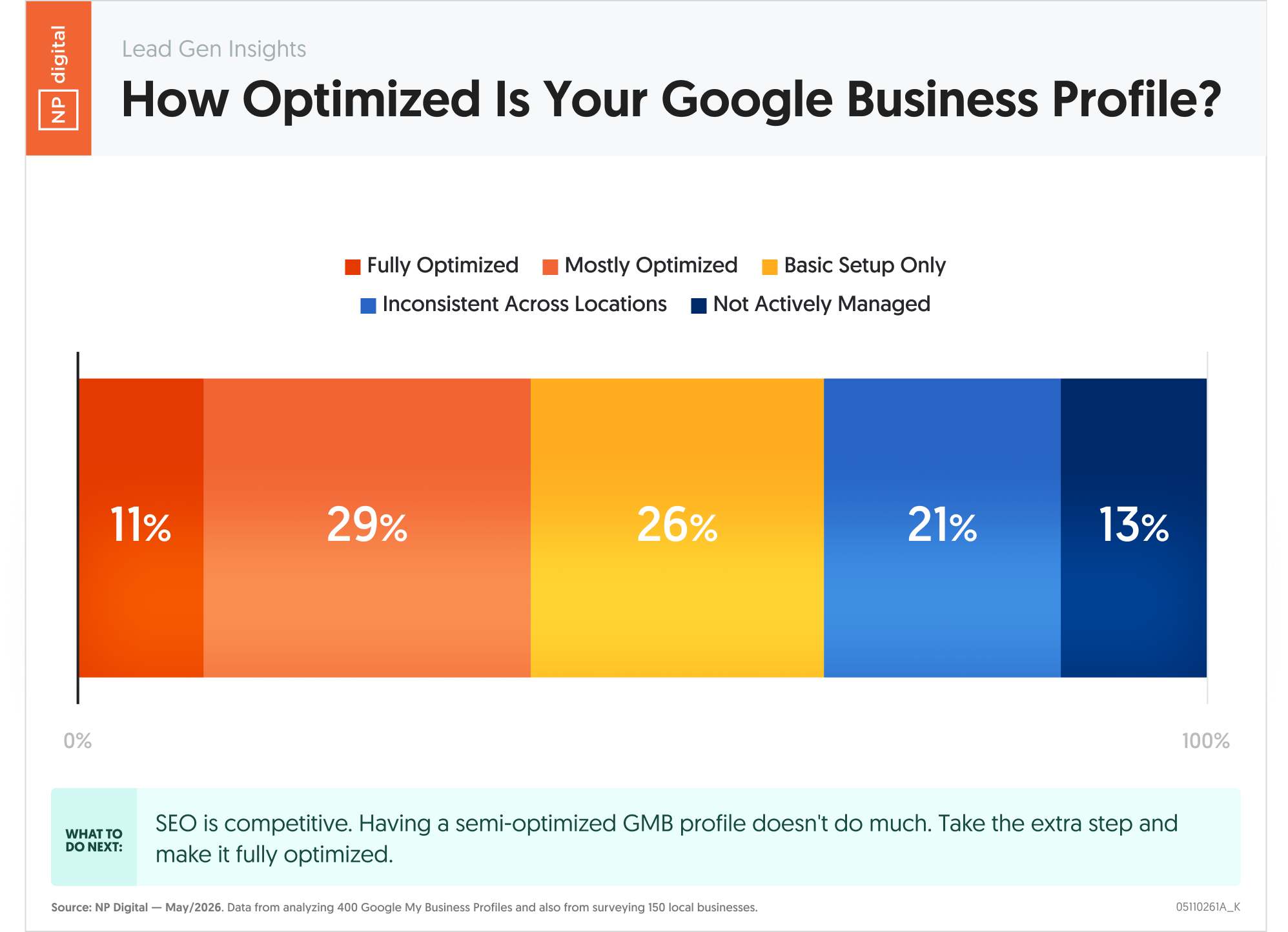
Only 11 percent of local businesses describe their Google Business Profile as fully optimized. That number comes from a combination of 400 profile audits and 150 business surveys, which means it reflects actual profile state, not just self-assessment. The remaining 89 percent fall somewhere between basic setup and active mismanagement and the distribution tells a specific story about where local search lead volume is being lost. A semi-optimized profile is not neutral. It actively underperforms a fully optimized one in local pack rankings, and the gap in lead volume is measurable.
Essential Statistics
- Only 11 percent of local businesses describe their Google Business Profile as fully optimized across all available fields and features.
- 29 percent report being mostly optimized, making it the single largest segment in the distribution.
- 26 percent have completed only basic setup with no further optimization beyond the initial profile creation.
- 21 percent report inconsistent profile states across multiple locations with no centralized management in place.
- 13 percent are not actively managing their profile at all, meaning hours, photos, reviews, and posts are either absent or outdated.
- A combined 60 percent of businesses sit in the basic-setup-only, inconsistent, or unmanaged categories.
Key Takeaways
- The 29 percent mostly-optimized segment is the most strategically important finding in this dataset. These businesses believe they are covered but are missing categories, absent photo libraries, unanswered reviews, and inactive Google Posts leave significant ranking signals untouched. Mostly optimized is a position of false confidence.
- The 26 percent with basic setup only have a Google Business Profile that exists but does not compete. Basic setup typically means name, address, and phone number are present, but services, attributes, Q&A, products, and business descriptions are incomplete or absent. Google uses completeness as a quality signal, and incomplete profiles rank lower in the local pack than complete ones targeting the same queries.
- The 21 percent reporting inconsistency across locations face a structural problem that cannot be solved by optimizing individual profiles. Inconsistent NAP data, mismatched categories, and varying photo quality across locations send conflicting signals to Google about business identity. This suppresses rankings across the entire location portfolio.
- The 13 percent with no active management are functionally invisible in competitive local markets. Unanswered reviews, outdated hours, and absent posts signal low engagement to Google’s local ranking algorithm, which incorporates activity signals alongside relevance and proximity.
- The 11 percent that are fully optimized represent the competitive benchmark. In markets where two or three businesses are competing for the same local pack position, full GBP optimization is often the deciding factor.
Actionable Insights
- Run a full field-by-field audit of your Google Business Profile against Google’s current completeness checklist, not just the fields you remember filling in at setup. The 26 percent with basic setup only and the 29 percent mostly optimized are both leaving ranking signals on the table. Specifically check: business description, service categories, individual service listings with descriptions, attributes relevant to your business type, products if applicable, and the Q&A section.
- Set up a weekly 15-minute GBP maintenance routine that covers review responses, at least two Google Posts, and a photo upload. Google’s local ranking algorithm incorporates engagement and activity signals. Profiles that respond to reviews consistently and post regularly demonstrate active management, which is a positive ranking signal. The 13 percent not managing their profiles at all are ceding this signal entirely to competitors who maintain even a minimal posting cadence.
- Centralize GBP management for multi-location businesses and implement a standardized completeness template before allowing location-level customization. The 21 percent with inconsistent profiles across locations need a top-down fix. Build a master profile template that specifies required fields, approved categories, photo minimums, and description standards, then audit each location against that template quarterly.
- Prioritize photo library completeness as a standalone optimization task. Google’s local algorithm uses photo engagement as a ranking signal. At minimum, upload exterior photos, interior photos, team photos, and product or service photos. For service businesses, before-and-after or work-in-progress images perform particularly well in engagement.
- Move your profile from mostly optimized to fully optimized before investing in any additional local marketing channels. The data shows only 11 percent of businesses reach full optimization. In competitive local markets, that 11 percent is the group winning the local pack. The ROI on completing an existing profile almost always exceeds the ROI on adding a new channel when the profile is still leaving ranking signals on the table.
“Most businesses treat their GBP like a directory listing — set it up once and forget it. The data shows that is exactly what their competitors are hoping for. Full optimization is not complicated. It is just attention to detail that most teams never get around to.” – Neil Patel