 Sign In







What Makes Content Citable by AI? Freshness Leads at 91%
Info
-
Source: NP Digital
-
Date: April 2026
-
Category: AI-Generated Content
-
Study Methodology: Surveyed 100 content marketers on what makes content citable. Self-reported ranking of citability factors across six content quality dimensions.
Getting cited by AI systems is not the same as ranking in Google. The signals that drive AI citability are distinct from traditional SEO factors, and understanding that distinction is the prerequisite for building a content strategy that earns citations in AI-generated responses. This survey of 100 content marketers identifies the factors they find most influential in AI citability, and the ranking reveals a clear hierarchy that should reshape how content teams prioritize their production and optimization work.
Essential Statistics
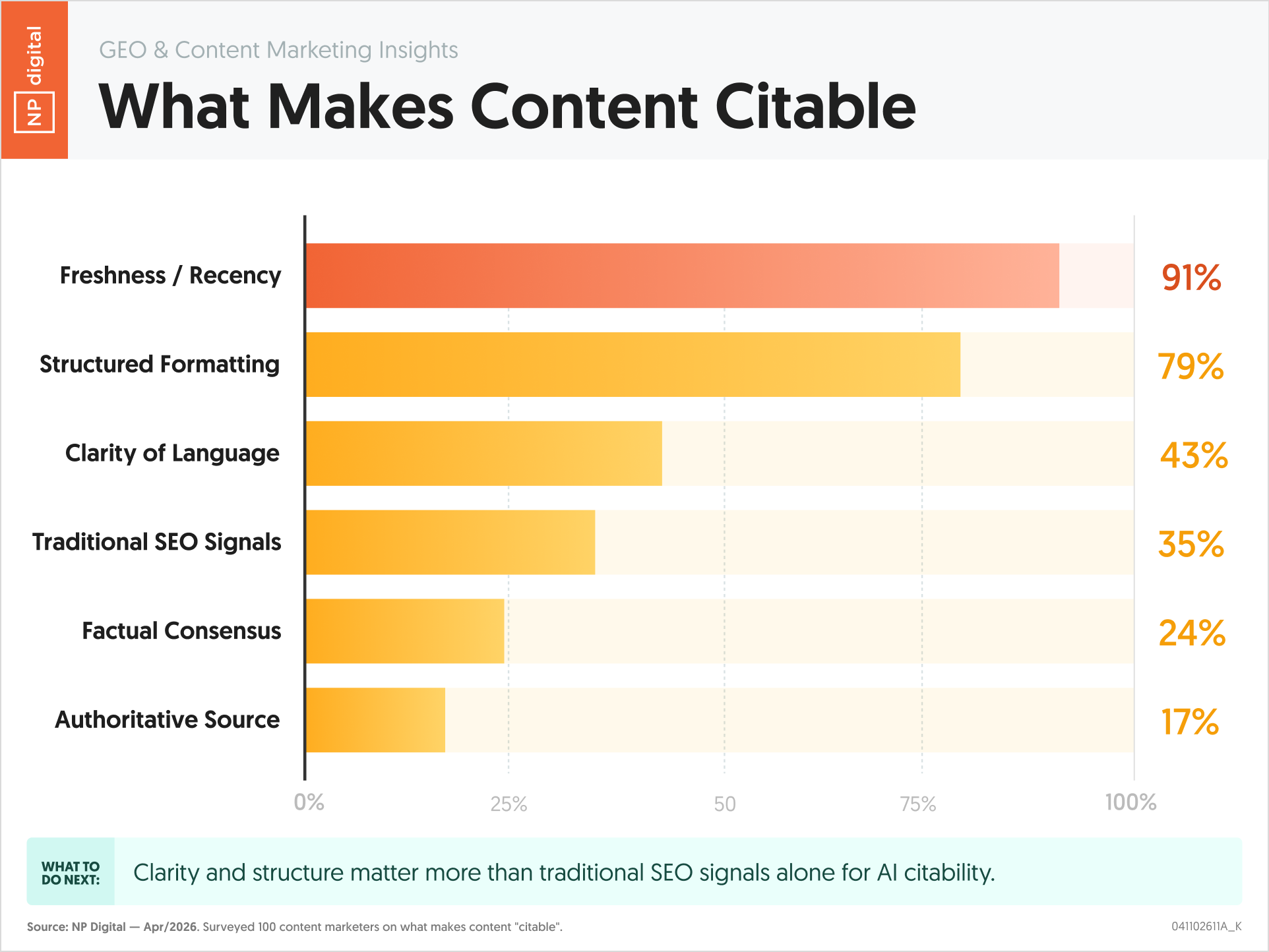
- Freshness and recency was identified by 91 percent of content marketers as a primary driver of AI content citability, the highest-ranked factor in the dataset.
- Structured formatting ranked second at 79 percent, with nearly four in five marketers identifying it as a key citability signal.
- Clarity of language ranked third at 43 percent, less than half the endorsement rate of freshness but still cited by a substantial share of respondents.
- Traditional SEO signals ranked fourth at 35 percent, confirming that conventional optimization factors contribute to AI citability but are not the primary drivers.
- Factual consensus ranked fifth at 24 percent, and authoritative source designation ranked sixth at 17 percent.
- The gap between the top two factors (91 percent and 79 percent) and the remaining four factors (17 to 43 percent) indicates that freshness and structured formatting are in a separate tier of citability influence from the other signals.
Key Takeaways
- Freshness at 91 percent is the dominant AI citability signal by a significant margin. AI systems are trained to weigh recency because outdated information carries higher risk of inaccuracy. Content that is not regularly updated is structurally disadvantaged in AI citation selection regardless of its quality on other dimensions.
- Structured formatting at 79 percent confirms a finding that appears repeatedly across GEO research: AI systems extract and attribute structured content more readily than prose-heavy formats. Headers, numbered lists, and clearly delineated sections give language models clean extraction targets that unstructured writing does not provide.
- Clarity of language at 43 percent reflects the AI extraction challenge directly. Content written in complex, jargon-heavy, or ambiguous language is harder for AI systems to accurately paraphrase and attribute, making plain and direct language a citability advantage independent of the information’s underlying quality.
- Traditional SEO signals ranking fourth at 35 percent is a critical calibration point. SEO signals contribute to AI citability but are not the primary driver. Brands that optimize only for traditional SEO without addressing freshness, structure, and clarity are leaving significant citability potential unrealized.
- Authoritative source designation ranking last at 17 percent is the most counterintuitive finding. Despite the intuitive assumption that AI systems heavily weight source authority, the practitioners surveyed rank it below freshness, structure, clarity, and even traditional SEO signals as a citability driver.
Actionable Insights
- Build a content refresh calendar that treats all existing high-priority pages as requiring regular updates. Freshness is the top AI citability signal, which means stale content is a structural citability liability regardless of how well it performed historically. Set a quarterly review cycle for your top 20 traffic and citation-eligible pages, updating statistics, examples, and publication dates to maintain freshness signals.
- Audit your top content assets for structural formatting and add headers, numbered lists, and clearly delineated sections to any pieces that rely primarily on prose. Reformatting existing high-quality content to improve AI extractability is one of the highest-ROI GEO optimizations available. This does not require rewriting the underlying content, only restructuring how it is presented.
- Rewrite introductions and key claim sections in plain, direct language for your most important GEO-target pages. Clarity of language is the third-ranked citability signal. Content that buries its key claims in complex sentence structures or industry jargon is harder for AI systems to extract accurately. A plain-language summary at the top of each major content piece improves both AI citability and human readability simultaneously.
- Do not abandon traditional SEO optimization, but reorder your content quality checklist to address freshness and structure before keyword optimization. Traditional SEO signals contribute to AI citability, but at less than half the endorsement rate of freshness. A content piece that scores well on freshness and structure but moderately on SEO signals will outperform a piece that scores well on SEO but poorly on freshness and structure for AI citation purposes.
- Use the authoritative source finding to recalibrate expectations about brand authority as a citability shortcut. Source authority is the weakest signal in this dataset. Brands that assume their domain authority or industry reputation will automatically generate AI citations without attending to freshness, structure, and clarity will consistently underperform brands that prioritize the higher-ranked signals regardless of relative authority level.
“Freshness at 91 percent and structured formatting at 79 percent are the top two AI citability signals by a wide margin. That means the content most likely to get cited by AI systems is recent and easy to extract, not necessarily the most authoritative or the most SEO-optimized. Reorder your content quality checklist accordingly.” – Neil Patel