 Sign In






 Ubersuggest
  AnswerThePublic
 Do Visitors Trust Your Website? Companies and Visitors Disagree.
Info
-
Source: NP Digital
-
Date: July 2026
-
Category: Website Performance
-
Study Methodology: Source: NP Digital, June 2026. Survey of 100 businesses generating $10M+ annual revenue, investing in both CRO and traffic generation.
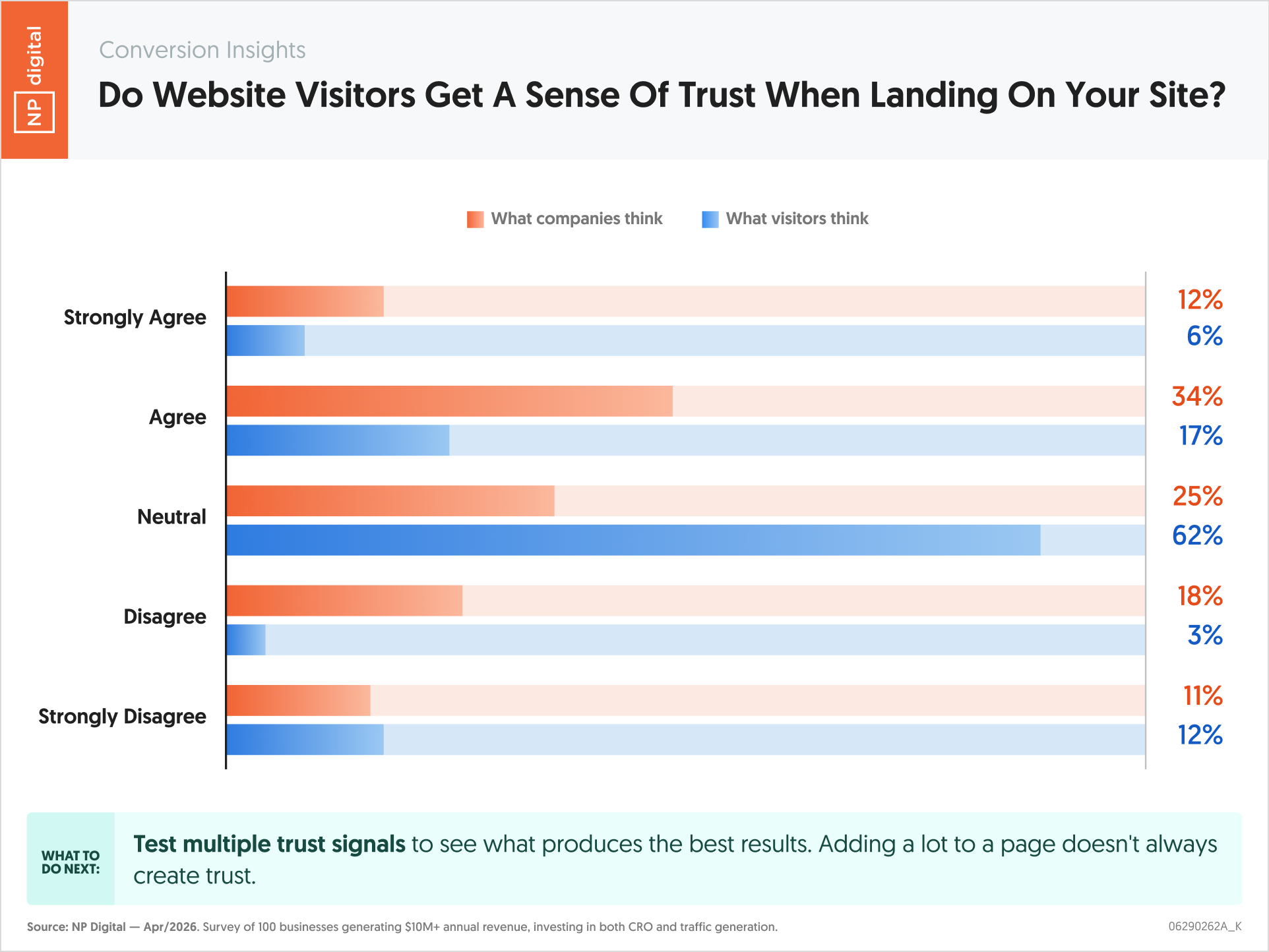
Companies overestimate how much trust their websites generate. This survey of 100 businesses and their visitors reveals a consistent gap between what companies believe visitors experience and what visitors actually report. Forty-six percent of companies believe visitors strongly agree or agree that they feel trust on landing. Only 23 percent of visitors report the same. Meanwhile, 62 percent of visitors describe their trust response as neutral, a state that rarely produces conversion without additional trust-building intervention.
Essential Statistics
- 12 percent of companies say visitors strongly agree that they get a sense of trust, compared to only 6 percent of visitors who strongly agree.
- 34 percent of companies say visitors agree they feel trust, compared to only 17 percent of visitors who agree.
- 25 percent of companies say visitors are neutral about trust, while 62 percent of visitors report neutrality, the largest single response category among visitors.
- 18 percent of companies say visitors disagree about feeling trust, while only 3 percent of visitors report actively disagreeing.
- 11 percent of companies say visitors strongly disagree about trust, compared to 12 percent of visitors who strongly disagree.
- Combined, 46 percent of companies believe visitors feel trust on landing (strongly agree plus agree), while only 23 percent of visitors report the same, a 23-point perception gap.
Key Takeaways
- The 23-point gap between company belief and visitor experience is the primary finding. Companies systematically overestimate the trust their websites generate because they see their sites through the lens of people who built them, understand the brand, and have context about the company. Visitors arrive without that context and must evaluate trustworthiness from visible signals alone.
- The 62 percent visitor neutrality rate is the most actionable finding for CRO. Neutrality does not mean the visitor does not trust the site. It means trust has not been established strongly enough to influence the conversion decision. Neutral visitors are undecided, and undecided visitors convert at lower rates than visitors with a clear positive trust signal. Every neutral visitor is a conversion improvement opportunity.
- The low visitor strongly disagree rate at 12 percent, close to the company estimate of 11 percent, confirms that both companies and visitors agree on the small minority with active negative trust responses. The perception gap is concentrated in the large neutral segment that companies misread as positive while visitors experience as genuinely undecided.
- The company perception that 34 percent of visitors agree they feel trust, versus the 17 percent visitor reality, shows that companies are reading neutral visitor behavior as positive. Visitors who do not leave immediately are interpreted as expressing trust, when they may simply be undecided or continuing to evaluate before making a judgment.
- The finding that adding more trust signals does not always create trust is explicitly noted in the chart guidance. Trust is contextual and cumulative, and more signals do not automatically produce better trust outcomes. Testing which specific signals move the needle for your specific audience is more effective than adding trust signals generically.
Actionable Insights
- Run a trust signal audit using actual visitors, not internal team evaluation. The perception gap in this chart exists precisely because internal evaluation of trust is unreliable. Use moderated usability testing with target-persona participants to observe how first-time visitors respond to your landing pages, or run an unmoderated test with a tool that captures think-aloud commentary. Real visitor reactions to trust elements will produce specific insights that internal review cannot generate.
- Target the neutral 62 percent specifically rather than addressing the small active-distrust segment. The 3 percent who actively disagree about trust are unlikely to convert regardless of intervention. The 62 percent who are neutral are in an undecided state where the right trust signal, at the right moment in the page experience, can shift them from neutral to positive. Map where on the page the neutral state is most likely to occur and add trust signals specifically at those points in the visitor journey.
- Test one trust signal variable at a time rather than adding multiple trust elements simultaneously. The guidance that adding more signals does not always create trust reflects a real optimization pitfall. When trust elements are added all at once, you cannot identify which ones produced the improvement or which ones created visual clutter that reduced clarity. Test individual trust signals, including review widgets, security badges, guarantee statements, and social proof numbers, in controlled A/B tests to identify which ones actually move conversion rate for your specific audience.
- Present the perception gap data to your leadership team before the next website redesign. The 23-point gap between what companies believe about their site trust and what visitors experience is a strong argument for building visitor trust validation into any redesign process. Requiring usability testing and trust signal testing as part of the redesign brief reduces the risk of investing in a redesign that maintains or widens the trust perception gap.
- Build a trust signal testing roadmap rather than a trust signal checklist. The most common mistake in trust optimization is creating a checklist of elements to add, executing it once, and treating the work as done. Trust signals need to be tested against your specific audience, in your specific category, at your specific price points. A quarterly trust signal testing program, rotating through different signal types and placements, produces continuous conversion improvement rather than a one-time design update.
”Forty-six percent of companies think visitors feel trust when they land on their site. Twenty-three percent of visitors agree. The other 62 percent of visitors are neutral. Neutral visitors do not convert at the same rate as visitors who feel trust. That gap between company belief and visitor experience is where conversion rate improvement lives. Test your way to understanding it, because internal review alone will not close it.” – Neil Patel