 Sign In





Which On-Site Content Types Earn the Most AI Citations?
Info
-
Source: NP Digital
-
Date: August 2026
-
Category: AI & GEO Optimization
-
Study Methodology: Data from 1,000 marketers surveyed. Data rounded, which may cause numbers not to add up to 100%.
Listicles and roundups earn the largest share of AI citations among on-site content types, but the distribution across all nine content formats in this survey is more even than many GEO practitioners might expect. No single content type dominates, and product pages, category pages, articles, and how-to guides all contribute meaningfully. The data suggests a diversified content format strategy is more likely to capture AI citations across varied query types than concentrating investment in any single format.
Essential Statistics
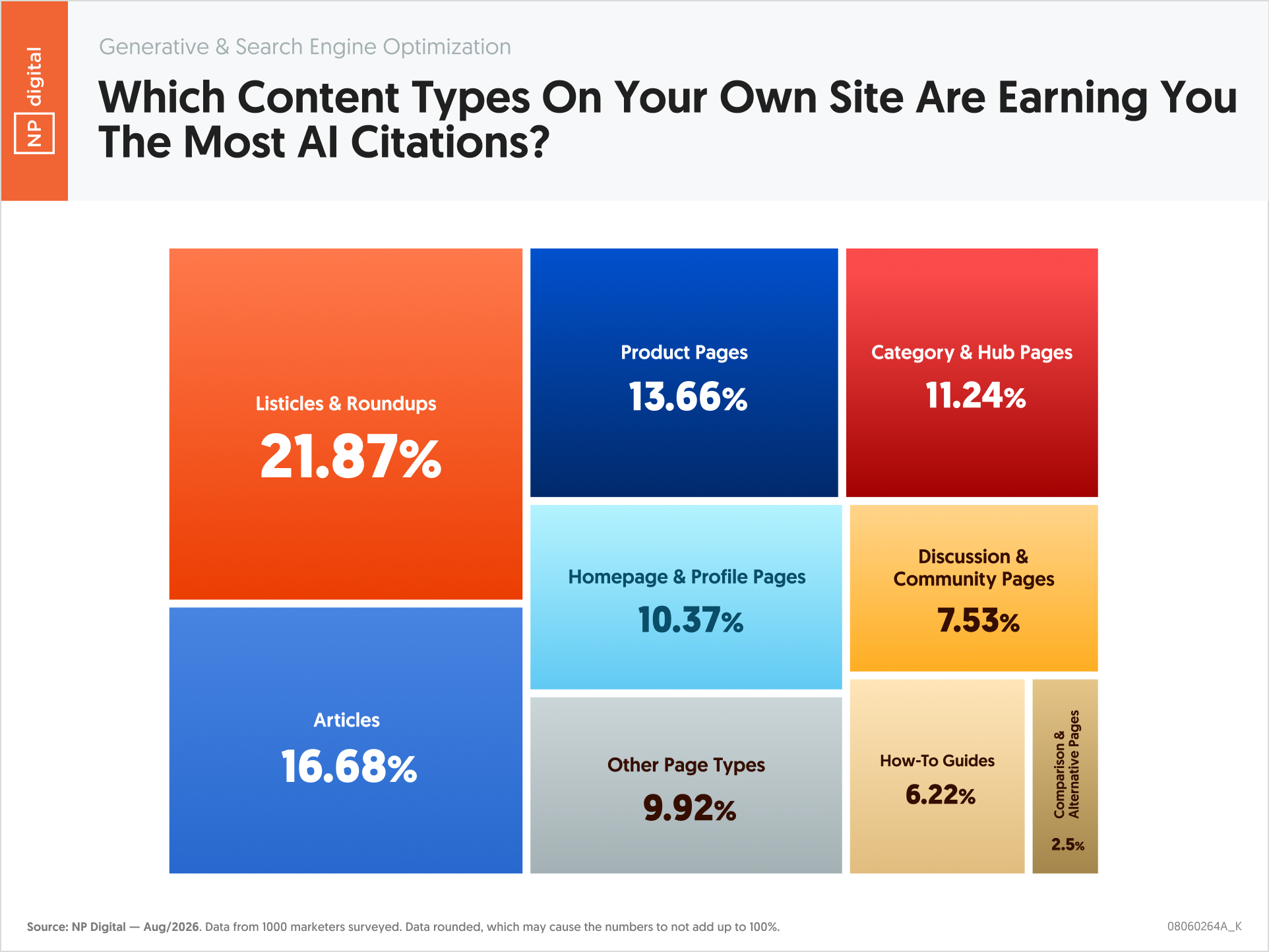
- Listicles and roundups earn 21.87 percent of AI citations, the highest share among the nine content types in the dataset.
- Articles earn 16.68 percent of AI citations, the second-ranked content type.
- Product pages earn 13.66 percent of AI citations, the third-ranked type.
- Category and hub pages earn 11.24 percent, homepage and profile pages earn 10.37 percent, and other page types earn 9.92 percent.
- Discussion and community pages earn 7.53 percent, how-to guides earn 6.22 percent, and comparison and alternative pages earn 2.5 percent of AI citations.
- The spread from highest at 21.87 percent to lowest at 2.5 percent suggests meaningful variation in citation frequency across content types, though the mid-tier categories are relatively clustered.
Key Takeaways
- Listicles leading AI citation share is consistent with other data showing structured, extractable content formats perform well in AI citation environments. The format gives AI systems clean, segmentable content to pull from, which may explain its continued citation advantage even as some practitioners flag long-term sustainability concerns.
- Product pages earning 13.66 percent of citations is notable and often underappreciated in GEO strategy. Product pages that include structured specifications, use cases, and comparison information may earn citations on commercial intent queries where AI systems reference specific products.
- Comparison and alternative pages earning only 2.5 percent is counterintuitive given that comparison queries are among the highest-volume commercial AI search query types, and that comparison pages convert AI traffic at high rates in other datasets. This may reflect that comparison pages are less commonly built than other content types rather than a signal that they underperform when they do exist.
- The relatively even distribution across most content types suggests that AI platforms draw from a broad range of content formats rather than privileging a narrow set, which means a diversified content architecture is likely more resilient than concentration in any single format.
- This data reflects practitioner-reported citation distribution rather than a controlled analysis of actual AI citation behavior, so it should be treated as directional guidance rather than a precise content investment formula.
Actionable Insights
- Maintain listicle and roundup content as part of your content mix rather than deprioritizing it solely based on authority concerns. The 21.87 percent citation share suggests that this format continues to earn citations, and managing the quality and freshness of existing listicle content is likely more efficient than abandoning the format.
- Audit your product pages for AI extractability by reviewing whether they include structured information about use cases, specifications, and comparisons. Product pages earning 13.66 percent of citations suggests they are already a meaningful citation source for commercial queries. Optimizing the structure and depth of existing product pages may improve their citation rate without requiring new content creation.
- Build comparison and alternative pages if you do not have them, given their low current citation share and high conversion rate performance in other data. The 2.5 percent citation share may reflect scarcity rather than underperformance. These pages address evaluation-stage queries that AI systems are increasingly being used for, and their conversion rates for AI traffic suggest they are worth building even if the citation volume is currently modest.
- Diversify your content format investment rather than concentrating production in the single highest-citation format. The relatively even distribution across content types suggests that different formats capture different query types and intent stages. A content architecture that includes listicles, articles, product pages, category pages, and how-to guides is likely to generate more total AI citation coverage than one built around a single dominant format.
- Track which content types generate AI citations in your specific category rather than relying on aggregate survey data. The 1,000-marketer survey captures broad patterns, but citation behavior varies by industry. Running queries relevant to your category in major AI platforms and noting which of your content types appears in responses gives you category-specific data that is more actionable than industry averages.
Listicles lead AI citations at 22 percent. Product pages are at 14 percent. Comparison pages are at 2.5 percent despite being among the highest-converting page types for AI traffic. That last number might be a supply problem more than a demand problem. If your competitors are not building comparison pages, being one of the few who does could earn you outsized citation share in a relatively uncrowded format.’ – Neil Patel