 Sign In









How Organizations Measure SEO Success Today
Info
-
Source: NP Digital
-
Date: August 2026
-
Category: SEO & Keyword Strategy
-
Study Methodology: Data from 1,000 people surveyed. Numbers rounded to the closest whole number. Importance scale 0-10.
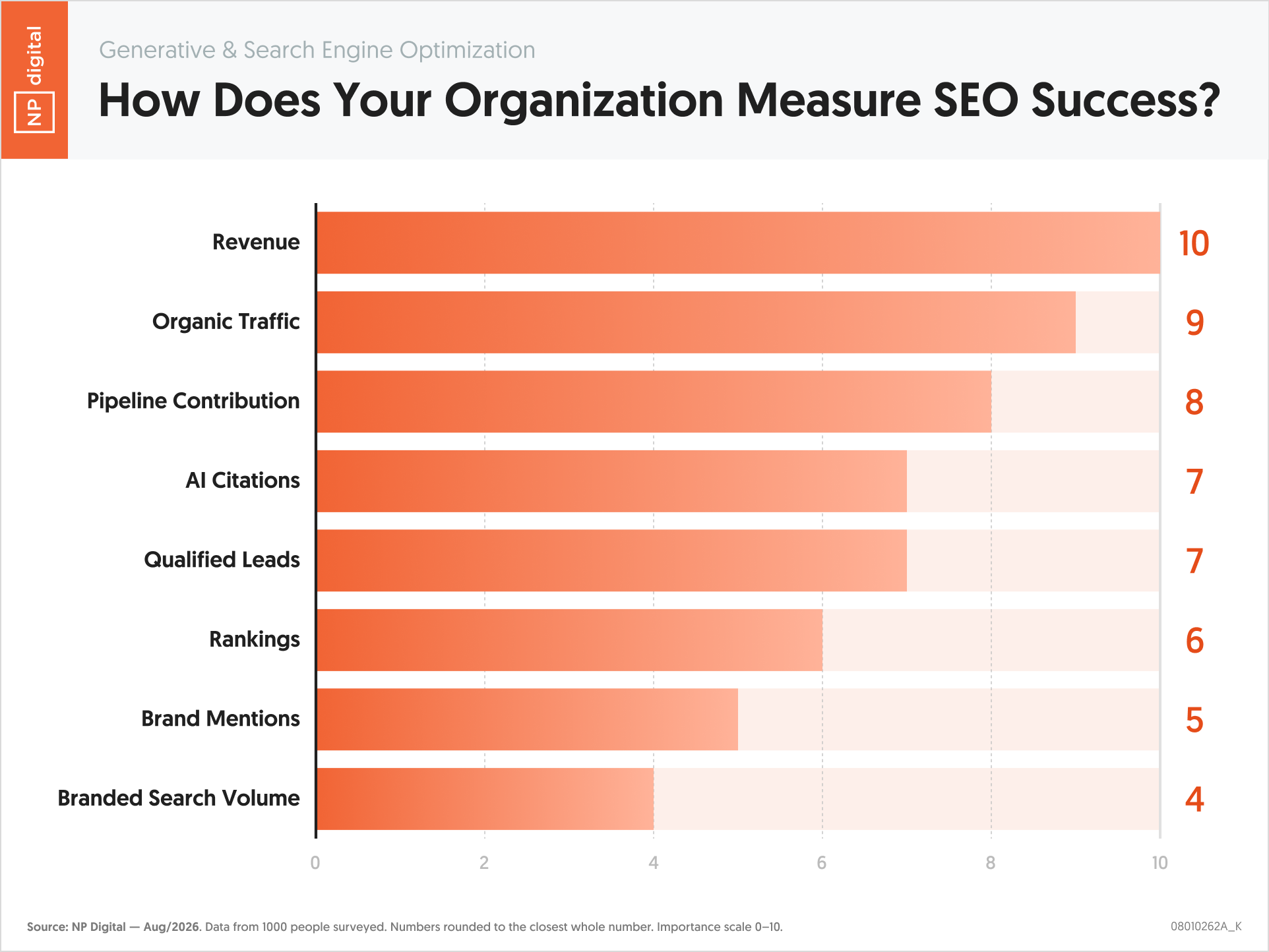
Revenue and organic traffic still lead SEO measurement, but the metrics organizations use to define search success are expanding. This survey of 1,000 respondents scores eight SEO success metrics on a 0 to 10 importance scale, and AI citations have entered the measurement mix at a score of 7, tied with qualified leads. The ranking suggests that while traditional SEO metrics retain their primacy, practitioners are beginning to integrate AI visibility as a measurable component of search program evaluation.
Essential Statistics
- Revenue scores 10 out of 10 as the most important SEO success metric, the only metric to receive a perfect score.
- Organic traffic scores 9, pipeline contribution scores 8, and AI citations and qualified leads both score 7.
- Rankings score 6 and brand mentions score 5 on the importance scale.
- Branded search volume scores 4, the lowest-rated metric in the dataset.
- AI citations scoring 7 and entering the top tier of metrics alongside qualified leads and pipeline contribution represents a meaningful shift in how SEO success is being defined across the 1,000-person sample.
Key Takeaways
- Revenue scoring 10 and being the top SEO metric reflects the broader shift in how marketing functions are being evaluated. SEO is increasingly expected to demonstrate direct revenue contribution rather than serving as a traffic delivery mechanism.
- AI citations scoring 7 and entering the measurement tier alongside qualified leads and pipeline contribution is a meaningful finding. It suggests that practitioners increasingly view AI visibility as a commercial SEO outcome worth tracking, not just a brand awareness signal.
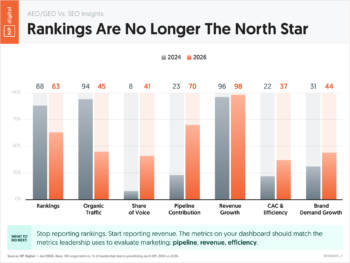
- Rankings scoring 6, below pipeline contribution and AI citations, reflects the continued evolution in how SEO value is communicated internally. Rankings are still tracked but are increasingly positioned as an intermediate metric rather than a primary success indicator.
- Branded search volume scoring lowest at 4 is somewhat counterintuitive given its close relationship to brand health and direct-intent traffic. It may reflect that branded search is seen as a brand marketing metric rather than an SEO metric, or that it is deprioritized relative to more directly commercial outcomes.
- Importance scores on surveys of this kind reflect current priorities but may shift rapidly as AI search behavior changes and new measurement tools emerge. The inclusion of AI citations at this stage suggests the metric is already embedded in practitioner thinking even if measurement infrastructure for it is still developing.
Actionable Insights
- Restructure your SEO reporting to lead with revenue and pipeline contribution before presenting organic traffic and rankings. The top-two metrics in this dataset are business outcomes, not channel metrics. If your SEO reports lead with impressions, clicks, and rankings before connecting to revenue, they are organized in the inverse of how practitioners say they weight SEO success. Restructuring the report hierarchy requires no new measurement infrastructure and immediately improves how SEO performance is communicated to leadership.
- Add AI citation tracking as a standing metric in your SEO reporting if you have not already. The 7 out of 10 importance score for AI citations suggests this metric is considered meaningful by many practitioners. Even basic manual tracking, testing 20 to 30 target queries monthly across major AI platforms and documenting citation frequency, provides a usable baseline before more sophisticated monitoring tools are implemented.
- Build pipeline contribution measurement for SEO before the next planning cycle. The 8 out of 10 importance score for pipeline contribution reflects leadership expectation that SEO demonstrate its contribution to revenue pipeline. If your current SEO measurement cannot show pipeline impact, connect your organic traffic data to your CRM using UTM parameters and source attribution to create the pipeline contribution view that matches what leadership now considers important.
- Retain rankings in your measurement stack as a leading indicator but position them explicitly as a predictive metric rather than a success outcome. A score of 6 confirms rankings still matter, but their position below AI citations and pipeline contribution signals that they should be presented as context for future performance rather than evidence of current business impact.
- Use the AI citations score of 7 as an argument for investing in AI citation monitoring tools and processes. The practitioner consensus that AI citations are important enough to rank alongside qualified leads and pipeline contribution provides the internal justification needed to allocate budget and time to building the measurement infrastructure. Framing the investment as implementing a metric that practitioners already consider important is more persuasive than framing it as speculative future-proofing.
Revenue is the top SEO metric at a score of 10. AI citations scored 7, tied with qualified leads. Rankings scored 6. That ordering tells you something important about how SEO measurement is evolving. The teams that add AI citations and pipeline contribution to their SEO dashboards this quarter will be reporting what leadership actually cares about, while teams still leading with rankings are answering a question that matters less than it used to.’ – Neil Patel