 Sign In











Why Paid Media Forecasts Break: CPC Inflation Leads at 54%
Info
-
Source: NP Digital
-
Date: June 2026
-
Category: Ad Spend & Budgets
-
Study Methodology: Top forecasting challenges, percentage of respondents who selected each. Base: 210 marketers.
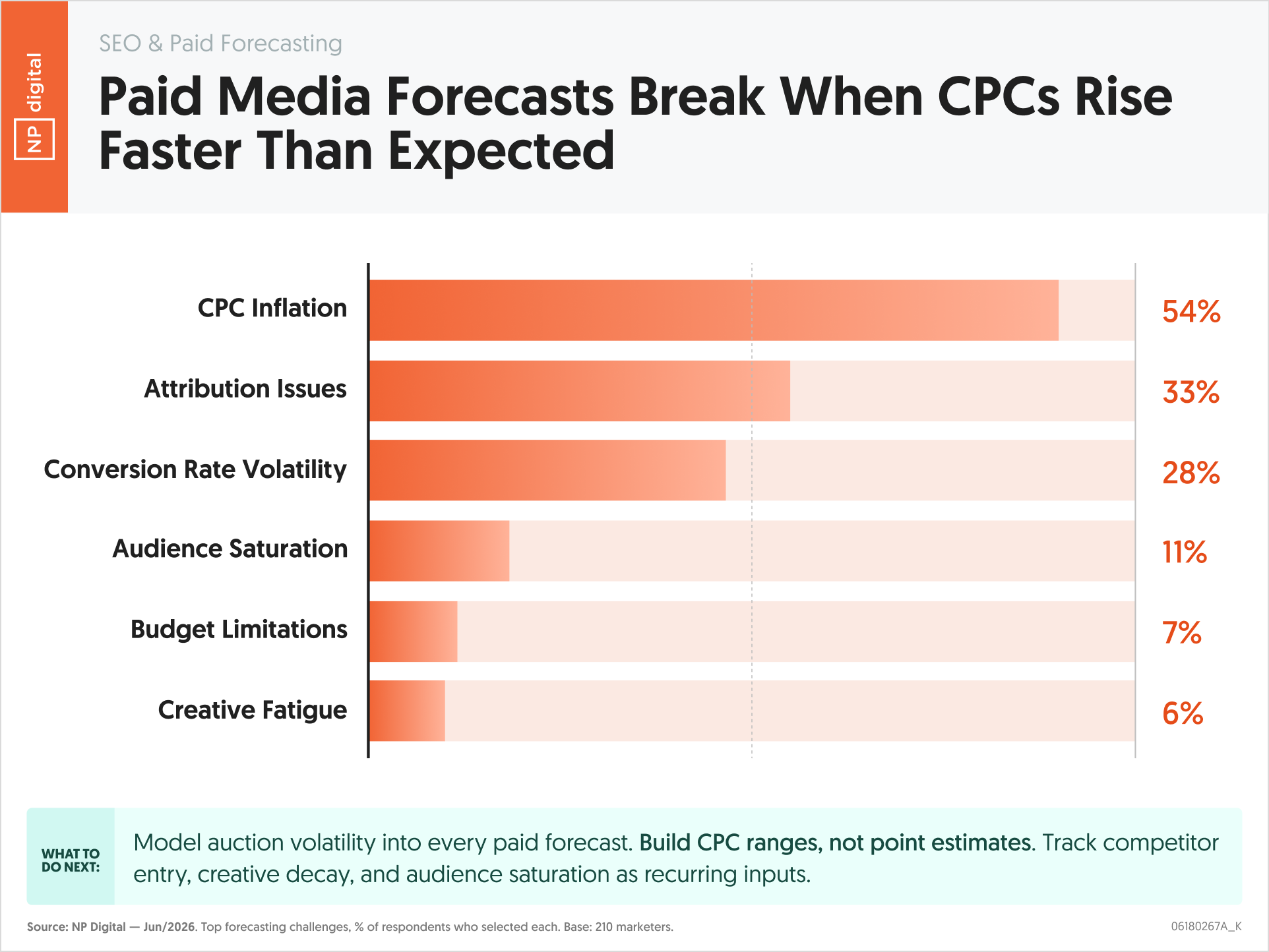
Paid media forecasts fail for specific, knowable reasons. This survey of 210 marketers identifies the top factors that break paid forecasts in practice, and the results show a clear hierarchy. CPC inflation at 54 percent leads by a wide margin, confirming what most paid media teams experience but rarely build into their models: auction dynamics change faster than annual forecast cycles account for, and the difference between a modeled CPC and an actual CPC compounds through the entire forecast period.
Essential Statistics
- CPC inflation is cited by 54 percent of marketers as a primary reason paid media forecasts break, the top-ranked failure factor by a significant margin.
- Attribution issues account for 33 percent of paid forecast failures, the second most cited factor.
- Conversion rate volatility is identified by 28 percent of marketers as a primary forecast failure driver.
- Audience saturation accounts for 11 percent of forecast failures, budget limitations for 7 percent, and creative fatigue for 6 percent.
- The top three factors, CPC inflation, attribution issues, and conversion rate volatility, together account for 115 percent of selections on a multi-select basis, indicating that many forecasts fail due to the combined effect of more than one factor simultaneously.
Key Takeaways
- CPC inflation leading at 54 percent reflects a structural problem with how most paid forecasts are built. Point-estimate CPCs assume a stable auction environment, but competitive entry, AI Overview changes, and seasonal pressure all move CPCs in ways that annual forecasts cannot anticipate from a fixed starting point.
- Attribution issues at 33 percent confirm that the measurement problems identified elsewhere in this dataset directly affect forecast quality. A forecast built on last-click attribution will consistently overstate channel efficiency and understate the CPC needed to hit revenue targets, creating a predictable gap between forecast and actual performance.
- Conversion rate volatility at 28 percent is the factor most likely to interact with CPC inflation simultaneously. When CPCs rise and conversion rates fall together, the forecast error compounds multiplicatively rather than additively, which explains why actual performance can deviate dramatically from projections even when individual input assumptions seem reasonable.
- Audience saturation at 11 percent and creative fatigue at 6 percent are lower-ranked but operate as multipliers on CPC inflation. Saturated audiences require higher bids to reach incremental users, and fatigued creative reduces quality scores, both of which increase effective CPCs beyond what the baseline inflation rate predicts.
- Budget limitations, at 7 percent ranking near the bottom suggests that most paid forecast failures are not primarily resource problems. The data points toward model construction issues, specifically the failure to build CPC ranges and conversion rate scenarios into forecasts, rather than insufficient budget as the primary cause of forecast breakdown.
Actionable Insights
- Replace point-estimate CPCs in your paid forecasts with CPC ranges representing low, expected, and high auction scenarios. Any paid forecast built on a single CPC assumption is structurally fragile. Model a 15 to 25 percent CPC increase scenario alongside your expected case so leadership can see what revenue impact that scenario produces before it occurs rather than after.
- Build attribution quality assessment into your paid forecast process as a prerequisite step. Forecast accuracy is downstream of measurement quality. Before building any paid forecast, document which attribution model is feeding the conversion data, its known limitations, and how those limitations affect the CPC efficiency assumptions in the model. That documentation prevents the forecast from being treated as more precise than the underlying data supports.
- Add a conversion rate sensitivity table to every paid media forecast. The 28 percent failure rate from conversion rate volatility means that a forecast accurate on CPC can still fail if conversion rates shift. A sensitivity table showing forecast outcomes at conversion rates 20 percent above and below your expected case costs minimal effort to produce and gives leadership a clear picture of the conversion rate risk embedded in the projection.
- Track competitor entry as a leading CPC indicator rather than a lagging one. New competitors entering your core auction categories is the most predictable cause of CPC inflation, and it is often visible in impression share data before it shows up in CPC averages. Building a monthly competitor entry audit into your forecasting process gives you 30 to 60 days of advance signal before the CPC impact hits your actuals.
- Review your paid forecast against actual performance at the 60-day mark using CPC variance as the primary diagnostic metric. If your actual CPCs are running 10 percent or more above forecast at Day 60, the trajectory will compound through the rest of the forecast period. An early CPC variance review allows budget reallocation or scenario revision before the gap becomes a missed target.
“Fifty-four percent of paid media forecasts break because of CPC inflation that the model did not account for. The fix is not a better crystal ball. It is building CPC ranges into every forecast instead of point estimates, and tracking competitor entry as a leading indicator of where the auction is heading before the CPC data catches up.” – Neil Patel