 Sign In






Which AI Platform Will Shape Search Most? Marketers Weigh In.
Info
-
Source: NP Digital
-
Date: August 2026
-
Category: AI & GEO Optimization
-
Study Methodology: Source: NP Digital, August 2026. Data from 1,000 people surveyed. Numbers rounded to the closest whole number.
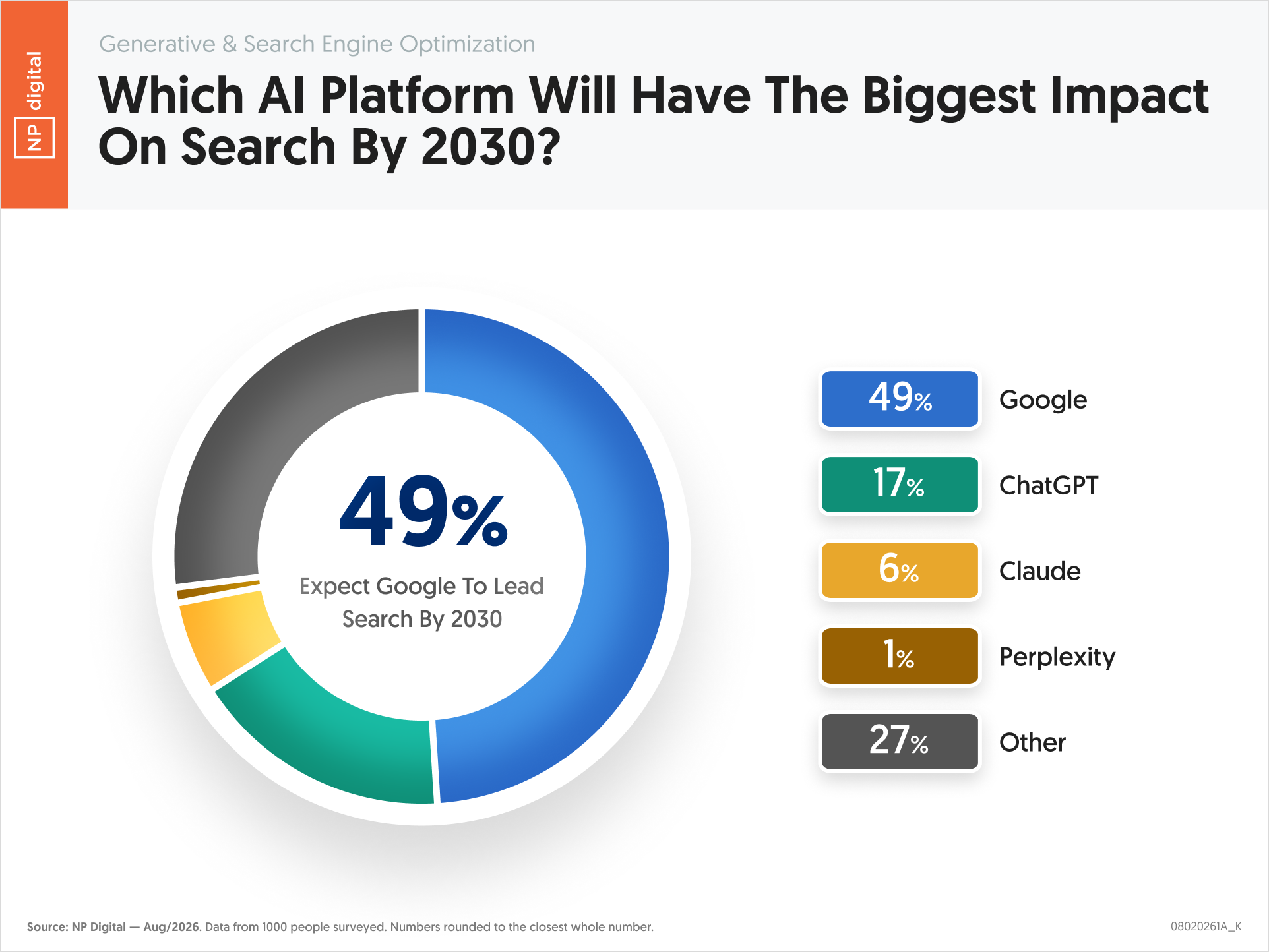
Asked which AI platform will have the biggest impact on search, a thousand respondents split almost evenly between Google and everything else. Google leads at 49 percent, but the combined share backing ChatGPT, Claude, Perplexity, and other platforms reaches 51 percent. The near-even split reflects genuine market uncertainty about how the search landscape will consolidate over the next several years, and it has practical implications for how brands should be thinking about where to invest their optimization effort.
Essential Statistics
- 49 percent of respondents expect Google to have the biggest impact on search, making it the plurality choice but not a majority.
- 27 percent expect other platforms not individually named to lead, the second-largest share in the dataset.
- ChatGPT is expected to lead by 17 percent of respondents.
- Claude is expected to lead by 6 percent and Perplexity by 1 percent of respondents.
- The combined share of non-Google platforms reaches 51 percent, suggesting that a majority of respondents anticipate meaningful fragmentation in search authority rather than continued Google dominance.
Key Takeaways
- The near-even split between Google and non-Google platforms reflects how much uncertainty exists in the market about the future of search. Prediction data of this kind is inherently speculative, and a 1,000-person survey captures sentiment rather than market forecasting.
- The 27 percent other share is notable because it reflects respondents who believe the dominant search platform may not yet be widely known or named. This is consistent with historical patterns where category leaders emerge from relative obscurity faster than incumbents expect.
- ChatGPT at 17 percent is the only named non-Google platform with substantial share. Its position reflects current mindshare more than a rigorous forecast, but it confirms that AI search challengers are already embedded in how practitioners think about search’s future.
- The very low shares for Claude at 6 percent and Perplexity at 1 percent should be interpreted as current brand recognition more than predictive accuracy. Both platforms may have meaningfully different search footprints by the time the question becomes relevant.
- Treating this data as a planning input means building flexibility into your optimization strategy rather than a binary bet on any single platform. The data suggests concentration risk in optimizing only for Google.
Actionable Insights
- Use the near-even split as a rationale for building platform-diversified optimization rather than doubling down exclusively on Google SEO. If roughly half of informed practitioners expect non-Google platforms to lead search, building some GEO capability now reduces the risk of being unprepared if the market shifts faster than expected.
- Do not interpret the 17 percent ChatGPT share as a directive to shift the majority of your search budget toward ChatGPT optimization. This is a sentiment survey, not a market share forecast. It suggests ChatGPT is on the radar, not that it will necessarily become the dominant search platform.
- Monitor how actual search referral traffic from each named platform evolves in your analytics over the next 12 months. Sentiment data tells you what people expect. Analytics data tells you what is actually happening. Building a monthly referral source report that tracks Google, ChatGPT, Perplexity, and other AI sources gives you leading indicators that are more actionable than survey predictions.
- Build your optimization strategy around content signals that tend to transfer across platforms, including expertise signals, structured formatting, third-party citations, and clear factual content, rather than platform-specific tactics that may not generalize. This reduces the risk of over-optimizing for a platform that does not ultimately win the category.
- Revisit your platform investment assumptions every six months rather than treating this as a settled question. The search landscape is changing fast enough that a strategy built on predictions from early data will need regular recalibration as actual platform adoption data becomes available.
Half of the people surveyed think a non-Google platform will lead search. That is not a forecast but serve as an interesting sentiment reading. But it is worth taking seriously as a signal that concentration risk in Google-only SEO is real. Build some optionality into your strategy before the market makes that choice for you.’ – Neil Patel