 Sign In






 Ubersuggest
  AnswerThePublic
 The Biggest Email Marketing Challenges Marketers Face Today
Info
-
Source: NP Digital
-
Date: July 2026
-
Category: Email Marketing
-
Study Methodology: Source: NP Digital, April 2026. Data from SimilarWeb, SEMrush, DemandSage.
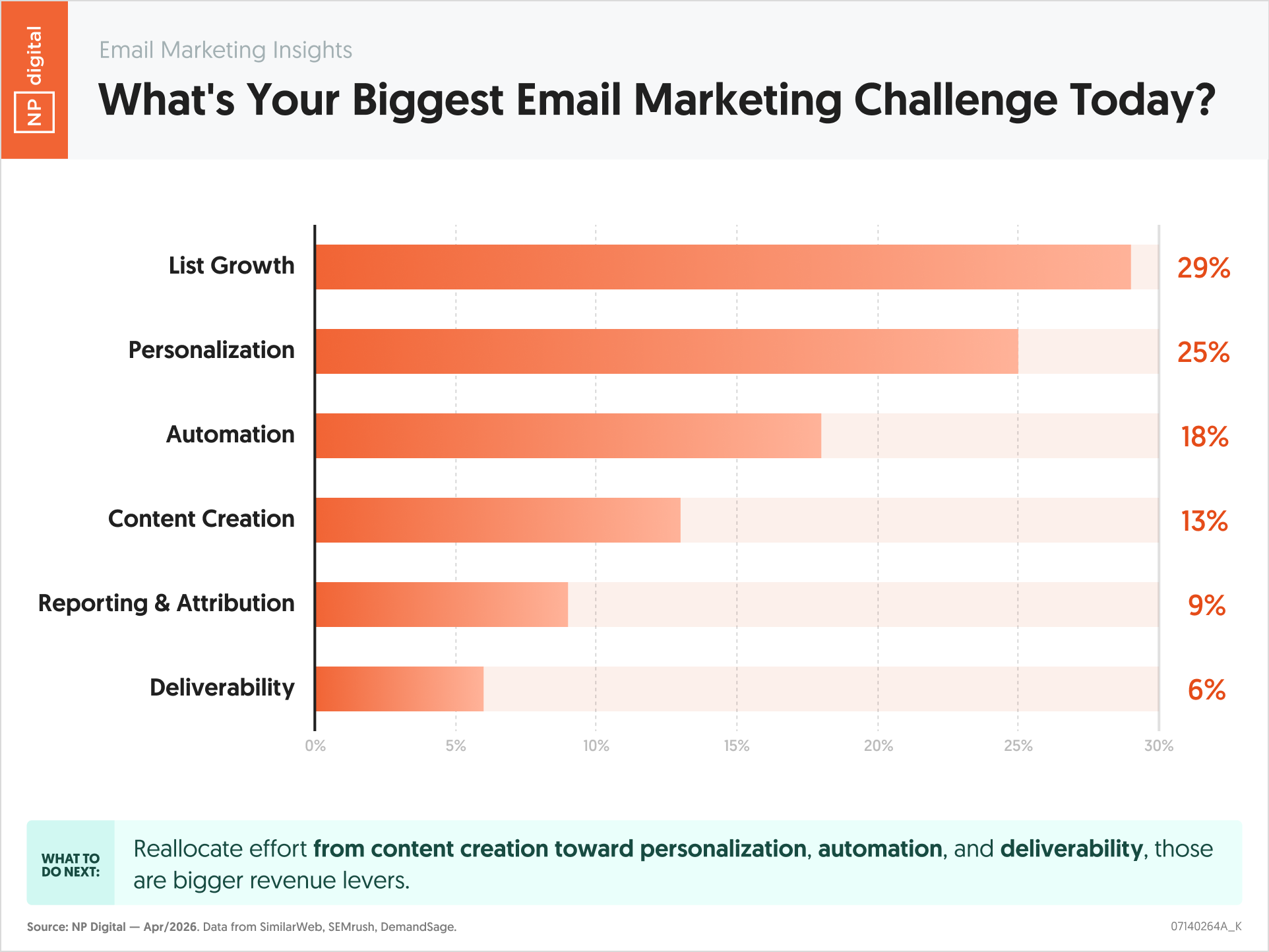
Email marketers are not struggling with the same problems equally. This ranking from SimilarWeb, SEMrush, and DemandSage shows list growth as the dominant challenge at 29 percent, followed closely by personalization at 25 percent. These two challenges sit at opposite ends of the email funnel: list growth is an acquisition problem and personalization is an engagement and relevance problem. Together they account for more than half of reported email challenges, which means most programs are fighting on two fronts simultaneously.
Essential Statistics
- List growth is cited as the biggest email marketing challenge by 29 percent of marketers, the top-ranked challenge in the dataset.
- Personalization is the second-largest challenge at 25 percent of marketers.
- Automation challenges are reported by 18 percent of marketers, the third-ranked challenge.
- Content creation is cited as the biggest challenge by 13 percent of marketers.
- Reporting and attribution challenges are reported by 9 percent of marketers.
- Deliverability is reported as the biggest challenge by only 6 percent of marketers, the lowest-ranked named challenge despite its significant impact on program performance.
Key Takeaways
- List growth leading at 29 percent reflects a structural tension in email marketing: acquiring high-quality subscribers is getting harder as privacy regulations, platform changes, and consumer attention become more constrained. Most traditional list growth tactics, pop-ups, gated content, and checkout opt-ins, are producing declining yield as subscriber behavior evolves.
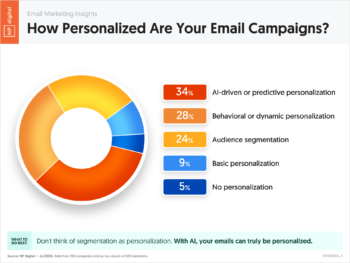
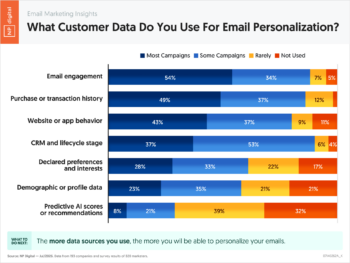
- Personalization at 25 percent being the second-largest challenge is consistent with the companion data showing significant gaps in behavioral data integration and AI personalization readiness. The challenge is not that marketers do not understand the value of personalization but that they lack the data infrastructure and technical implementation to deliver it at scale.
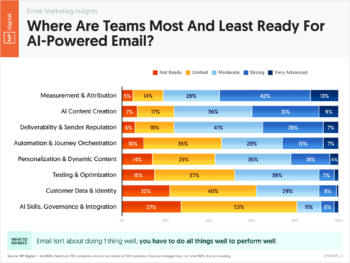
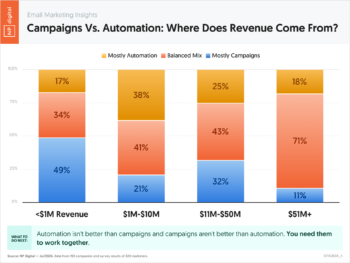
- Automation at 18 percent reflects the same readiness gap seen in the AI email readiness chart: 46 percent of teams report not ready or limited automation capability, and this challenge ranking confirms that a significant share of practitioners experience that gap as an active obstacle in their day-to-day work.
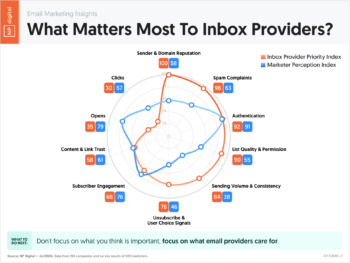
- Deliverability at only 6 percent being the lowest-ranked challenge is a significant finding given the companion data showing major perception gaps between what marketers think matters for inbox placement and what inbox providers actually prioritize. The low challenge ranking suggests most marketers do not recognize deliverability problems when they occur because they are not monitoring the right metrics.
- Content creation at 13 percent being a mid-ranked challenge rather than the top one is notable given that AI investment in content creation leads all other applications at 61 percent. Content creation has become easier to address with AI tools, which may explain why it ranks lower as a challenge even though it remains a significant investment area.
Actionable Insights
- Address list growth through lead magnet diversification rather than just adding more opt-in placements. At 29 percent, list growth is the most reported challenge, but most teams respond by adding more pop-ups rather than improving the value exchange. High-quality lead magnets, including tools, calculators, templates, and exclusive data reports, produce higher-quality subscribers who engage more consistently than subscribers acquired through discount-based or low-friction opt-ins.
- Prioritize the personalization challenge by closing one data integration gap rather than attempting a full personalization overhaul. At 25 percent, personalization is the second-largest challenge, and the most effective near-term response is connecting one additional data source to your email platform. Website behavioral data or purchase history, if not already integrated, produces the largest personalization improvement for the implementation effort required.
- Connect automation challenges to your specific workflow bottleneck rather than treating automation as a single problem category. The 18 percent automation challenge rate encompasses everything from building initial flows to managing complex multi-branch journeys. Identify whether your automation challenge is primarily about building new flows or maintaining and improving existing ones, because those require different investments: content and strategy for building, analytics and testing for optimization.
- Monitor deliverability proactively even though only 6 percent report it as their top challenge. The low ranking reflects the perception gap documented in the inbox provider signals chart, not a low rate of deliverability problems. Set up monthly deliverability monitoring using inbox placement tools and Google Postmaster Tools before a deliverability problem becomes severe enough to register as your biggest challenge.
- Use AI content generation to free time from content creation toward the higher-ranked challenges of list growth and personalization. The 13 percent content creation challenge rate combined with the availability of AI writing tools suggests an opportunity to redirect time from content production toward the more difficult-to-solve challenges of subscriber acquisition strategy and personalization data infrastructure.
”List growth and personalization together account for 54 percent of email marketing challenges. They are opposite problems, one about getting the right people in and one about serving them relevantly once they are there. Most email programs need to work on both simultaneously, which means the teams that solve one but not the other will see limited total program improvement.” – Neil Patel