 Sign In







Where Buyers Now Discover Brands: Social Leads, LLMs at 16%
Info
-
Source: NP Digital
-
Date: June 2026
-
Category: Brand & Reputation
-
Study Methodology: Data based on 85 businesses that surveyed their customers upon completion.
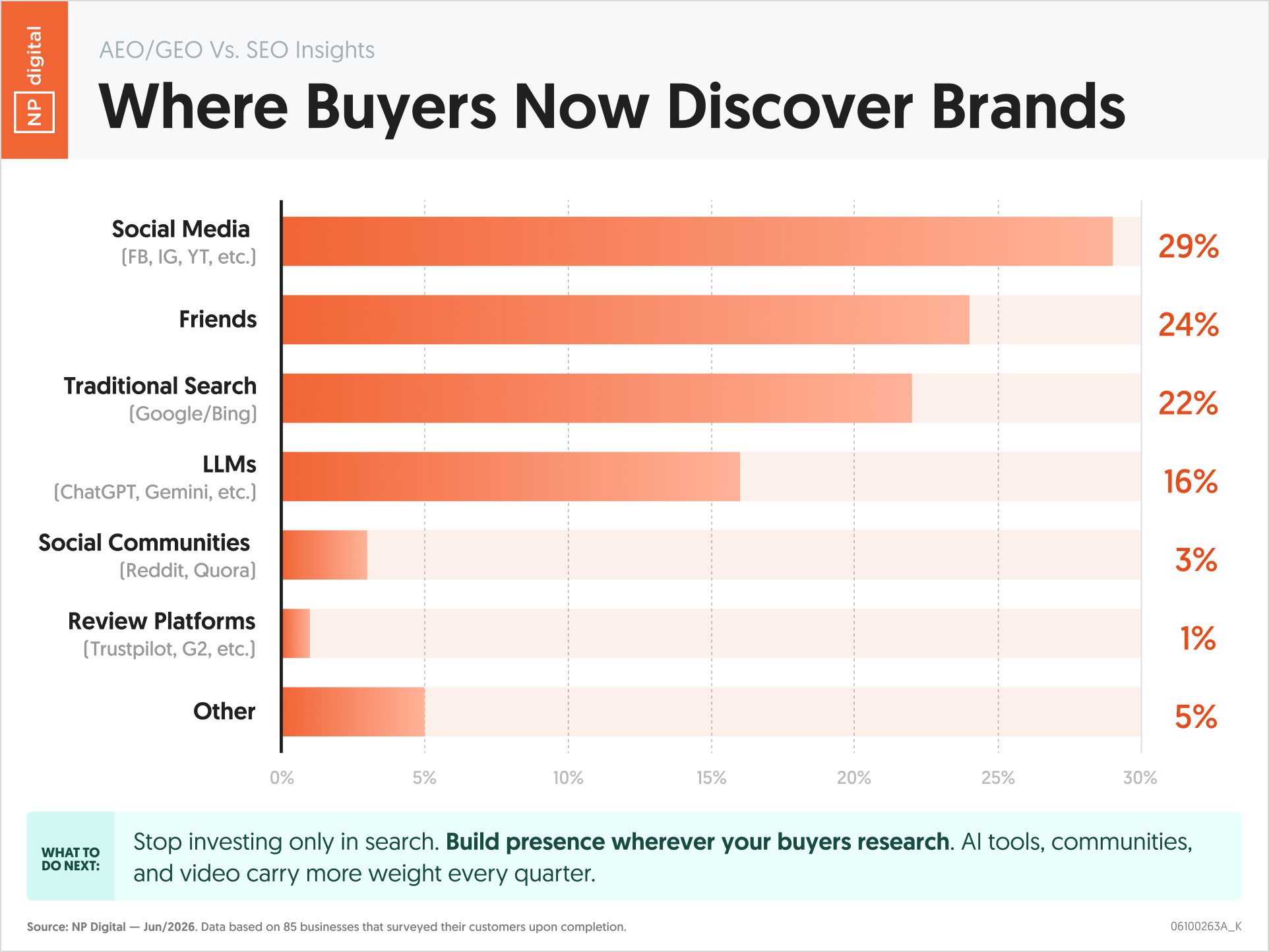
Brand discovery is no longer a search-first journey. This post-purchase survey of customers across 85 businesses maps where buyers first encountered the brands they ultimately purchased from, and the results show a fragmented discovery landscape. Social media leads at 29 percent, followed closely by friends at 24 percent and traditional search at 22 percent. LLMs account for 16 percent of brand discovery, a figure that would have been near zero two years ago and now represents nearly one in six new brand relationships beginning in an AI tool.
Essential Statistics
- Social media, including Facebook, Instagram, and YouTube accounts for 29 percent of brand discovery, the largest single channel.
- Friends and word-of-mouth account for 24 percent of brand discovery, the second largest channel.
- Traditional search, including Google and Bing accounts for 22 percent of brand discovery, third among the channels measured.
- LLMs, including ChatGPT and Gemini account for 16 percent of brand discovery, the fourth largest channel.
- Social communities, including Reddit and Quora account for 3 percent of brand discovery, review platforms for 1 percent, and other sources for 5 percent.
- The top four channels together account for 91 percent of brand discovery, with social media, friends, traditional search, and LLMs capturing the overwhelming majority of first-brand-contact moments.
Key Takeaways
- Social media leading brand discovery at 29 percent reflects the sustained importance of visual and short-form content in reaching audiences before they have articulated a search query. Brand discovery on social often precedes intent, which is why social-first discovery journeys tend to be longer from first exposure to purchase than search or AI-referred journeys.
- Friends and word-of-mouth at 24 percent, nearly matching social media, confirms that referral and community trust remain some of the most powerful brand discovery mechanisms available. Brands that actively cultivate word-of-mouth through referral programs, community building, and exceptional customer experience are influencing nearly a quarter of all new brand discoveries.
- Traditional search at 22 percent is now the third-largest brand discovery channel in this dataset, behind both social media and word-of-mouth. That positioning reflects a structural change from the era when search was the dominant first-touch channel for most categories.
- LLMs at 16 percent in a post-purchase customer survey is a significant finding. These are buyers who completed a purchase and attributed their first brand contact to an AI tool. The commercial reality of AI-driven brand discovery is already present in actual purchase behavior, not just in usage statistics.
- Review platforms at only 1 percent of first-brand-contact is surprisingly low given their influence on conversion decisions later in the journey. This suggests that review platforms operate primarily as evaluation tools rather than discovery tools, which has implications for where brands invest in review generation versus review optimization.
Actionable Insights
- Build discovery-stage content strategies for the top four channels rather than concentrating investment on search alone. Social media at 29 percent, friends at 24 percent, traditional search at 22 percent, and LLMs at 16 percent represent four distinct discovery contexts with different content requirements. A brand investing only in search optimization is capturing 22 percent of the discovery addressable market while leaving 78 percent to other channels and competitors.
- Invest in brand-building activities that generate word-of-mouth at the 24 percent channel scale. This includes referral programs that incentivize customers to recommend, community building that creates regular brand mentions, and post-purchase experiences that are remarkable enough to generate organic sharing. Word-of-mouth at 24 percent is too significant a discovery channel to leave entirely to chance.
- Develop a presence on social communities like Reddit and Quora specifically for AI citation purposes, even though they account for only 3 percent of direct brand discovery. The source type data from this batch shows UGC and forums rate Very High for AI citation frequency. A brand with strong Reddit and Quora presence may generate AI citations that contribute to the 16 percent LLM discovery share, even if the community platform itself shows low direct discovery attribution in post-purchase surveys.
- Track brand discovery attribution in your own post-purchase surveys using the channel categories in this chart. Most businesses track acquisition attribution through digital analytics, which systematically undercounts word-of-mouth and LLM discovery because those channels often do not produce trackable clicks. A post-purchase survey question asking where the customer first heard about your brand produces more accurate discovery attribution than any analytics model.
- Use the LLM discovery figure as a baseline for setting AI visibility goals. If 16 percent of buyers across 85 businesses are already attributing first brand contact to LLMs, your AI visibility strategy needs to be calibrated to capture a proportional share of those discovery moments in your specific category. Brands with strong AI citation presence earn a disproportionate share of that 16 percent. Brands without it are absent from a channel that is already driving meaningful purchase journeys.
“One in six buyers now first discovers a brand through an LLM. That is not a projection. It is what customers said in post-purchase surveys across 85 businesses. Social media is still the biggest discovery channel, and word of mouth is still second, but LLMs are already fourth and closing. Build presence wherever your buyers research, because the research is happening in more places than it was two years ago.” – Neil Patel