 Sign In







Where Search Traffic and Revenue Actually Come From Today
Info
-
Source: NP Digital
-
Date: August 2026
-
Category: Search Trends
-
Study Methodology: Data from 30 B2C businesses that surveyed customers upon checkout. Small sample; findings are directional.
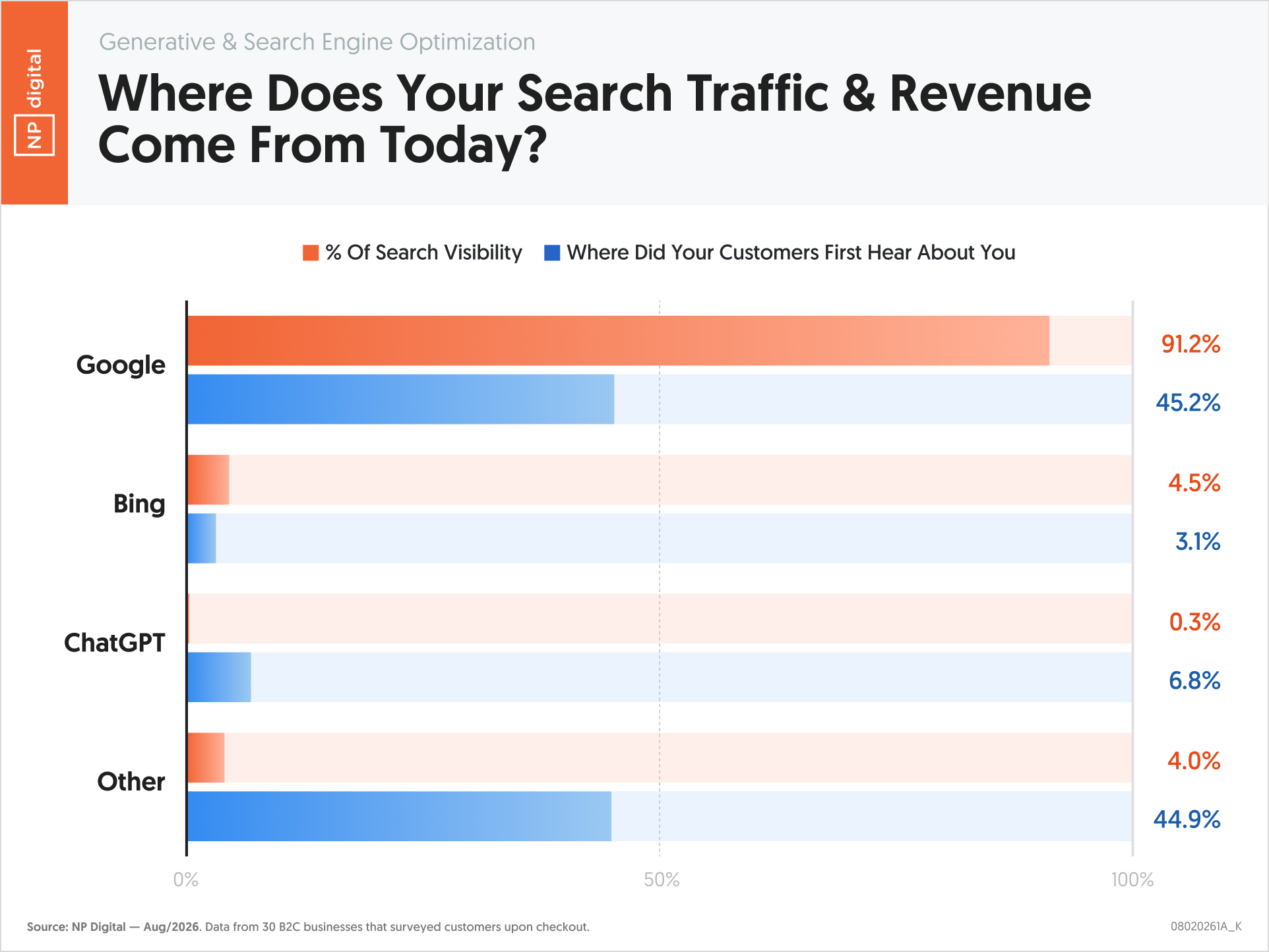
Search visibility and brand discovery do not move in lockstep. This chart from 30 B2C businesses compares where search visibility comes from against where customers say they first heard about the brand, and the two distributions tell a different story. Google commands the vast majority of search visibility, but customers attribute far less of their initial discovery to Google than that visibility share would suggest. ChatGPT, with minimal measurable visibility, is already producing a meaningful share of first-brand-contact moments.
Essential Statistics
- Google accounts for 91.2 percent of search visibility but only 45.2 percent of customer-reported first-brand-contact.
- ChatGPT accounts for just 0.3 percent of search visibility but 6.8 percent of customer-reported first-brand-contact.
- Bing accounts for 4.5 percent of search visibility and 3.1 percent of first-brand-contact, a closer alignment than either Google or ChatGPT.
- Other sources account for 4.0 percent of search visibility but 44.9 percent of first-brand-contact, a substantial gap suggesting significant undercounting of non-search discovery channels.
- The data is drawn from 30 B2C businesses surveying customers upon checkout, making it a directional signal rather than a definitive market benchmark.
Key Takeaways
- The gap between Google visibility at 91 percent and Google first-contact at 45 percent suggests that not all search visibility translates into discovery, particularly in an environment where AI Overviews and zero-click behavior intercept intent before a brand visit occurs.
- ChatGPT’s outsized first-brand-contact share relative to its visibility share is an early signal worth watching. With a small sample of 30 businesses, it is not possible to draw firm conclusions, but the directional finding that AI tools are producing discovery moments disproportionate to their measured visibility is consistent with broader AI traffic data.
- The 44.9 percent other first-brand-contact share reflects how much discovery happens outside channels that standard analytics tracks well. Social media, word of mouth, offline, and AI tools that do not send trackable referrals all flow into this bucket, which limits the precision of any single-source attribution model.
- The misalignment between visibility and discovery across all channels reinforces the need for post-purchase attribution research rather than reliance on last-click or even multi-touch digital attribution alone.
- For a 30-business sample in B2C specifically, results will vary significantly by category. A brand selling high-consideration products may see very different discovery patterns than one selling impulse or commodity goods.
Actionable Insights
- Run your own post-purchase survey asking customers where they first heard about you before drawing conclusions from industry-level data. The 30-business sample here is useful for framing the question, but your specific category, price point, and audience will produce different discovery patterns. A one-question survey at checkout or in a post-purchase email is the lowest-cost way to generate brand-specific discovery data.
- Start monitoring ChatGPT and other AI tool referral traffic in your analytics even if current volumes appear small. The 6.8 percent first-brand-contact share from ChatGPT in this dataset suggests AI-assisted discovery is already happening for B2C buyers. Setting up the measurement infrastructure now means you will have a baseline when volumes grow rather than scrambling to attribute traffic retroactively.
- Treat the “other” category in your own discovery data as a research priority rather than an analytics failure. Nearly 45 percent of first-brand-contact in this dataset flows through channels that are difficult to attribute digitally. Qualitative research, customer surveys, and social listening may surface discovery channels that standard analytics cannot measure.
- Avoid over-indexing GEO investment toward channels with the highest measurable visibility. The data suggests that ChatGPT drives more discovery than its visibility metrics imply. Visibility and discovery impact are worth tracking separately so investment decisions reflect both dimensions.
- Use this data to open an internal conversation about whether your current attribution model is capturing discovery accurately, not to make firm budget reallocation decisions. This may not be the be-all end all of channel investment at 30 businesses, but makes a great conversation starter and a framework for asking more questions internally.
Google owns 91 percent of search visibility but only 45 percent of first-brand-contact in this data. ChatGPT owns 0.3 percent of visibility but 6.8 percent of discovery. That gap is worth investigating in your own business before treating it as a universal truth. Run the post-purchase survey and find out what your own customers actually say.’ – Neil Patel