 Sign In










How Often Teams Update Existing Content and How It Affects Revenue
Info
-
Source: NP Digital
-
Date: August 2026
-
Category: Content Production
-
Study Methodology: Data from 1,000 people surveyed. Numbers rounded to the closest whole number.
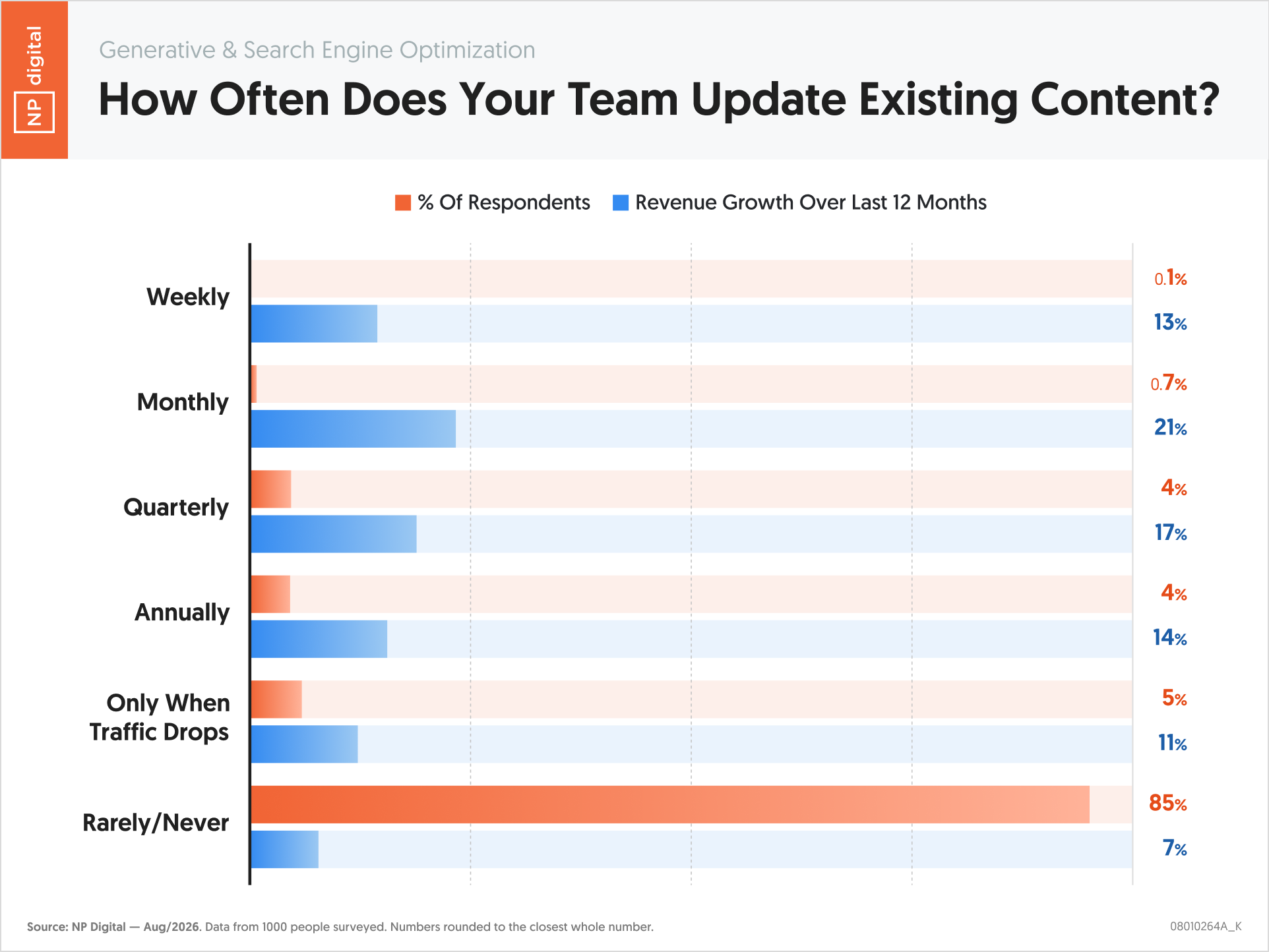
The vast majority of teams rarely or never update existing content, despite data suggesting that regular updates correlate with meaningfully higher revenue growth. This survey of 1,000 respondents maps content update frequency against reported revenue growth over the prior 12 months, and the pattern is consistent: teams updating content more frequently report higher revenue growth rates. Monthly updaters report 21 percent revenue growth while the rarely or never group reports 7 percent. The correlation is directional, not causal, but the gap is large enough to warrant attention.
Essential Statistics
- 85 percent of respondents rarely or never update existing content, the most common update behavior in the dataset by a wide margin.
- Rarely or never updaters report 7 percent revenue growth over the prior 12 months.
- Monthly updaters account for only 0.7 percent of respondents but report 21 percent revenue growth, the highest growth rate in the dataset.
- Weekly updaters account for 0.1 percent of respondents and report 13 percent revenue growth.
- Quarterly updaters account for 4 percent of respondents and report 17 percent revenue growth.
- Only-when-traffic-drops updaters account for 5 percent of respondents and report 11 percent revenue growth.
Key Takeaways
- The 85 percent rarely or never rate confirms that content updating is structurally neglected across most organizations. Content production receives the majority of content team investment, while the existing content library, which often represents years of accumulated authority and ranking history, goes largely unmaintained.
- The revenue growth correlation across update frequency tiers is suggestive but should not be interpreted as causal. Teams that update content frequently are likely to differ from rarely-updating teams in multiple ways, including overall marketing sophistication, investment levels, and strategic maturity, that independently influence revenue growth.
- The monthly update group reporting higher growth than the weekly group at 21 percent versus 13 percent may reflect that weekly updating is often reactive and low-quality, while monthly updating is more strategic and substantive. Update quality may matter more than update frequency above a certain threshold.
- The very small percentages in the high-frequency update tiers, 0.7 percent monthly and 0.1 percent weekly, mean that those revenue growth figures are based on small sample sizes within the overall 1,000-person survey. They should be treated as directional rather than statistically robust findings.
- For GEO specifically, content freshness is one of the top-rated citability signals in practitioner surveys, which provides additional rationale for regular content updates beyond the SEO and revenue correlation shown here.
Actionable Insights
- Audit your top 20 traffic-generating pages for their last update date before creating any new content. For most teams, the highest-return content investment is not creating new pages but refreshing existing ones that already have ranking history, backlinks, and indexed status. A content audit that identifies pages with outdated statistics, broken links, or thin sections is the starting point for a systematic update program.
- Establish a quarterly content review cadence as a realistic minimum rather than targeting monthly or weekly updates. The quarterly tier at 4 percent of respondents and 17 percent revenue growth represents a significant improvement over the rarely or never baseline at a cadence that is achievable for most teams without dedicated content update resources. A quarterly review calendar that assigns specific pages to each quarter is the structural change that separates reactive from systematic updating.
- Prioritize updating pages that rank on page one but have declining CTR or impressions. These pages have established authority but are losing performance, which is often a signal that the content is becoming stale relative to fresher competing pages. Updating these pages with current data, additional depth, and revised structure can recover declining performance without the time investment of starting from scratch.
- Connect your content update program to your GEO strategy by prioritizing updates on pages targeting queries where AI Overviews appear. Freshness is a top-rated AI citability signal, which means pages updated recently are more likely to be cited in AI responses than pages with equivalent quality but older publication dates. Aligning your update schedule with the queries most affected by AI search behavior amplifies the GEO benefit of the same update investment.
- Track content update activity as a leading indicator in your SEO reporting alongside traffic and ranking metrics. Most SEO dashboards track output metrics but not update activity. Adding a simple metric counting the number of pages substantively updated per month creates the accountability that drives update cadence improvement and allows you to correlate update frequency with performance trends in your own data.
Eighty-five percent of teams rarely or never update existing content, and those teams report 7 percent revenue growth while monthly updaters report 21 percent. That gap may not be entirely caused by the update frequency difference, but it is large enough to take seriously. The lowest-effort version of this improvement is a quarterly review calendar that forces updates to your highest-value pages on a schedule.’ – Neil Patel