 Sign In







 Ubersuggest
  AnswerThePublic
Key Takeaways
- LinkedIn announced algorithm changes on May 20, 2026, targeting low-quality AI-generated posts, comments, and automation tools.
- Content flagged as AI slop will not be removed but will be suppressed beyond a user’s immediate network, limiting reach significantly.
- LinkedIn’s detection systems claim 94 percent accuracy in identifying generic AI content, though false-positive data has not been disclosed.
- Content creation on the platform is up 14 percent year over year, driven largely by AI-assisted creation.
- AI-assisted content is still welcome if it contains original perspective, expertise, or meaningful contribution.
- Brands that combine AI efficiency with authentic subject matter expertise will gain a competitive distribution advantage as the algorithm matures.
LinkedIn has a problem, and it is one the platform created for itself.
After years of integrating AI writing tools directly into its product, LinkedIn is now fighting to contain the flood of low-quality AI-generated content those tools helped produce. The result is a content algorithm that is actively suppressing posts it identifies as “AI slop”: polished-sounding, generic, and hollow.
For brands and marketers who have been using AI to scale their LinkedIn presence, this is a signal worth taking seriously.
What LinkedIn Is Actually Doing
LinkedIn VP of Product Laura Lorenzetti announced the changes in a May 20 blog post. Three types of content are in scope: generic AI-generated posts that lack original perspective, bot-generated and generic AI comments, and automation tools that create AI content at scale.
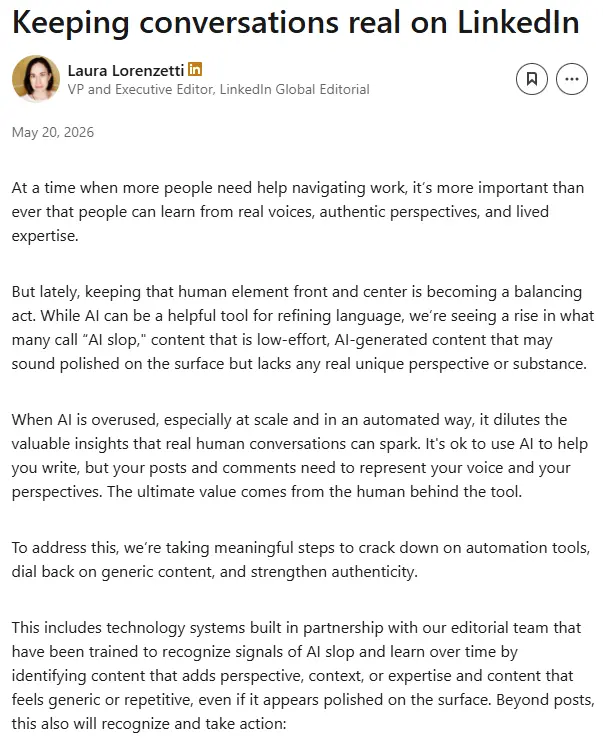
Posts flagged by LinkedIn’s detection systems will not be removed, but their distribution will be suppressed. They will remain visible to a user’s direct connections and followers, but the broader recommendation engine will not amplify them. In practice, this means the platform reach that makes LinkedIn valuable for brand awareness and thought leadership becomes inaccessible to content that fails the originality check.
LinkedIn built its detection capability using an “AI solving AI” approach. Human editors annotated thousands of posts as either generic or original, those examples trained machine learning models to identify patterns at scale, and the system now runs on the feed continuously. The 94 percent accuracy figure comes from LinkedIn’s own testing, which means false positive rates are unknown. Some legitimate content will likely be caught in the net.
The business logic behind the crackdown is straightforward. LinkedIn sells premium subscriptions and advertising on the promise of a high-value professional audience. A feed filled with content nobody wrote undermines that promise, reduces engagement, pushes premium members out, and eventually costs advertisers. Protecting content quality is protecting the revenue model.
What Gets Flagged and What Does Not
LinkedIn has been specific about what it is targeting. Posts that feel generic or repetitive, even if they appear polished on the surface. Comments that simply summarize the post they are replying to without adding anything. Content created through bulk automation tools. Posts that use construction patterns associated with AI assembly, including phrasing like “it’s not X, it’s Y.”
What is explicitly not being targeted is AI-assisted content that contains original thinking. LinkedIn has been careful to draw this line. If a writer uses AI to research, structure, or polish a post built around a real professional insight, that post is welcome. What is not welcome is a post where AI is doing all of the intellectual work.
The practical distinction is whether the content contains something that only the author or their organization could provide. A post built around a first-party data point, a client case study, an executive’s direct experience, or a genuinely specific industry observation has something AI cannot fabricate. A post built around generic claims about industry trends or leadership principles, however well-written, has nothing that differentiates it from the thousands of similar posts already in the feed.
Why This Changes the Distribution Math
For teams that have been using AI to increase posting frequency on LinkedIn, the suppression mechanism changes the math significantly. Volume without quality now actively works against reach. A suppressed post still consumes the posting slot without delivering the visibility that made posting worthwhile in the first place.
The brands and individuals who will gain distribution advantage as this algorithm matures are the ones that understand what LinkedIn’s algorithm actually measures. The system does not detect AI-written text directly. It detects whether anyone cared enough to stop scrolling. Near-zero dwell time, no saves, and no meaningful comments are the behavioral signals that reduce distribution. Content without a specific professional insight at its core produces exactly those outcomes.
What Content Actually Passes LinkedIn’s Test
The behavioral signal LinkedIn’s algorithm reads is whether people engaged with the content meaningfully: dwell time, saves, substantive comments, and shares. These behaviors correlate strongly with one thing: whether the post contains something specific that only the author or their organization could provide.
A post built around a generic observation about industry trends, however well-written, will produce near-zero dwell time because it says nothing the reader has not already seen. A post built around a specific client outcome, a first-party data point, or a direct professional experience produces engagement because it contains information that does not exist elsewhere in exactly that form.
LinkedIn’s detection system cannot read AI-generated text as such. What it can detect is whether the behavioral signals suggest anyone cared enough to read past the first two lines. That is the actual test. The brands and individuals who will outperform in this environment are the ones producing posts that earn saves and real comments because they contain something worth returning to.
The practical audit for any LinkedIn content program is simple: read the last ten posts and ask, for each one, what specific information does this contain that only our brand could provide? If the answer is “nothing,” the content is at suppression risk regardless of how it was produced.
What to Do Now
Continue using AI as a production tool, not a thinking tool. Research, drafting, editing, formatting, and refinement are all appropriate uses of AI in the LinkedIn content workflow. The step AI cannot replace is identifying the specific professional insight that makes the post worth reading.
Prioritize writing LinkedIn articles with executive thought leadership and first-party perspectives. Our guide to covers how to build that kind of content at scale.
These are the content types most resistant to AI suppression because they contain information that genuinely cannot be replicated at scale. An executive’s direct experience with a business problem, a client outcome with specific context, or an internal data point with genuine industry relevance will consistently outperform generic posts on the same topic.
Audit your current LinkedIn content mix. If a meaningful percentage of recent posts would pass for content from any other company in your category, that is a suppression risk worth addressing. The fix is not less AI. It is more raw material from the people and experiences that are actually specific to your brand.
FAQs
Will LinkedIn remove AI-generated posts entirely?
No. Posts identified as AI slop will be suppressed in the recommendation feed but remain visible to a user’s direct connections and followers. Removal is not currently part of the announced changes.
How does LinkedIn detect AI slop?
LinkedIn uses a machine learning system trained on human-annotated examples of generic versus original content. The system identifies patterns in language, structure, and engagement behavior. It claims 94 percent accuracy, though false-positive data has not been disclosed.
Is AI-assisted writing still allowed?
Yes, explicitly. LinkedIn has drawn a clear line between AI-generated content that lacks original perspective and AI-assisted content that uses AI tools to support human thinking. The latter is welcome. The former is what the suppression system targets.
Does this affect LinkedIn ads as well as organic content?
The announced changes target the organic recommendation feed. LinkedIn’s paid advertising products operate separately and are not currently in scope for these content quality restrictions.
Conclusion
LinkedIn’s crackdown on AI slop is a predictable consequence of the content inflation that AI writing tools have produced on every major platform. The platforms that survive on professional audience quality will protect that quality, even when it means limiting the reach of content created using their own tools.
For brands, the competitive advantage in this environment goes to those who treat AI as a production accelerator for content that starts with genuine expertise. The brands already doing this will benefit from the suppression of lower-quality content filling the same feeds. The brands relying on AI as a substitute for original thinking face a meaningful distribution penalty.