 Sign In





 Ubersuggest
  AnswerThePublic
 How Personalized Are Email Campaigns Today?
Info
-
Source: NP Digital
-
Date: July 2026
-
Category: Email Marketing
-
Study Methodology: Source: NP Digital, July 2026. Data from 193 companies and survey results of 820 marketers.
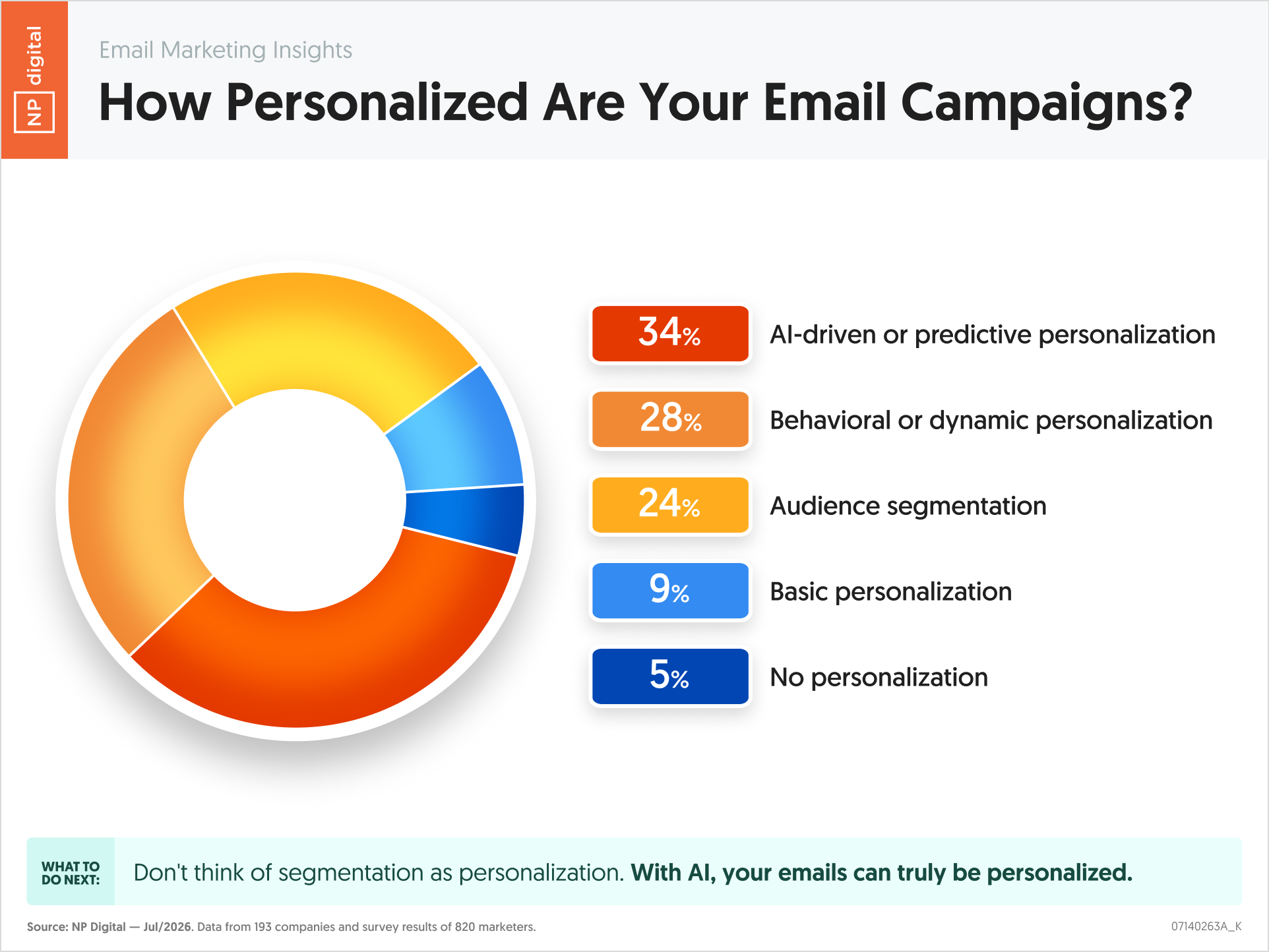
Email personalization has matured significantly. This survey of 193 companies and 820 marketers shows that the majority of email programs have moved beyond basic personalization into behavioral and AI-driven approaches. At 34 percent, AI-driven or predictive personalization is now the most common personalization level, a shift that reflects both the availability of AI personalization tools and the growing understanding that basic name-in-subject-line personalization produces diminishing returns.
Essential Statistics
- AI-driven or predictive personalization is used by 34 percent of email marketers, the most common personalization level in the survey.
- Behavioral or dynamic personalization is used by 28 percent of email marketers, the second most common approach.
- Audience segmentation, defined as segment-based but not dynamically personalized, is used by 24 percent of email marketers.
- Basic personalization, defined as name or simple fields only, is used by 9 percent of email marketers.
- No personalization at all is reported by 5 percent of email marketers.
- Together, AI-driven and behavioral personalization account for 62 percent of all email programs, confirming that dynamic and predictive approaches have become the majority mode of email personalization.
Key Takeaways
- AI-driven personalization leading at 34 percent is a meaningful market shift. Three years ago this number would have been in the low single digits. The accessibility of AI personalization tools through major email platforms has accelerated adoption beyond what the technical complexity of underlying models would suggest.
- The 62 percent combined AI-driven and behavioral personalization share confirms that static segmentation-based email has become a minority approach. Teams still relying primarily on segment-level content rather than individual-level dynamic content are increasingly behind the market norm in personalization sophistication.
- Audience segmentation at 24 percent representing a distinct middle tier reflects that many teams have advanced beyond basic personalization but not yet built the behavioral or AI infrastructure for dynamic content. Segmentation remains a valuable approach but produces lower engagement rates than dynamic personalization at the same list size because it applies the same content to everyone in a segment regardless of individual behavior differences.
- The 5 percent no-personalization rate is lower than many would expect, confirming that the vast majority of email programs have implemented at least minimal personalization even at small scale. The more meaningful capability gap is between basic and behavioral personalization, not between no personalization and basic.
- The distribution from no personalization through AI-driven represents a natural maturity progression that most teams follow as their data infrastructure and tooling mature. Teams at each level typically advance to the next through a combination of data integration improvements, platform capability upgrades, and growing analytical sophistication.
Actionable Insights
- If you are currently at audience segmentation, build one behavioral trigger into your next campaign rather than waiting to build a full behavioral email infrastructure. The transition from segmentation to behavioral personalization does not require a complete platform overhaul. Adding a single behavioral condition, such as suppressing the email for subscribers who purchased in the last 30 days or showing a different product block based on the last category browsed, produces a measurable engagement improvement while building the behavioral personalization muscle.
- If you are at basic personalization, advance to audience segmentation as the next step by building three distinct lifecycle segments. The transition from basic name personalization to segment-based personalization requires only that you define what segments matter for your business and build them in your email platform. New subscribers, active buyers in the last 90 days, and lapsed buyers with no activity in 90 days are three segments that improve relevance across most programs without requiring complex data integration.
- If you are using AI-driven personalization, audit whether the AI recommendations are trained on current behavioral data or static product catalogs. Many AI personalization implementations use catalog-based recommendation logic rather than true behavioral prediction. If your AI recommendations are catalog-based, they will not improve when subscriber behavior changes. True predictive personalization updates in real time as behavioral signals change, which is what produces the engagement improvements that make AI personalization worth the investment.
- Use the 62 percent AI-driven and behavioral majority as a competitive context signal. If your email program is at basic or segmentation level, you are below the current market majority for personalization sophistication. That gap affects engagement rates, sender reputation, and revenue per email relative to competitors operating at higher personalization levels.
- Do not confuse segment personalization with individual personalization. Audience segmentation is an important step but it still sends the same content to everyone in a segment. True personalization responds to individual subscriber behavior, preferences, and lifecycle position in ways that segment-level targeting cannot. The commercial difference between segment and individual personalization typically shows up in open rate, click rate, and revenue per send as you move up the maturity ladder.
”AI-driven personalization is now the most common email personalization level at 34 percent. The market has moved. Teams still relying on basic name-in-subject-line personalization or broad segment targeting are below the current majority. The transition to behavioral and predictive personalization is not optional if you want email performance to match what the top 62 percent of programs are achieving.” – Neil Patel