 Sign In









Key Takeaways
- Google launched dedicated Generative AI performance reports in Search Console on June 3, 2026, initially rolled out to a subset of UK-based sites.
- The report tracks impressions across AI Overviews, AI Mode, and AI features in Discover, broken down by pages, countries, devices, and dates.
- Data begins from May 18, 2026; there is no historical backfill.
- Click data is not included in the current version, which is the most significant limitation.
- Google also introduced an opt-out toggle allowing sites to block content from AI features without affecting traditional organic rankings.
- AI visibility and traditional organic visibility are now two distinct, separately measurable channels.
For two years, AI search performance has operated as a black box. Brands could see that AI Overviews were growing, that click-through rates were falling, and that something had changed in how Google surfaced content. But first-party data on what was actually happening inside AI features was not available.
Google changed that on June 3, 2026.
What Google Actually Launched
Google’s Search Generative AI performance reports give site owners a dedicated view inside Search Console showing how their content appears within generative AI features. Previously, any traffic or impressions from AI Overviews and AI Mode were folded into the standard Performance report with no way to isolate them. That separation is now possible.
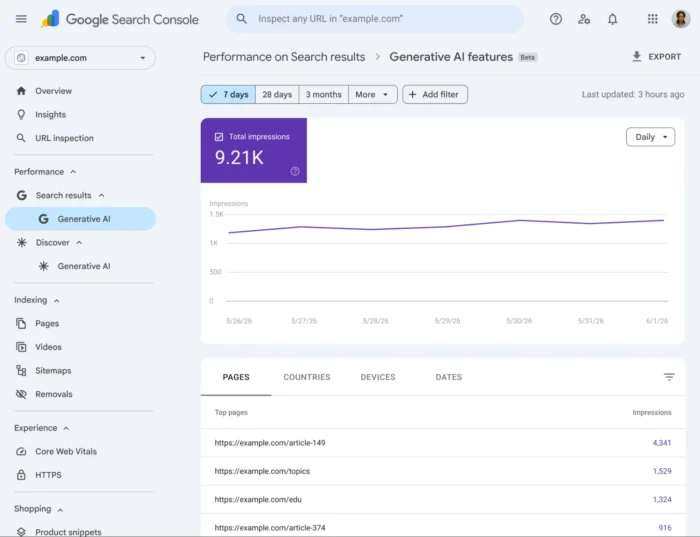
The report covers five dimensions: impressions (how often your URLs appeared in AI features), pages (which specific URLs were cited), countries (geographic breakdown of AI visibility), devices (for Search results), and dates (with hourly through monthly granularity).
The rollout launched June 3, 2026, initially for a subset of UK-based site owners. This is a direct response to the UK Competition and Markets Authority mandate, which requires Google to share this data under the Digital Markets Act. A global rollout is planned but no timeline has been confirmed. If your Search Console does not yet show the report, it is coming.
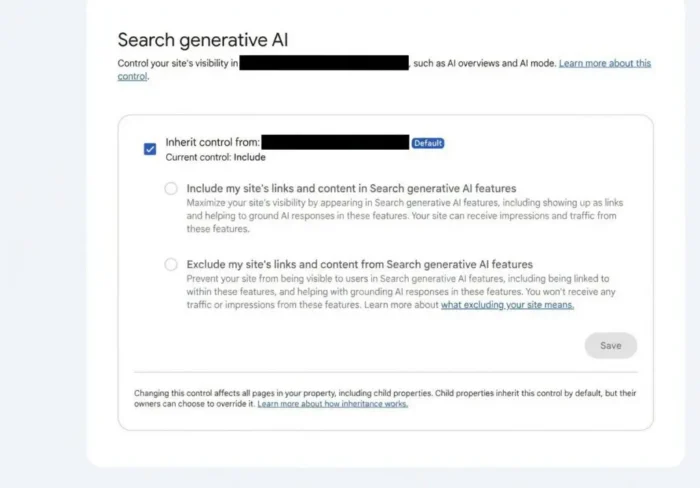
Alongside the reporting launch, Google introduced an opt-out toggle that allows site owners to exclude their content from AI Overviews, AI Mode, and Discover AI features entirely. Critically, opting out carries no organic ranking penalty. Google has confirmed the toggle will not be used as a ranking signal for traditional search results. The toggle takes effect from June 17, 2026.
What the Data Does and Does Not Tell You
The most significant limitation of the current report is that it tracks impressions only. There is no click data, no CTR, no average position, and no query-level breakdown. You can see that your content appeared in an AI feature, but not whether anyone clicked through to your site as a result.
For performance marketers accustomed to building decisions around clicks and conversion, this creates a measurement gap. AI systems are designed to answer questions directly, which means click rates from AI features are likely structurally lower than click rates from traditional results. An impression inside an AI Overview does not confirm a visit, and given how AI Overviews behave, it may not produce one at all.
The right way to read this data, at least in its current form, is as a resonance signal. A page that earns high AI impressions is content the model finds worth citing. Cross-reference AI impressions against the organic clicks that same URL earns in the standard Performance report, and you get a genuinely useful picture: pages that perform strongly in both channels are your highest-value content assets. As one analysis put it, high AI impressions and high organic clicks on the same page is the clearest signal of what non-commodity content actually looks like. For a deeper look at how to interpret and act on AI brand visibility data, see our recent breakdown.
The data also starts from May 18, 2026, which sits inside the May 2026 core update window. Early trend interpretation should account for that overlap, since ranking shifts from the update will be mixed into the initial AI impression patterns.
Reading AI Impressions as a Strategy Signal
The absence of click data in the current report does not make AI impressions useless. It changes how they should be read.
An impression inside an AI Overview or AI Mode response means Google’s system selected your content as a grounding source for its answer. That selection reflects the same quality signals that drive strong traditional rankings: factual accuracy, topical authority, clear structure, and relevance to the specific question being answered. Pages that consistently earn AI impressions are your content assets that the model finds most citable.

Cross-referencing AI impressions with organic clicks from the standard Performance report creates a genuinely useful diagnostic. Pages with high organic clicks and high AI impressions are performing in both paradigms simultaneously.
These are your non-commodity pages: content that earns traffic from users who click through and citation from AI systems answering related questions. Pages with high AI impressions but low organic clicks may indicate content that answers queries well enough to be cited but does not generate sufficient click intent on its own. These are worth examining for conversion optimization. Pages with low AI impressions and high organic clicks may represent ranking-driven traffic that is increasingly vulnerable as AI Overviews expand into their query categories.
Should You Opt Out of AI Features?
Almost certainly not, for most brands.
The business case for opting out is narrow. Publishers with content-licensing models, paywalled material, or specific legal reasons to restrict AI citation may have legitimate reasons to consider it. For the vast majority of brands, opting out means losing a growing visibility channel, with no ranking benefit to offset it.
The opt-out toggle is most useful as a signal that Google has acknowledged the tension between feeding AI systems with publisher content and compensating those publishers for it. Having the control is meaningful. Using it defensively, without a clear strategic rationale, is not recommended.
What to Do Now
Even before your Search Console account gains access, prepare the reporting infrastructure now.
Define how AI impressions will feed into your performance reporting. AI visibility and traditional organic visibility are now distinct channels, and they need separate measurement frameworks. A page ranking well in traditional search is not the same as a page earning AI citations, even though both matter.
Identify which pages are likely candidates for AI citation in your current content mix. Content that directly answers specific questions, uses clear structure, and is factually accurate and current is more likely to surface in AI features. Those pages should be audited for completeness and optimized before the report gives you data to react to.
Set a baseline as soon as access arrives. The report currently has no historical data before May 18, 2026, which means the earlier you establish your first benchmarks, the more useful comparative data you will have going forward.
FAQs
When will I get access to the new AI report in Search Console?
The current rollout is limited to a subset of UK-based site owners. Google has said a global rollout is planned but has given no specific timeline. Monitor your Search Console account for the Generative AI section to appear.
Can I see which queries trigger AI impressions for my content?
Not in the current version. The report does not include query-level data. This is one of the most significant gaps and may be addressed in future updates.
Does opting out of AI features help my rankings?
No. Google has confirmed that the opt-out setting will not be used as a ranking signal for traditional organic search. Opting out affects AI Overviews, AI Mode, and Discover AI features only.
Should I treat AI impressions the same as organic impressions?
No. AI impressions indicate your content was cited inside a generative feature, not that a user was shown your link in a traditional results format. The downstream behavior is different, click rates from AI features are likely lower, and your measurement framework should reflect that distinction.
Conclusion
AI search visibility has been growing for two years with no way to measure it directly. The new GSC Generative AI performance report closes that gap, partially. Impressions data without clicks is an incomplete picture, but it is a meaningful start. The brands that build reporting frameworks around this data now, before a global rollout makes it standard practice, will be better positioned to interpret performance and make decisions as the reporting matures.