 Sign In









Rankings Are No Longer the North Star: How SEO KPIs Shifted
Info
-
Source: NP Digital
-
Date: June 2026
-
Category: SEO & Keyword Strategy
-
Study Methodology: Base: 100 organizations. Percentage of leadership teams prioritizing each KPI in 2024 versus 2026.
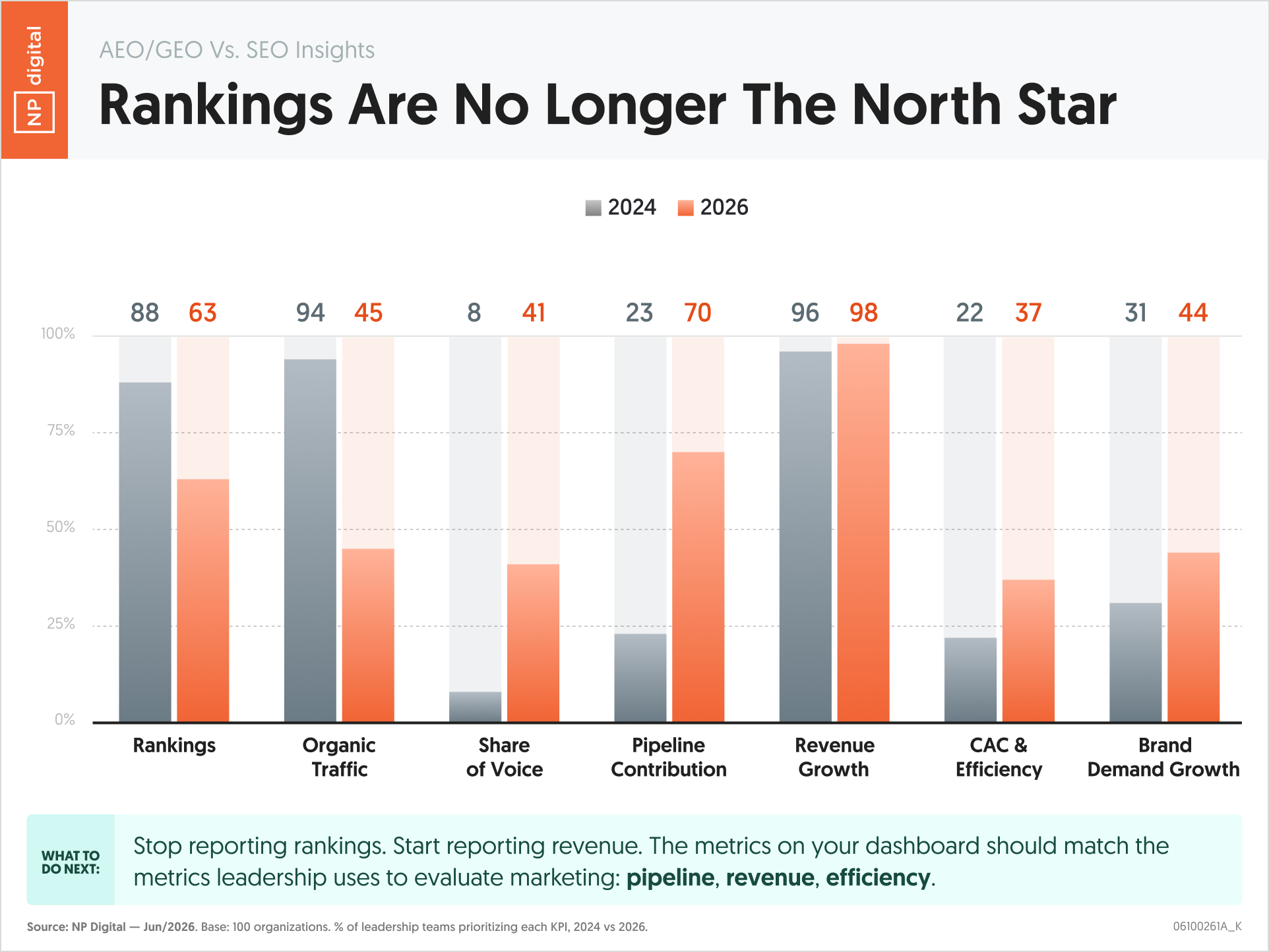
The KPIs that leadership uses to evaluate marketing have shifted significantly in two years. This survey of 100 organizations compares how leadership teams weighted seven marketing metrics in 2024 versus 2026, and the pattern is clear: visibility metrics are declining in priority while business outcome metrics are rising. Rankings dropped from 88 to 63 percent. Pipeline contribution rose from 23 to 70 percent. The teams still reporting rankings as their primary success metric are out of alignment with how their own leadership is now defining marketing value.
Essential Statistics
- Rankings priority among leadership teams dropped from 88 percent in 2024 to 63 percent in 2026, a 25-point decline.
- Organic traffic priority dropped from 94 percent in 2024 to 45 percent in 2026, a 49-point decline and the largest drop in the dataset.
- Share of voice rose from 8 percent in 2024 to 41 percent in 2026, a 33-point increase.
- Pipeline contribution rose from 23 percent in 2024 to 70 percent in 2026, a 47-point increase and among the largest gains in the dataset.
- Revenue growth held near the top in both years, moving from 96 percent in 2024 to 98 percent in 2026, confirming its consistent status as the most universally prioritized KPI.
- CAC and efficiency rose from 22 percent to 37 percent, and brand demand growth rose from 31 percent to 44 percent.
Key Takeaways
- The 49-point decline in organic traffic priority is the largest movement in the dataset and the most consequential for marketing teams that built their reporting around session counts. Leadership is no longer treating organic traffic as a primary success metric at the same rate it did in 2024, which means teams still leading with traffic in their reporting are out of step with current leadership expectations.
- Pipeline contribution rising from 23 to 70 percent in two years represents one of the fastest KPI priority shifts in this dataset. It reflects the growing leadership expectation that marketing demonstrate a direct contribution to revenue pipeline, not just traffic delivery. Teams that cannot show pipeline contribution in their reporting face increasing credibility risk with leadership.
- Revenue growth at 98 percent in 2026 confirms that leadership has always cared most about revenue. What changed is the expectation that marketing connect its activities directly to that outcome rather than pointing to traffic as a proxy.
- Share of voice rising from 8 to 41 percent reflects the influence of AI search on how marketing leadership thinks about visibility. In an environment where AI Overviews and AI tool citations are capturing significant search intent, traditional ranking position is an incomplete measure of how visible a brand actually is across the full answer-seeking landscape.
- The CAC and efficiency gain from 22 to 37 percent reflects budget pressure driving leadership to evaluate marketing return per dollar spent rather than absolute channel performance. Efficiency metrics reward integrated forecasting and attribution investment, which is consistent with the pattern across the companion forecasting data in this batch.
Actionable Insights
- Audit your current marketing reporting dashboard and identify which KPIs have declined in leadership priority based on the 2024-to-2026 shifts in this chart. If rankings and organic traffic dominate your report, you are leading with the two metrics that declined most in leadership priority over the past two years. Restructuring your report to lead with pipeline contribution, revenue growth, and CAC before presenting visibility metrics brings your reporting into alignment with current leadership expectations.
- Add pipeline contribution as a tracked metric in your next reporting cycle, even if the data is imperfect at first. The rise in pipeline contribution priority means this is what leadership is now asking for. A rough pipeline attribution estimate, even if based on assumed conversion rates and average deal values, is more credible than not reporting it at all. Precision improves as attribution matures; starting the measurement is more important than starting with complete accuracy.
- Replace rankings as your SEO success headline with share of voice. Share of voice rose from 8 to 41 percent in leadership priority, while rankings fell 25 points. Share of voice measures how often your brand appears across the full range of relevant queries, including in AI Overviews and AI tool responses, which better reflects actual visibility in the current search environment than position tracking alone.
- Build a CAC trend line into your marketing forecast to demonstrate efficiency improvement over time. The rise in CAC and efficiency priority means leadership wants to see that marketing is becoming more efficient at acquiring customers, not just generating more of them. A CAC trend line that shows improvement quarter over quarter tells a more credible performance story than volume metrics alone.
- Use the 2024-to-2026 shift data when proposing changes to your reporting structure. Presenting this external benchmark to leadership confirms that the metric shifts you are proposing reflect industry-wide changes in how marketing value is measured, not internal preferences. That framing reduces resistance to reporting restructuring because it positions the change as responding to market reality rather than advocating for a particular measurement philosophy.
“Organic traffic priority dropped 49 points in two years. Pipeline contribution rose 47 points. Your leadership already knows what they want to see. The teams still leading their reports with rankings and sessions are speaking a language their leadership stopped prioritizing in 2024. Change the headline metrics in your report and the conversation changes.” – Neil Patel