 Sign In







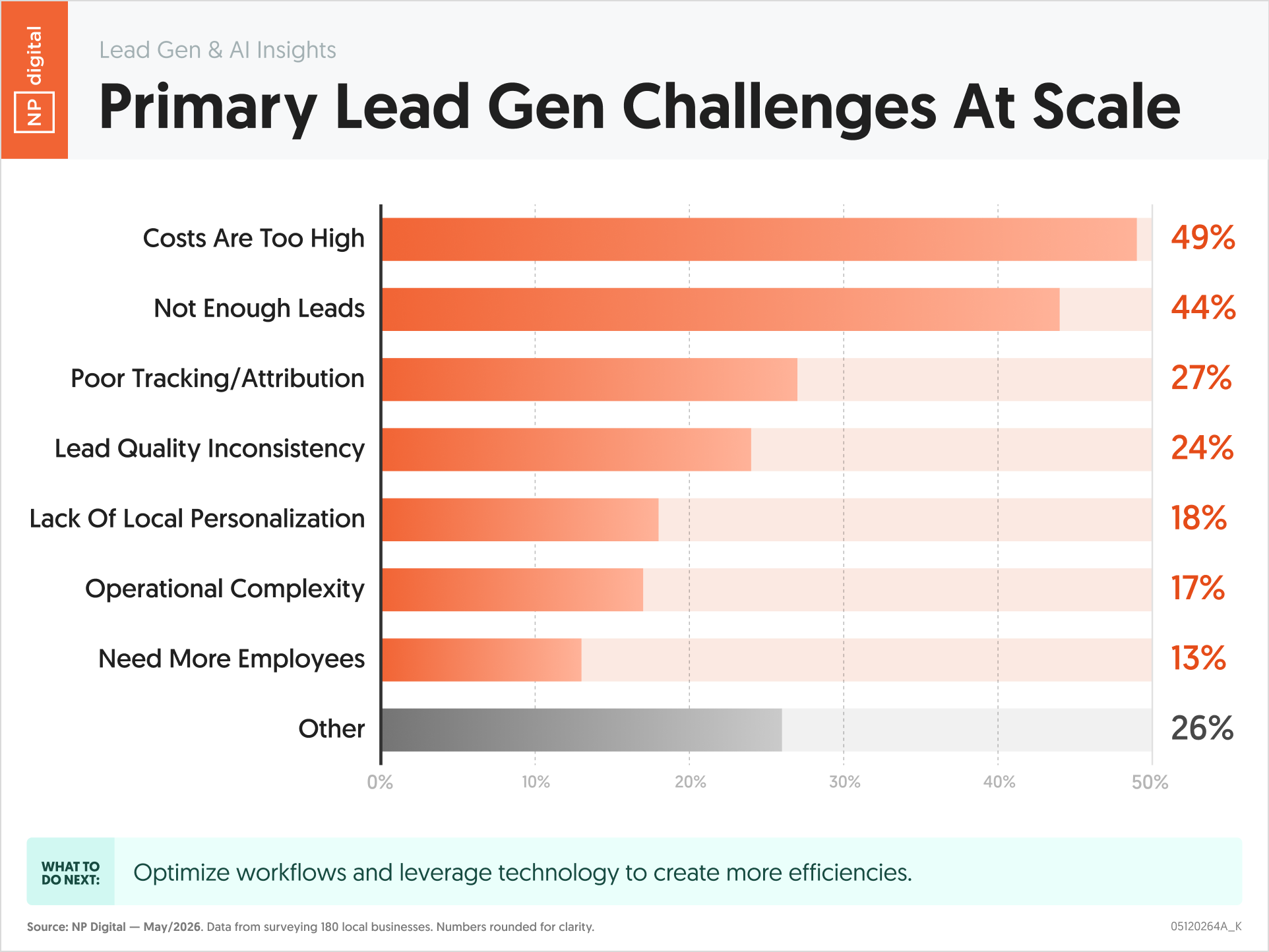
Primary Lead Gen Challenges at Scale
Info
-
Source: NP Digital
-
Date: May 2026
-
Category: Lead Gen & B2B
-
Study Methodology: Sample size: 180 local businesses. Collection method: Online survey. Numbers rounded for clarity.
Scaling lead generation amplifies the core challenges of cost and volume. This survey of 180 local businesses identifies where the pressure concentrates as lead programs grow, and the distribution reveals something important: cost and volume rank first and second, but attribution, quality, and personalization follow closely enough that they are almost certainly contributing to the cost and volume problems rather than sitting independently beside them. The 26 percent who selected other as their primary challenge signal that the standard framework does not fully capture what is slowing these programs down.
Essential Statistics
- 49 percent of local businesses cite high costs as their primary lead generation challenge at scale, making it the top challenge by a significant margin.
- 44 percent report not generating enough leads as a top challenge, the second-most-cited problem.
- 27 percent identify poor tracking and attribution as a significant challenge, ranking third.
- 24 percent flag lead quality inconsistency as a primary concern.
- 18 percent point to lack of local personalization as a challenge, and 17 percent cite operational complexity.
- 13 percent say they need more employees to manage lead generation at their current scale.
- 26 percent selected other, the second-highest individual response, suggesting meaningful challenges exist outside the standard categories.
Key Takeaways
- High cost at 49 percent is the top challenge, but cost problems in lead generation almost always have a root cause in one of the other challenges listed. Poor attribution means budget is being allocated to channels that appear efficient but are not. Lead quality inconsistency means the sales team is spending time on leads that should never have been qualified. Lack of local personalization means conversion rates are lower than they should be, driving up cost per acquisition. The 49 percent reporting high costs may be experiencing the symptom of problems that appear lower in the ranking.
- The 44 percent reporting insufficient lead volume requires a diagnosis before a solution. Teams that respond to low lead volume by increasing spend on existing channels will compound the cost problem if those channels have undetected attribution or quality issues. The right response to insufficient volume is a channel audit that distinguishes between genuinely underperforming channels and channels that appear to underperform because of measurement gaps.
- Poor tracking and attribution at 27 percent is likely an undercount. Attribution problems are often invisible to the teams experiencing them. They show up as cost or volume problems rather than being identified as measurement failures. The actual share of businesses affected by attribution gaps is probably closer to the 78 percent figure in the companion lead-to-close reporting chart.
- Lead quality inconsistency at 24 percent points to a targeting and qualification problem upstream of the sales handoff. More leads at the same quality level multiplies the wasted sales effort. Addressing quality inconsistency requires working backward from closed deals to identify what differentiates leads that close from leads that do not.
- The 26 percent selecting other is a strong signal that standard lead generation frameworks have blind spots. Follow-up research typically surfaces technology integration problems, internal alignment issues between marketing and sales, and process inefficiencies that do not fit neatly into cost, volume, or quality categories.
Actionable Insights
- Before increasing lead generation budget in response to high costs or low volume, run a channel-level diagnostic that separates measurement problems from actual performance problems. The 27 percent citing poor attribution and the 49 percent citing high costs are likely partially overlapping populations. Some high-cost teams are experiencing costs that appear elevated because attribution gaps are misallocating credit. A channel audit comparing cost-per-lead against close-rate-by-source will surface whether the cost problem is a channel efficiency problem or a measurement problem.
- Build a lead source quality report that tracks close rate and revenue by channel alongside volume and cost metrics, and use it to cut volume from sources that consistently produce low-quality leads regardless of the quantity they deliver. The 24 percent flagging quality inconsistency often have marketing metrics that look healthy while the sales team is quietly drowning in unqualified inquiries. The quality report makes that divergence visible.
- Implement automated lead scoring and nurture sequences to reduce the manual qualification workload before leads reach the sales team. The 17 percent citing operational complexity and 13 percent citing staffing constraints share a common fix. A basic lead scoring model using behavioral signals can filter the lead pool before it reaches sales and reduce per-lead handling time.
- Build location-specific landing pages for your top three to five service areas if you are among the 18 percent flagging lack of local personalization. Generic landing pages serving multiple locations produce lower conversion rates because they cannot match the local intent signals that drove the click. A location-specific page with locally relevant copy, local reviews, and a locally framed offer converts at a meaningfully higher rate.
- Create a structured internal challenge audit that explicitly asks the sales team which problems are slowing pipeline growth. The 26 percent selecting other reveal that standard challenge frameworks have blind spots. Sales teams see the downstream effects of marketing decisions in ways that marketing dashboards do not capture. A quarterly joint review organized around what is actually slowing deal velocity consistently surfaces the challenges that survey frameworks miss.
“High cost per lead is almost always a symptom, not the root problem. Trace it back and you usually find attribution gaps misdirecting budget, quality issues wasting sales time, or conversion problems inflating the volume needed to hit targets. Fix the root cause and the cost fixes itself.” – Neil Patel