 Sign In






 Ubersuggest
  AnswerThePublic
 Content Types That Perform Best in AI Search
Info
-
Source: NP Digital
-
Date: May 2026
-
Category: Content Strategy
-
Study Methodology: Sample size: 500 marketers and business owners. Collection method: Online survey.
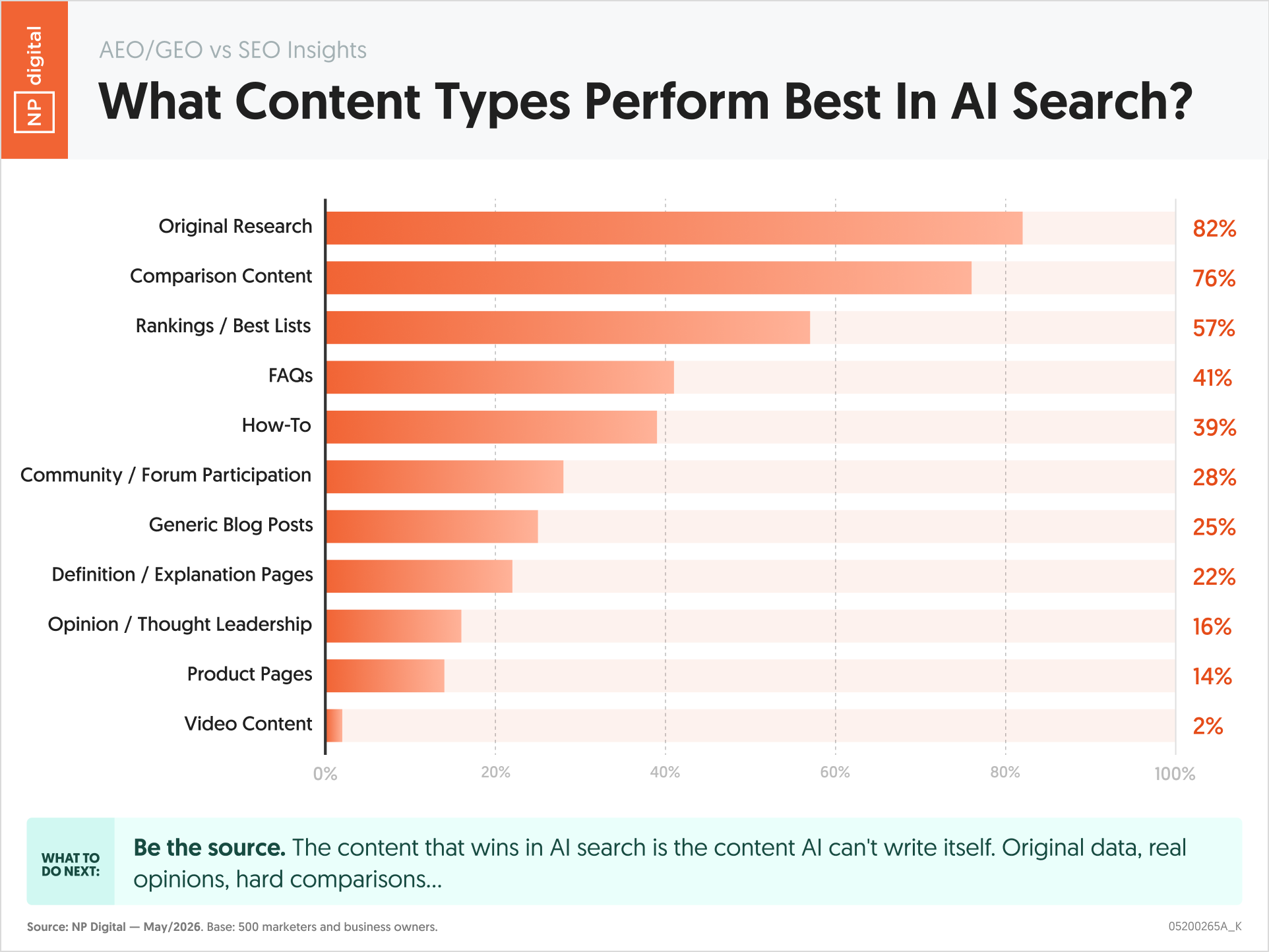
AI search engines are not indifferent to content format. They have strong, measurable preferences that this survey of 500 marketers and business owners makes explicit. Original research ranks first at 82 percent. Comparison content ranks second at 76 percent. The two share a defining characteristic: they contain information that AI engines cannot generate on their own. Everything below them in the ranking contains information that AI engines can produce without citing a source, which is precisely why they are cited less. This ranking is a content investment directive. If your content production is weighted toward formats AI can replicate, your citation rate will reflect that.
Essential Statistics
- Original research ranks first at 82 percent performance in AI search, the highest-rated content type in the dataset.
- Comparison content ranks second at 76 percent, within 6 points of original research.
- Rankings and best lists rank third at 57 percent.
- FAQs rank fourth at 41 percent and how-to content fifth at 39 percent.
- Community and forum participation ranks sixth at 28 percent, and generic blog posts seventh at 25 percent.
- Definition and explanation pages rank eighth at 22 percent, opinion and thought leadership ninth at 16 percent, and product pages tenth at 14 percent.
- Video content ranks last at 2 percent performance in AI search.
Key Takeaways
- Original research at 82 percent is the top-performing content type because it is the only format that AI engines cannot produce without a source. Proprietary survey data, original analysis, and unique datasets are irreplaceable. AI engines must cite the source because the information does not exist elsewhere. Every other content type contains information that AI can generate from its training data, making citation a choice rather than a necessity. Original research converts a citation from optional to required.
- Comparison content at 76 percent performs for the same structural reason as original research: it requires judgments, conclusions, and data points specific to the publisher’s methodology and perspective. A comparison of five CRM platforms based on proprietary testing criteria is content AI cannot replicate without referencing the source. Generic comparisons without proprietary data or unique evaluation criteria will perform closer to the generic blog post category at 25 percent.
- The drop from comparison content at 76 percent to rankings and best lists at 57 percent to FAQs at 41 percent reflects decreasing content specificity and decreasing citation necessity. Rankings are more replicable than comparisons. FAQs contain question-and-answer formats that AI engines can construct independently. These formats still contribute to AI citability, particularly when they incorporate specific examples or proprietary methodology, but they do not generate citations as reliably as the top two formats.
- Generic blog posts at 25 percent and product pages at 14 percent perform near the bottom because they are the formats AI engines can reproduce most completely without needing to reference the original. A generic explanation of what content marketing is, or a product description of a software tool, is information AI already has in its training data. Publishing more of it does not generate citations. It generates content that AI can summarize without attribution.
- Video content at 2 percent reflects a current technical limitation rather than a permanent ceiling. AI engines process text more reliably than video, which is why video content is rarely cited even when it contains genuinely original information. As multimodal AI capabilities mature and video transcripts become more systematically integrated into AI training data, this ranking will likely improve.
Actionable Insights
- Commission at least two original research studies per year as a non-negotiable content investment, and structure each one for maximum citation utility. At 82 percent, original research is the format most likely to earn AI citations, but publication alone is not sufficient. Include a clear methodology section with sample size and collection method. Lead with a headline statistic that is specific, surprising, and attributable. Use structured data markup to help AI engines understand the research context. Publish a dedicated data page that presents key findings in a format optimized for extraction alongside the full analysis article.
- Build a comparison content library for your top five product and service categories, prioritizing comparisons that include proprietary testing criteria or original evaluation methodology. At 76 percent, comparison content is the second most effective format, but the citation rate drops significantly when the comparison contains only publicly available information assembled without original analysis. A comparison page built on your own benchmark is citation-worthy. A comparison page that reiterates feature lists available on each product’s website is not.
- Add an FAQ section to every major page on your site, written in natural language that directly mirrors how users phrase questions in AI interfaces. FAQ content at 41 percent outperforms most other formats in AI search because question-and-answer structure is exactly how AI engines structure their responses. Each FAQ entry should be self-contained — answerable without context from the surrounding page — and written in the same conversational language users type into chat-based AI tools.
- Audit your current content production budget allocation against this performance ranking and shift at least 30 percent of generic blog post production budget toward original research and comparison content formats. Generic blog posts at 25 percent and definition pages at 22 percent represent a disproportionate share of most content teams’ output because they are faster and cheaper to produce. The volume reduction from shifting 30 percent of that budget is more than offset by the citation rate improvement.
- Build a community participation program as a deliberate content channel rather than a social media afterthought. Community and forum participation at 28 percent ranks above generic blog posts and definition pages, yet most content teams do not have it on their editorial calendar. Create a schedule for contributing expert answers to relevant industry forums, Reddit communities, LinkedIn discussions, and Quora topics in your space. These contributions appear in AI training data and build the peer-discussion presence that AI engines interpret as third-party validation of expertise.
“Original research and comparison content are what AI engines want to cite because they contain information AI cannot generate itself. If all your content explains things AI already knows, you are producing content AI can summarize without mentioning you. Be the source, not the summary.” – Neil Patel