 Sign In







Where B2B and B2C Funnels Lose the Most Conversions
Info
-
Source: NP Digital
-
Date: July 2026
-
Category: Ecomm & User Behavior
-
Study Methodology: Data from 300 companies that track their marketing efforts.
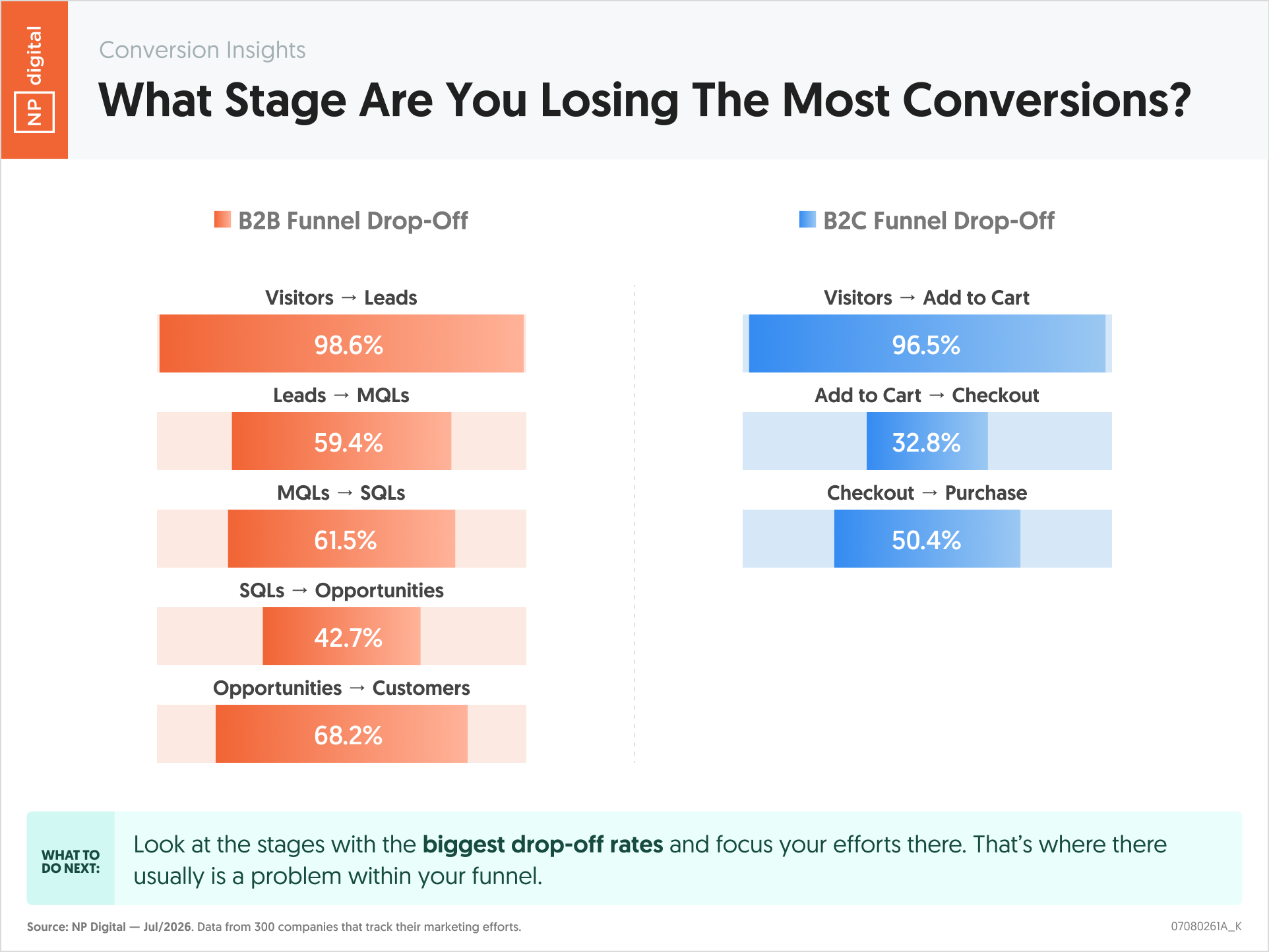
The largest conversion losses in both B2B and B2C funnels happen at the very first transition. This data from 300 companies maps drop-off rates at each funnel stage for both business models, and the numbers at the top of each funnel are stark. B2B loses 98.6 percent of visitors before generating a lead. B2C loses 96.5 percent of visitors before a product reaches the cart. Every other funnel stage operates on the fraction that survives those initial drops, which is why top-of-funnel conversion optimization produces the largest absolute revenue impact even when percentage improvements seem small.
Essential Statistics
- B2B funnel: 98.6 percent of visitors do not convert to leads, the largest single drop-off in the B2B funnel.
- B2B funnel: of leads generated, 59.4 percent do not become MQLs, representing the second-largest drop-off point.
- B2B funnel: 61.5 percent of MQLs do not become SQLs, and 42.7 percent of SQLs do not become opportunities.
- B2B funnel: 68.2 percent of opportunities do not convert to customers, the largest late-funnel drop-off in B2B.
- B2C funnel: 96.5 percent of visitors do not add a product to cart, the largest single drop-off in the B2C funnel.
- B2C funnel: of items added to cart, 32.8 percent do not reach checkout, and 50.4 percent of checkout sessions do not complete a purchase.
Key Takeaways
- The 98.6 percent B2B visitor-to-lead drop-off and the 96.5 percent B2C visitor-to-cart drop-off establish the primary constraint in both funnels. Every other optimization effort operates on the fraction that survives these initial transitions. Improving the visitor-to-first-action rate by even one percentage point produces a proportional improvement across every downstream stage simultaneously.
- The B2B opportunity-to-customer drop-off at 68.2 percent is the largest late-funnel loss and represents a stage where marketing and sales handoff quality, proposal effectiveness, and competitive positioning all converge. Despite the lower traffic volume at this stage, the high revenue concentration per opportunity makes it a high-priority optimization zone.
- The B2C checkout-to-purchase drop-off at 50.4 percent confirms that roughly half of all B2C checkout sessions fail to complete. This is one of the most-studied funnel stages in CRO and one of the highest-return optimization opportunities available to e-commerce teams. Friction reduction, trust signals, and payment option expansion at checkout are consistently the highest-return interventions at this stage.
- The B2B MQL-to-SQL transition at 61.5 percent drop-off reflects the qualification gap between marketing-defined and sales-accepted leads. This is often a lead quality problem rather than a conversion funnel problem, which means the solution may require aligning lead scoring criteria between marketing and sales rather than changing the conversion path itself.
- The B2C add-to-cart-to-checkout drop-off at 32.8 percent represents a significant friction point that often reflects price discovery issues, shipping cost surprises, or checkout initiation UX problems. Addressing these specifically, rather than optimizing the cart page as a whole, produces faster and more targeted improvements.
Actionable Insights
- Audit the visitor-to-first-action stage before optimizing any other part of your funnel. In B2B, the 98.6 percent visitor-to-lead drop-off means that a 0.1 percentage point improvement in that rate produces as much impact as a 10 percent improvement in any downstream stage combined. Map your top-traffic landing pages against their lead conversion rates and run your next test on the page with the highest traffic and lowest conversion rate.
- For B2C, prioritize reducing checkout abandonment above all other funnel optimizations. The 50.4 percent checkout-to-purchase drop-off means that half the revenue implied by checkout initiations is being lost at the last moment. Run a checkout friction audit that examines form length, payment option variety, shipping cost presentation, and trust signal placement before the payment step.
- Address the B2B opportunity-to-customer drop-off by reviewing proposal quality and competitive positioning rather than lead generation volume. A 68.2 percent late-funnel drop-off is typically a sales process and positioning problem rather than a marketing funnel problem. Gather win-loss data from recent lost opportunities before assuming the solution is more leads rather than better conversion of existing opportunities.
- Align marketing and sales on MQL definition to address the 61.5 percent MQL-to-SQL drop-off. High MQL-to-SQL drop-off typically signals that marketing is passing leads based on behavioral criteria that sales does not find credible. Reviewing the definition of a qualified lead together and adjusting lead scoring thresholds is faster and lower-cost than adding more lead nurture content.
- Use the B2C add-to-cart-to-checkout drop-off to justify a cart page UX audit. The 32.8 percent who add to cart but do not proceed to checkout often encounter a friction point on the cart page itself, whether it is an unexpected shipping cost, a confusing next step, or a trust signal gap. A dedicated cart page usability test with real users will surface the specific friction points faster than A/B testing alone.
”The biggest conversion loss in B2B happens before you even have a lead. The biggest loss in B2C happens before the product reaches the cart. Everything else in the funnel is a second-order problem. Fix the top of the funnel first, and every downstream improvement multiplies on a larger base.” – Neil Patel