 Sign In






 Ubersuggest
  AnswerThePublic
 Top PPC Performance Levers, Ranked by 200 Ad Managers
Info
-
Source: NP Digital
-
Date: May 2026
-
Category: Paid Ads
-
Study Methodology: Data from surveying 200 paid ad managers. Self-reported ranking of PPC performance drivers by active practitioners managing Google and Meta campaigns.
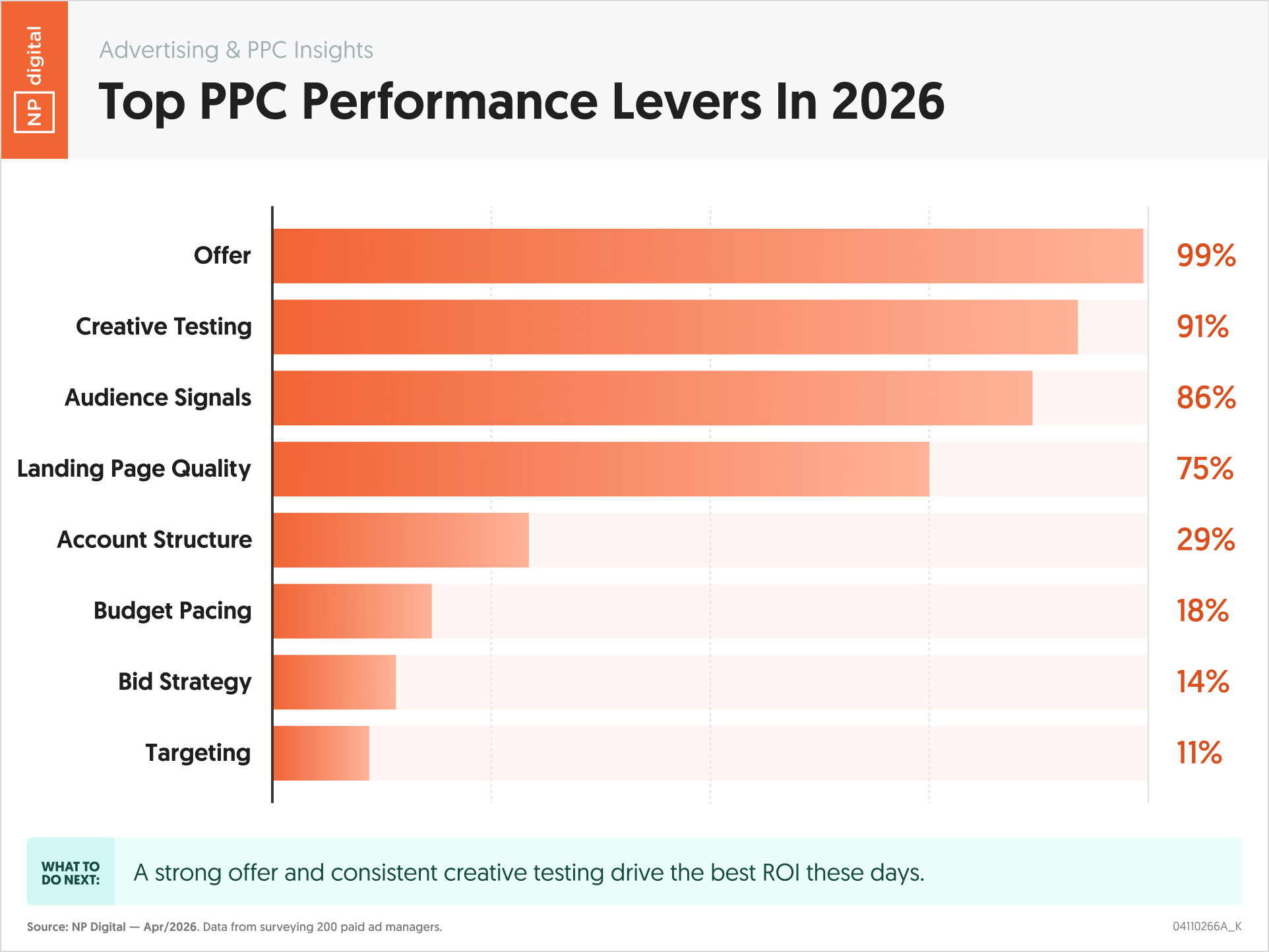
Two hundred paid ad managers were asked what actually moves the needle in PPC performance. The results cut through years of platform narrative about the primacy of bid strategy and automation. Offer quality, creative testing, and audience signals rank at the top. Bid strategy and targeting, the two variables that automation platforms most heavily promote, rank at the bottom. The data is a direct counterpoint to how most PPC budgets and team time are currently allocated.
Essential Statistics
- Offer ranked as the top PPC performance lever at 99 percent, the near-unanimous consensus among 200 surveyed paid ad managers.
- Creative testing ranked second at 91 percent, with nine in ten ad managers identifying it as a primary performance driver.
- Audience signals ranked third at 86 percent, followed by landing page quality at 75 percent.
- Account structure ranked fifth at 29 percent, the first lever with less than majority endorsement.
- Budget pacing ranked sixth at 18 percent, bid strategy seventh at 14 percent, and targeting eighth at 11 percent.
- The gap between the top four levers (75 to 99 percent) and the bottom four levers (11 to 29 percent) reflects clear practitioner consensus about where performance actually originates.
Key Takeaways
- The near-unanimous agreement on offer quality at 99 percent signals that experienced paid ad managers understand something most campaign optimizations miss: the offer is upstream of every other variable. A weak offer produces poor results regardless of how well everything else is optimized.
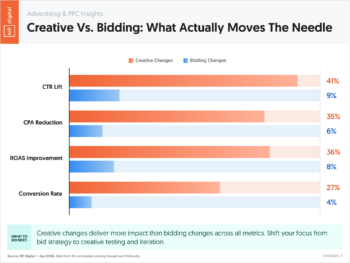
- Creative testing at 91 percent as the second-ranked lever aligns with companion data showing creative changes outperform bidding changes by a factor of four to six times across key metrics. Practitioners and performance data agree on where the leverage lives.
- Bid strategy at 14 percent is the most important finding for realigning team priorities. Despite being the focus of significant automation investment and team time in most PPC operations, bid strategy ranks seventh among eight levers by practitioner consensus.
- Landing page quality at 75 percent confirms that conversion rate optimization is a primary PPC performance lever, not a downstream activity. Ad managers who have seen their campaigns improve most dramatically consistently point to landing page changes as major contributors.
- The bottom four levers, account structure, budget pacing, bid strategy, and targeting, are all areas where automation platforms have invested heavily in tools and features. The practitioner data suggests those investments may be addressing the wrong variables relative to where performance actually comes from.
Actionable Insights
- Audit your PPC offer before auditing your campaigns. At 99 percent, offer quality is the most agreed-upon performance lever in the dataset. If your conversion rates are below benchmark and you have not recently tested a new offer structure, promotional angle, or value proposition, start there before adjusting bids, budgets, or creative.
- Reallocate team time from bid management to creative testing based on the practitioner consensus in this data. Bid strategy ranks 14 percent, creative testing ranks 91 percent. If your team spends more time on bid adjustments than on developing and testing new creative variants, that’s not effective use of your time.
- Add landing page quality as a standing agenda item in your weekly PPC review. At 75 percent, landing page quality ranks fourth among all performance levers. Most PPC reviews focus on campaign-level metrics and creative performance while treating landing pages as a static variable.
- Invest in first-party data infrastructure. The third-ranked lever requires data to work. Audience signal quality depends on the richness of your customer data, purchase history, engagement data, CRM lists, and lookalike foundations. If your first-party data infrastructure is weak, improving it will have a downstream effect on this lever before any platform-level optimization is possible.
- Deprioritize account structure changes as a go-to optimization when performance drops. If your instinct is to restructure campaigns when results soften, the data suggests looking at offer, creative, and landing pages first before making structural changes.
“The practitioners who run PPC every day at scale have voted with their rankings. Offer is number one at 99 percent. Creative testing is number two at 91 percent. Bid strategy is seventh at 14 percent. That is not what the platform automation pitch decks say, but it is what experienced ad managers have found to be true across real campaigns. Build your team priorities around that practitioner consensus.” – Neil Patel