 Sign In












Ad Fatigue: How CTR Decays Week Over Week
Info
-
Source: NP Digital
-
Date: April 2026
-
Category: Paid Ads
-
Study Methodology: Data from 50 companies running Google and Meta ads. Findings track cumulative CTR decay percentage week over week from a week-one baseline across active ad campaigns.
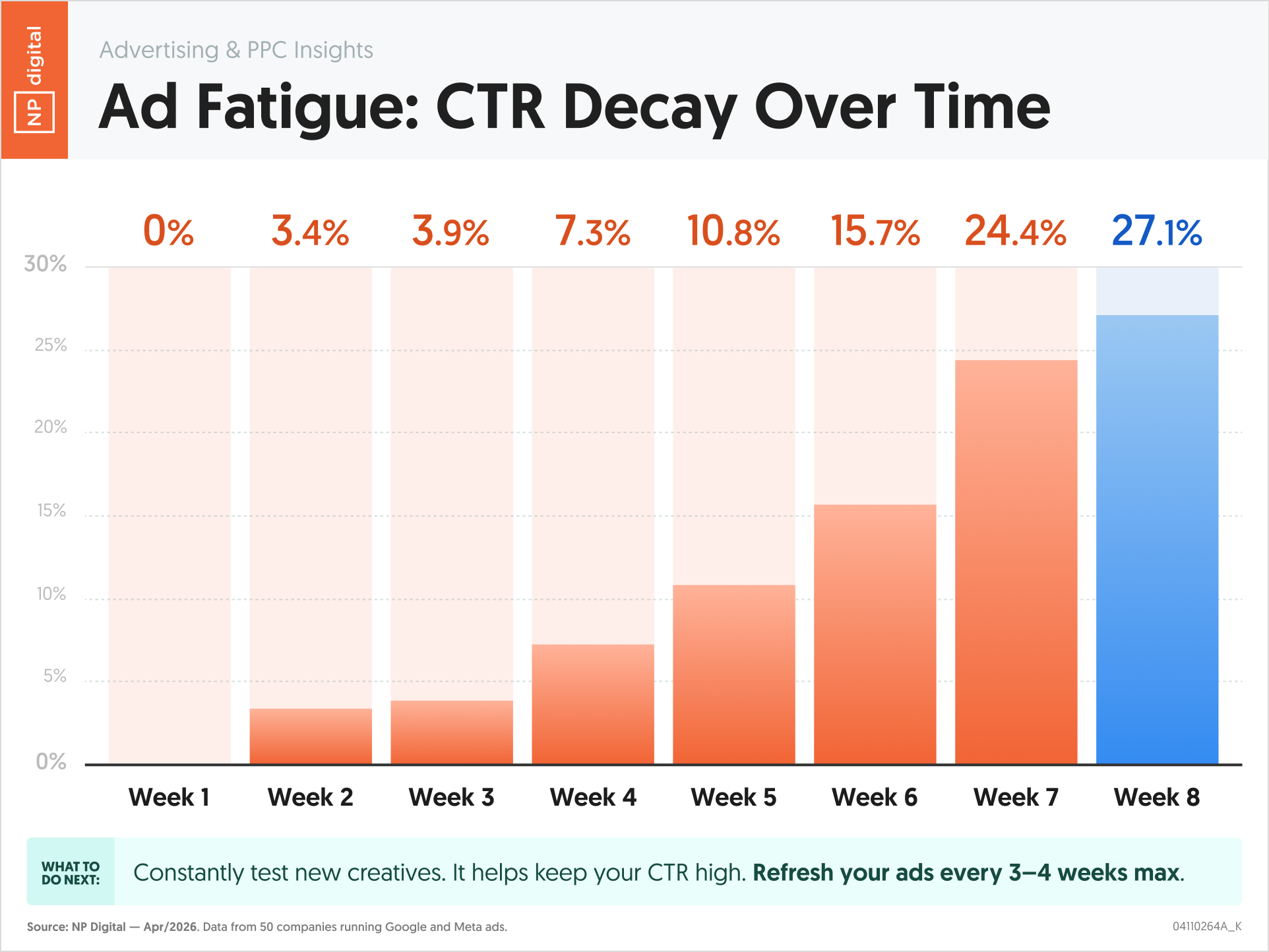
Every ad has a shelf life. What most paid teams underestimate is how quickly that shelf life expires. This chart tracks CTR decay week by week across campaigns from 50 companies on Google and Meta, using week one as the baseline. The decline is slow at first and then accelerates sharply, with nearly a quarter of original CTR lost by week seven and more than a quarter gone by week eight.
Essential Statistics
- CTR decay reached 3.4 percent by week two and 3.9 percent by week three, showing modest early decline.
- Decay accelerated in the second month, reaching 7.3 percent by week four and 10.8 percent by week five.
- By week six, cumulative CTR decay hit 15.7 percent, crossing the threshold where performance degradation becomes material.
- Week seven showed 24.4 percent cumulative CTR decay, a sharp acceleration from the prior week.
- By week eight, cumulative CTR decay reached 27.1 percent from the week-one baseline, representing more than a quarter of original click-through performance lost.
- The rate of decay roughly doubled between weeks five and seven, indicating an acceleration phase that begins around the five-week mark.
Key Takeaways
- Ad fatigue is not a linear process. CTR decay stays manageable through week four but accelerates sharply in weeks five through eight, meaning teams that check performance monthly are likely missing the inflection point where intervention would be most effective.
- A 27 percent CTR loss by week eight has direct cost implications. Assuming stable bid levels, declining CTR increases effective CPM and reduces conversion volume proportionally, compounding the budget waste of running fatigued creative.
- The acceleration pattern between weeks five and seven suggests a practical refresh window of three to four weeks for most campaigns. Creative refreshed before week five avoids the steepest decay slope.
- Teams that rotate creative on a monthly cadence are systematically running into the worst phase of the decay curve before taking action. Weekly CTR monitoring is necessary to catch the inflection point this data reveals.
- Higher-frequency audiences and retargeting segments likely experience steeper decay curves than the averages shown here, making the three-to-four-week refresh window a conservative estimate for those audience types.
Actionable Insights
- Set a creative refresh trigger based on week-over-week CTR change, not a fixed calendar date. The decay curve in this data accelerates between weeks five and seven. A trigger set at 10 percent week-over-week CTR decline will catch the inflection point before it becomes a 27 percent cumulative loss.
- Audit all currently running ads for flight duration. Pull every active creative and sort by days live. Any ad running for 28 days or more is likely past the point where this decay curve shows meaningful CTR loss. Flag those for immediate review and replacement based on their current week-over-week trend.
- Build a creative refresh queue that always has new variants ready before you need them. The 27 percent CTR loss by week eight happens because teams run out of tested creatives to rotate in. Maintaining a library of approved but undeployed variants means you can refresh on schedule rather than scrambling to produce new creative under performance pressure.
- Run higher-frequency audiences on shorter refresh cycles than standard prospecting campaigns. Retargeting audiences see your ads more often, which compresses the decay timeline. If standard campaigns need a refresh at three to four weeks, retargeting segments likely need one at two to three weeks to maintain the same CTR performance.
- Use the week-five acceleration point as your planning milestone for creative production. If a campaign launches on day one, brief and approve replacement creative by day 21 so it is ready to enter rotation at day 28, before the steepest part of the decay curve hits.
“The decay pattern here is what makes ad fatigue so expensive. The first four weeks look fine, so teams do not act. Then weeks five through eight happen and you have lost more than a quarter of your CTR before anyone notices. The fix is not reacting faster. It is refreshing before the curve turns.” – Neil Patel