 Sign In









Clicks. Leads. Customers.
We’re always looking to get more from our marketing efforts. If you haven’t been using Google Ads pay per click (PPC) ads to drive targeted traffic to your landing pages, you may be doing yourself a disservice.
More clicks translate into more visitors, leads, and customers for your business.
And, it can happen pretty quickly, when you avoid all of the mistakes that leave advertisers broke and learn how to set up high-converting Google Ads.
The truth is that if you’re just starting out in content marketing, creating free content alone will not get you the best results.
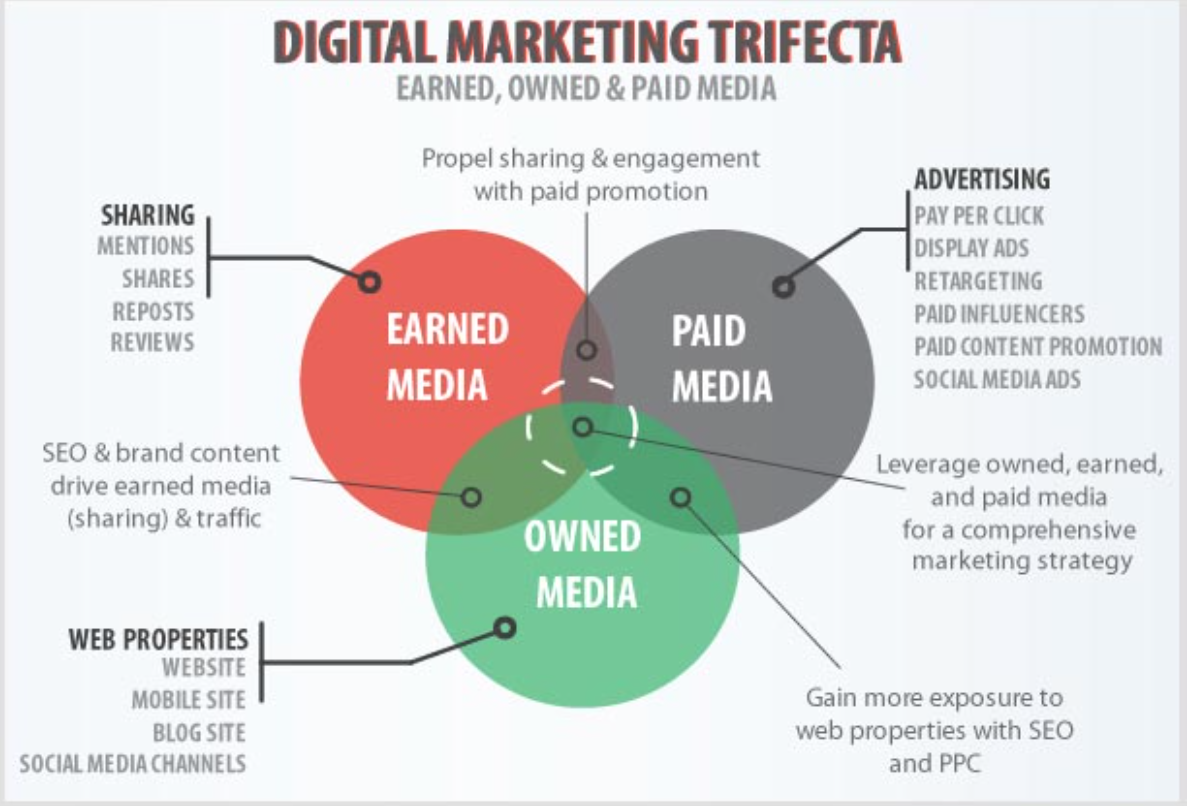
Instead, grow your business by combining the digital marketing trifecta: earned, owned and paid media.
I frequently offer a free PPC check for my clients. On many occasions, I’ve seen clients who are making fatal mistakes with their PPC campaigns, whether it’s in their ad copy or their landing page. Their quality score is often below its potential.
For example, a lot of Google Ads advertisers still send traffic to their homepage with no intention of capturing email addresses and nurturing the leads that result.
According to Eric Siu of Single Grain, another terrible mistake many advertisers make is not measuring their ROI. Imagine running an ad for 7 days with no way to check the profitability of your campaigns. Would you invest more money into it? In short, measuring your conversion tracking is a must.
In this in-depth article, you’ll learn the deadly mistakes that will frustrate your efforts with Google Ads PPC.
In addition, I’ll show you how to fix every single one of your Ads mistakes, so that you can write insanely effective Google Ads that’ll generate ready-to-buy leads for you.
Note: To get more help, try applying for the Google Partner program.
Mistake #1: Not Using the Right Keyword Matches
There are three categories of keywords that every Google Ads advertiser should be familiar with:
- Broad match
- Phrase match
- Exact match
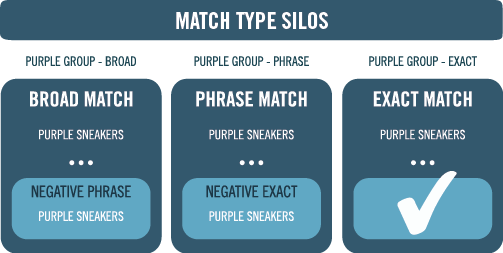
The mistake people often make is using the wrong keyword match type.
Google lets you run your ads in any of the keyword matches above. It’s your sole responsibility to decide which one(s) to use. So, let’s explore each of the keyword matches:
i). Broad match: When you add broad match keywords, your ads will show when people search for your given keywords. Your ads will display regardless of the order of the words in the search string.
So, if you run ads for best ogio bags, your ads will show for a broad match for best ogio bags, ogio bags best, best ogio bags to buy, ogio bags for best golf, etc.
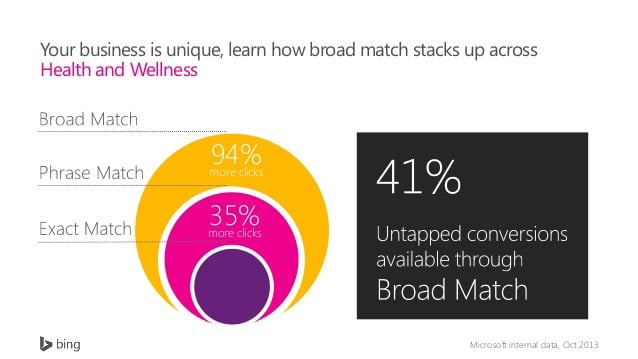
There’s a lot of potential when you target broad match keywords. For example, in the health & wellness industry, you’ll generate 94% more clicks if you’re targeting these broad match keywords.
A broad match keyword also means that your ads will show regardless of what the prospect intends to do. Even if they aren’t ready to buy your product, as long as they mention a few of the words that you’re targeting, your ads will display for them. In summary? Don’t underestimate the power of a broad match keyword when creating your ads.
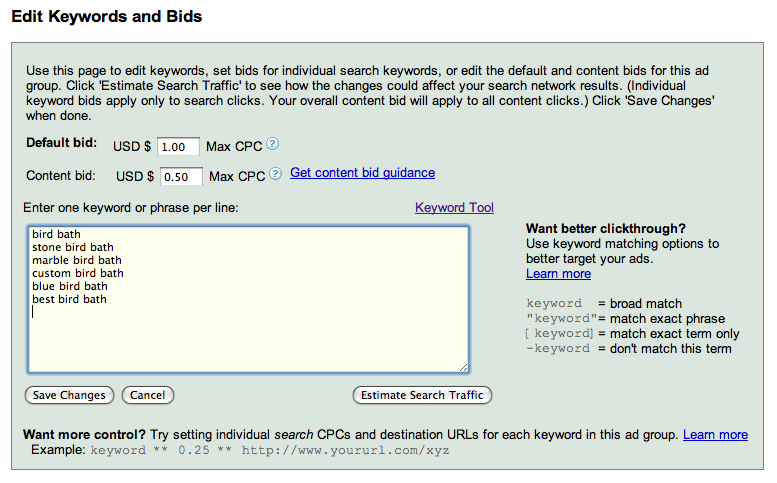
To enter a broad match keyword, just add it and don’t use any form of punctuation – no double quotation marks, no parentheses, no single quotation marks.
There is also the modified broad, which means that instead of having nike shoes, you’ll target broad match keywords such as black nike shoes, blue nike shoes for women, etc.
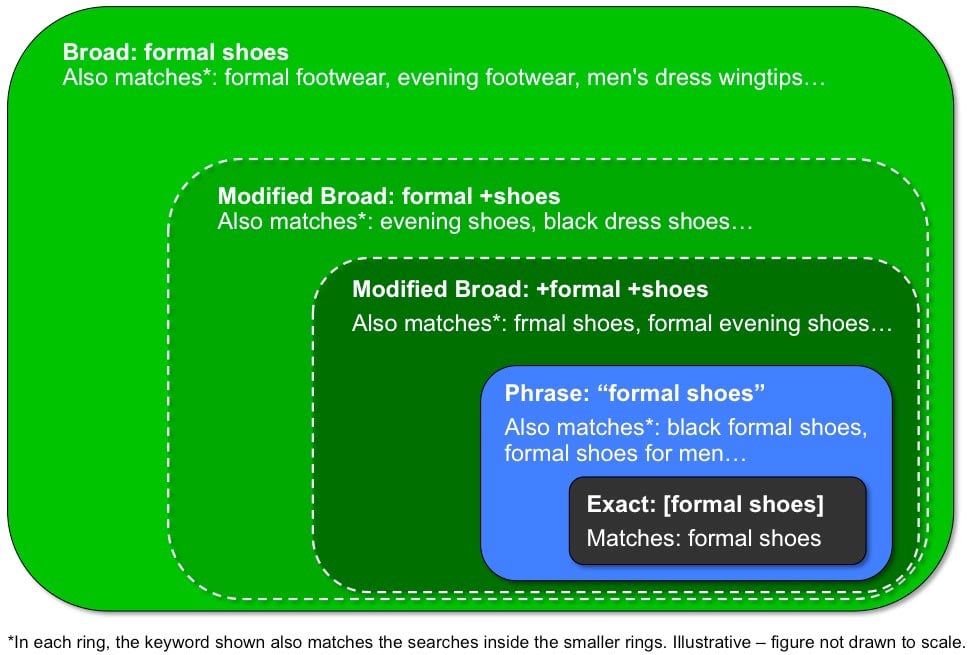
ii). Phrase match keyword: When you target phrase match keywords, your ads will appear when people search for your keywords in that exact order.
For example, if your phrase match keyword is best electric blanket, your ads will only show if people type in best electric blanket.
Sure, your ads can appear for other related keywords, but the individual words have to be in that order. So, your ads will also show for where to buy best electric blanket, etc.
If you want to enter a phrase match keyword, enclose it in double quotation marks, like this,: “best electric blanket.”
iii). Exact match keyword: With exact match, your ads will only display when the exact keyword that you’re targeting is typed in as a search term.
Still using the best electric blanket keyword above as our example, your ads will not show up when people search for best electric blanket online or where to buy best electric blanket.
To add an exact keyword match, simply enclose the keyword in a squared bracket, like this: [best electric blanket]
According to this research study, exact match keywords convert better than broad match and phrase match keywords, but the number of average monthly keyword searches is usually lower than broad.
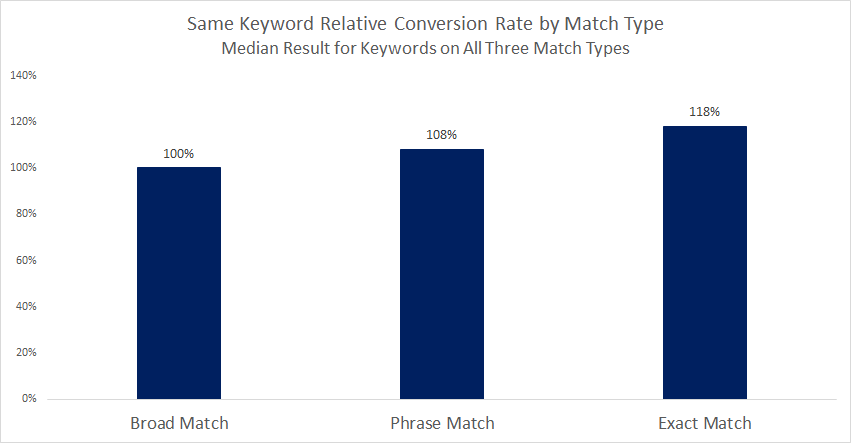
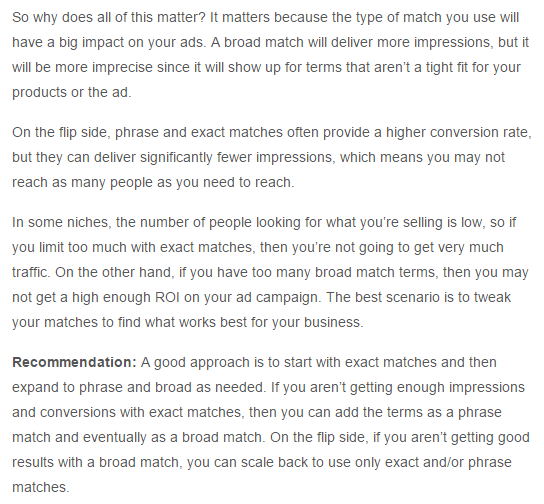
So, you’ve got to be strategic about your keyword selection and the match type (broad, phrase, or exact):
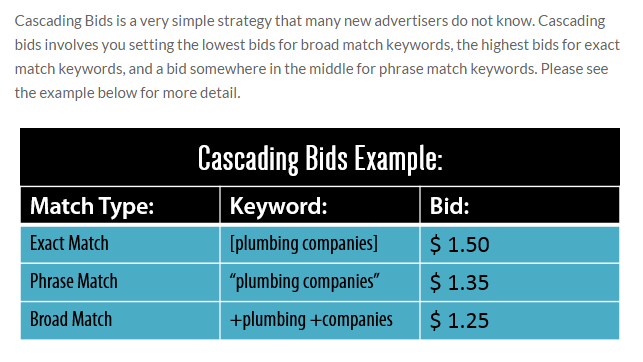
One last tip: If you want the best results, combine the 3 keyword matches -again, broad match, phrase match, and exact match- and bid strategically using a system known as cascading bids. Here’s how it works:
Mistake #2: Lack of Ad Extensions and Poorly Written Ads
You could master match type but still not see results.
One of the reasons?
Not having or optimizing ad extensions–both Ads mistakes that can be avoided.
Google has made it easier for you to write better ad copy and adjust your settings to yield the best ROI. With ad extensions, you can use sitelinks, call and location extensions to enhance your ad.
And, it’s all on your Ad Extensions tab, when you log in to your Ads account.
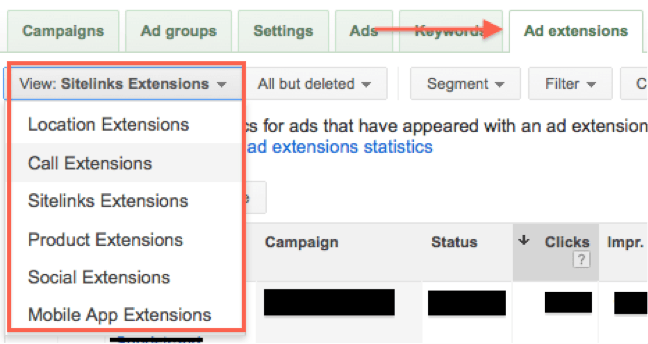
This simply means that you’ll add extra pieces of information or links to your ad. It’s like the rich snippet that you add to your organic listings. You’re giving customers more reasons to click your ads.
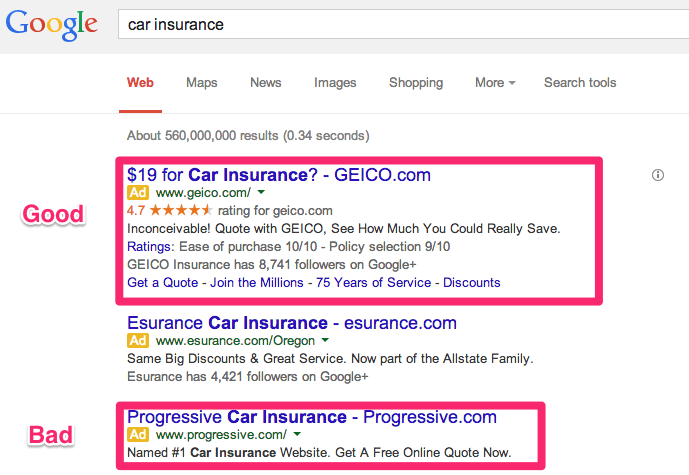
Using ad extensions can be very effective at increasing clicks. Take a look at these extensions:
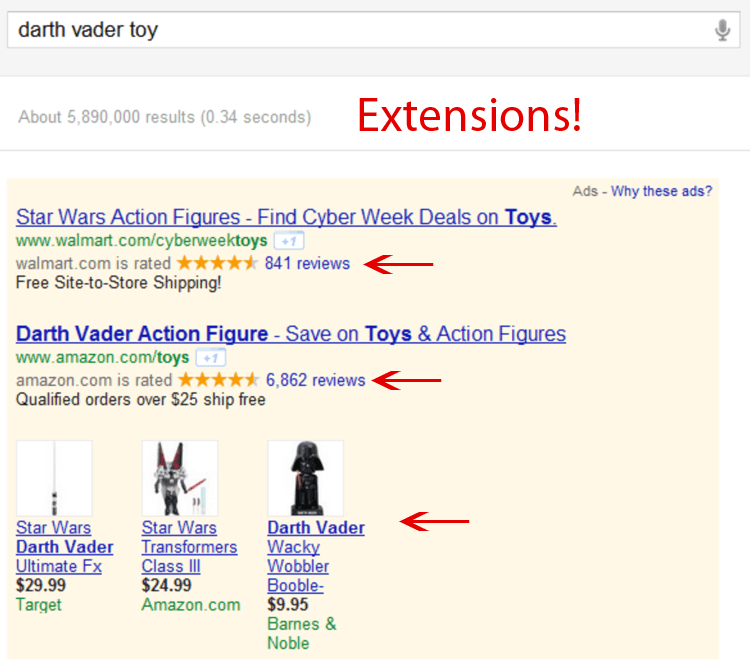
The ad below uses location, phone and sitelink extensions.
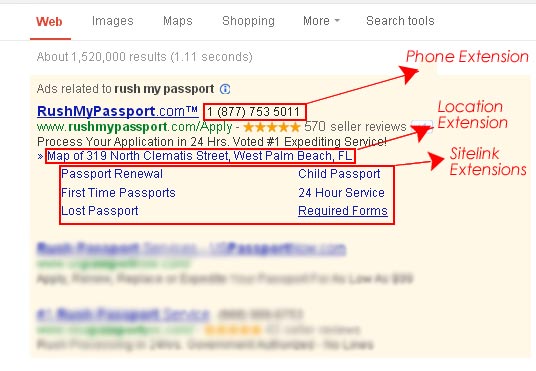
The right ad extensions will ultimately increase your click rate. The challenge is to ensure that your landing page is high-converting, so that when visitors get there, they’ll easily find what they’re looking for.
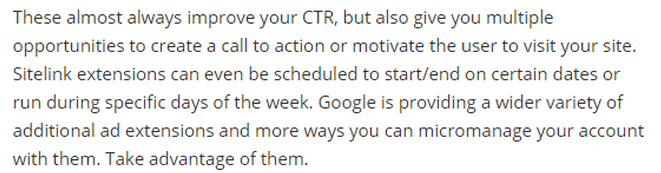
Writing compelling ad copy is a lot like writing a blog post headline. If you want to write powerful headlines, you’ve got to model what works. Likewise, if you want to write enticing ad copy, you’ve got to understand what’s effective.
You also have to use the opportunities and tools that are available to you. If you were doing search engine optimization, rich snippets would increase your search CTR. The best option that’s closely related to rich snippets for PPC ads is ad extensions.
Make sure to always use the right ones, because the wrong ad extensions won’t appeal to your users and might even scare them away.
Mistake #3: Not Understanding Profit Margins and Conversions
When you’re running a business – even in the offline world – you have to conduct conversion tracking and track your profit margins. You do this because you want to improve your revenue, not just your short-term profit.
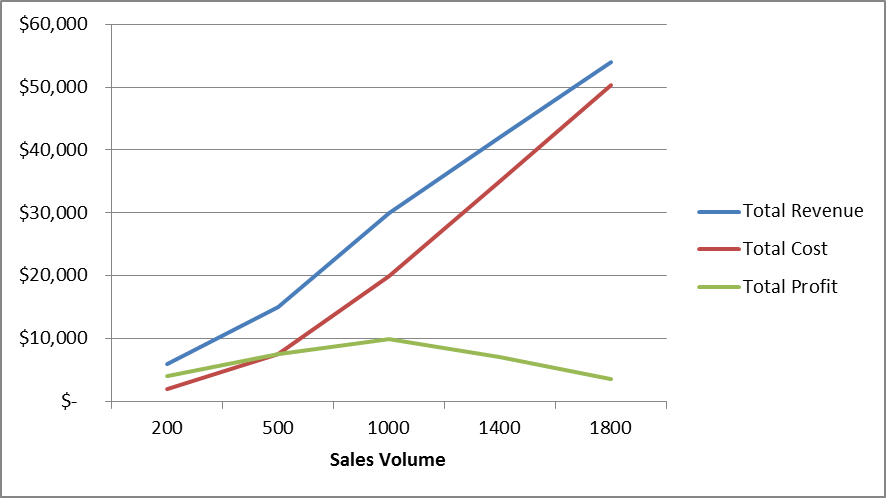
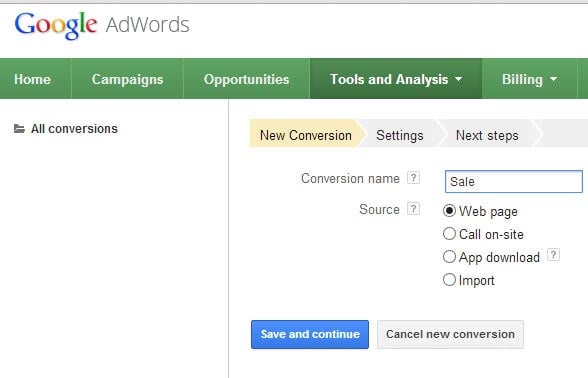
The same applies to your PPC ads. You should set up a conversion for inquiries or sales from the “Tools and Analysis” menu option > add new conversion:
You can actually save money when you understand how much you’re expected to make and what conversion rate will get you there. So, you could easily use this simple formula to calculate profit margin for your Google ads campaign:
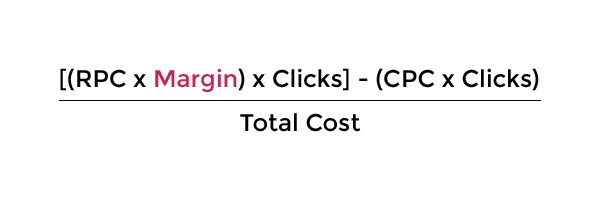
Let’s plug in a few numbers and calculate the profit margin to see how this formula works:
Cost per click – $1.00 Revenue per click – $10.00
Profit Margin – 0.3 Clicks – 1000
Sweet Tooth – $149
Here’s Sweettooth’s Ads ROI comparison:
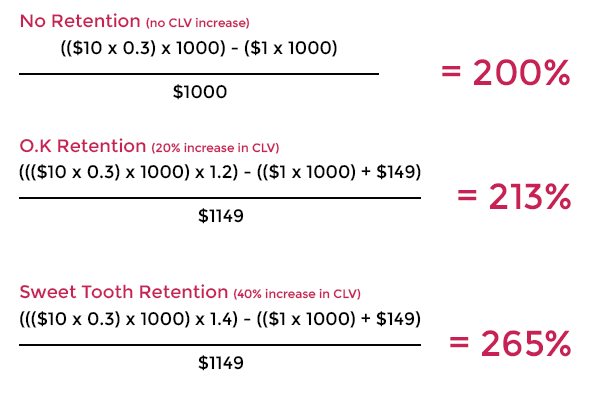
Remember that the profit margins above may not apply to every industry. You’ve got to know what works in your industry and test it out for yourself to be sure. In all, having an estimated profit margin is a great way to set up a winning Google Ads campaign.
Mistake #4: Not Using Negative keywords
Not using negative keywords is one of the biggest Ads mistakes I see.
Google processes over 6 million keywords every day and 15% of them are 100% new – that is, keywords that Google hasn’t registered yet.
This means that some of these keywords will be high-quality, while others will be detrimental to bid and target.
By using a negative keyword, you can exclude keywords that aren’t a good match for your product or service. Doing so can lower your cost and increase your revenue.
Many Google advertisers make the mistake of ignoring the importance of compiling a negative keyword list and then wonder why their ads aren’t converting the way that they’re supposed to.
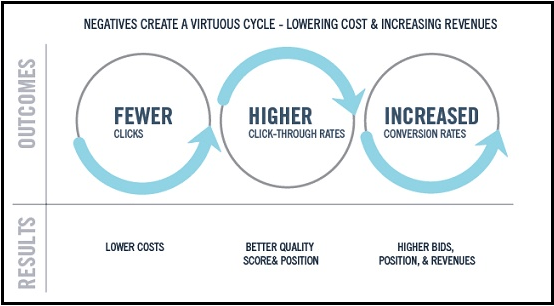
Negative keywords are the easiest way to reach the most targeted customers, reduce your costs and boost your ROI.
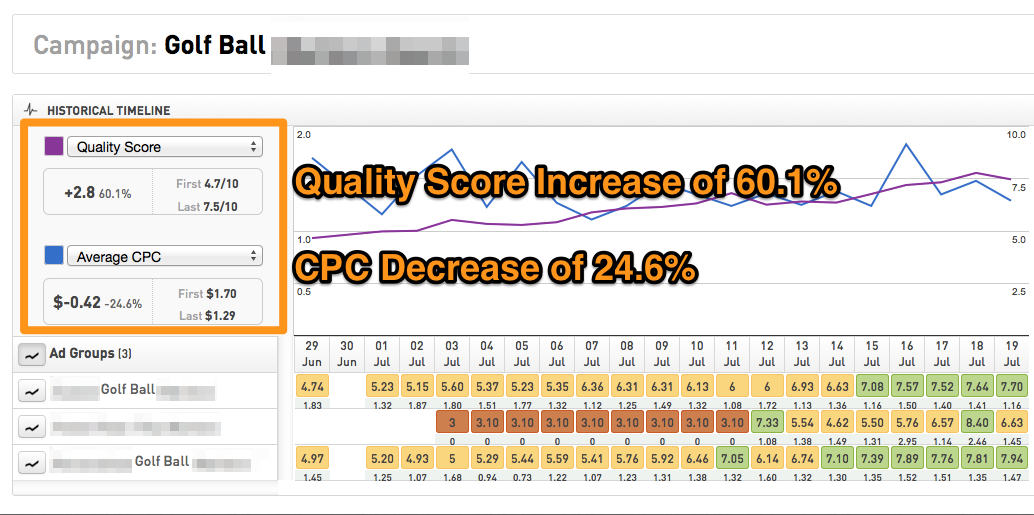
It also helps you increase your Google Ads quality score. For example, Search Scientists increased their client’s quality score by 60.1% and decreased CPC by 24.6%.
Suppose you run a website related to job placement. You could target profitable and commercial keywords such as engineering careers, technical career placement and long term careers.
You’re spending money for these clicks and you deserve to earn money back from them.
When you target a keyword like “jobs,” the people searching for that keyword may be looking for something short-term versus a career. Therefore, adding the word “job” or “jobs” to your negative keyword list will keep these people away.
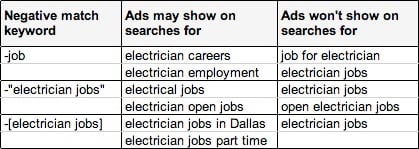
1). The essence of negative keywords: Why would you allow your ads to be shown to people who aren’t interested in your offer? This is how the concept of a negative keyword works.
Here’s a typical example: When I typed the keyword “small business programs” into Google, I saw an ad from Shopify advertising commerce software.
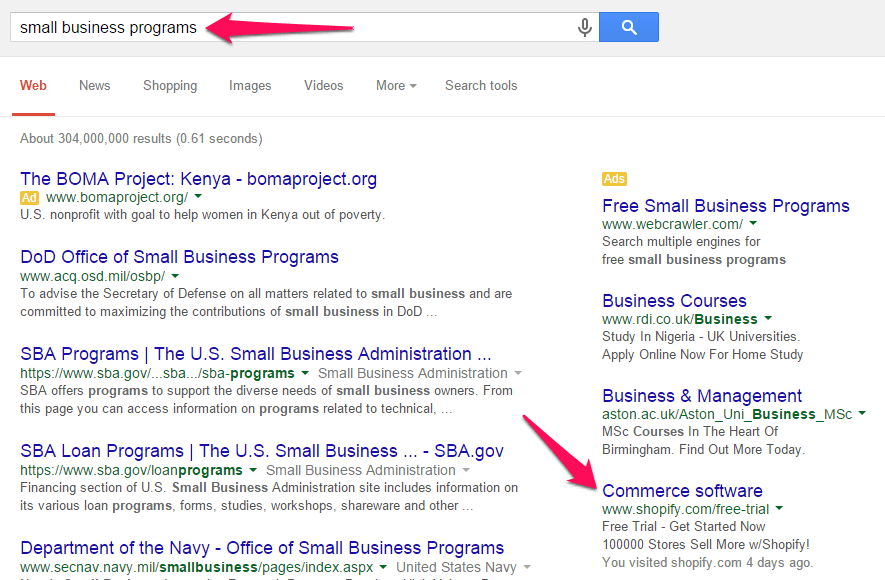
Trust me, this ad is totally irrelevant to the keyword. People who are looking for small business programs are probably not looking to start an online store.
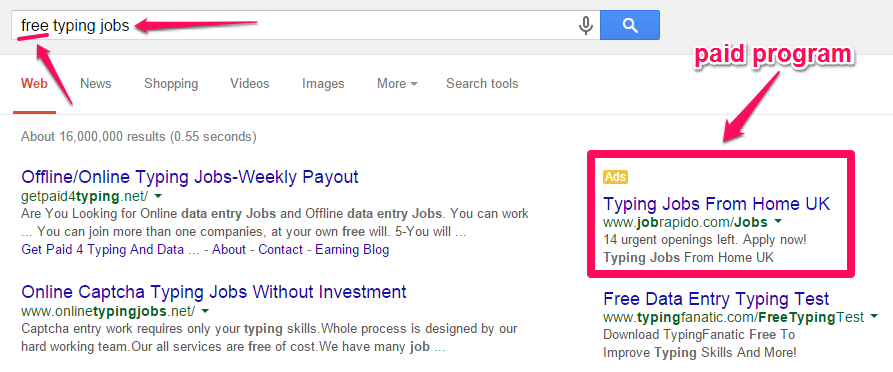
When I searched for free typing jobs, I saw lots of ads. But, when I clicked the one that resonated with me, I landed on a page that requested payment. I wasn’t looking for paid programs, only free ones.
Is your audience willing to buy from the first contact with a product like yours? If so, your select keywords will produce results.
Let’s say that you’re selling an information product (ebook) for starting a business. You would most likely include keywords such as:
- start a business
- free ways to start a business
- start a business at home
- start business cheap
- free business ideas
If you include “free, cheap” in your ad, it means that your ads will show up when people who are only interested in free information use keywords that include the word “free.”
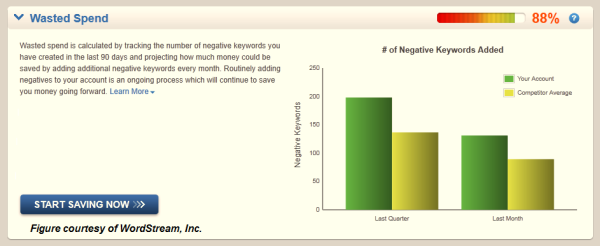
On the other hand, if you add the same keywords, “free, cheap,” to your negative keyword list, when people are searching for free information in your industry, your ad won’t show up and you won’t have any wasted spend.
2). Effect of negative keywords on Display Networks: If you set up your Google Ads to appear on both search and display networks, your negative keyword list will help you increase your conversions.
For example, Adapt Partners reduced the ad spend of their client company by 40%, while maintaining conversion volume and brand visibility. How did they do it?
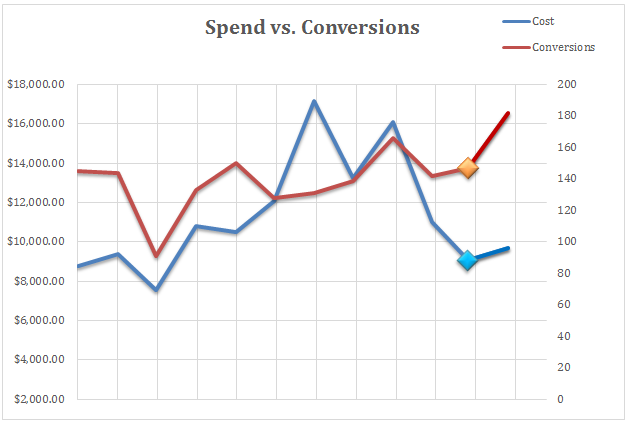
They aggressively used negative keywords, optimized the keywords on display networks, tested their ads and used strategic bidding techniques to achieve those tremendous results.
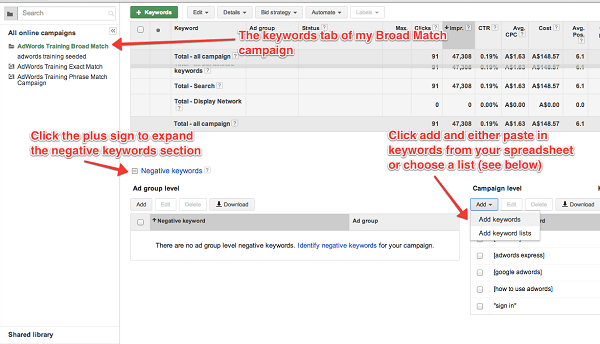
To add your negative keyword list, just click the [-] sign to expand it.
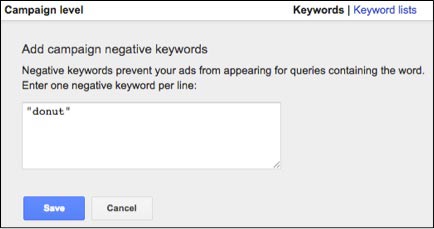
Paste your negative keywords into the space provided:
Finally, no matter what your industry or niche, start with these negative keywords:
- free
- porn
- cheap
- nude
- naked
- torrents
- youtube
- craigslist
- ebay
- kijiji
- sex
- porno
- torrent
Mistake #5: Not Bidding on Your Own Brand
You should bid on your own brand name keywords, in order to increase conversions. Along with that, though, you have to pay attention to your brand’s value.
A study by Loyalty360 found that 66% of U.S. customers are willing to pay more for a product if the brand delivers a positive customer experience. So, you’ve got to always strive to increase the value of your brand. Here’s how Pieppiermc.com explains it:
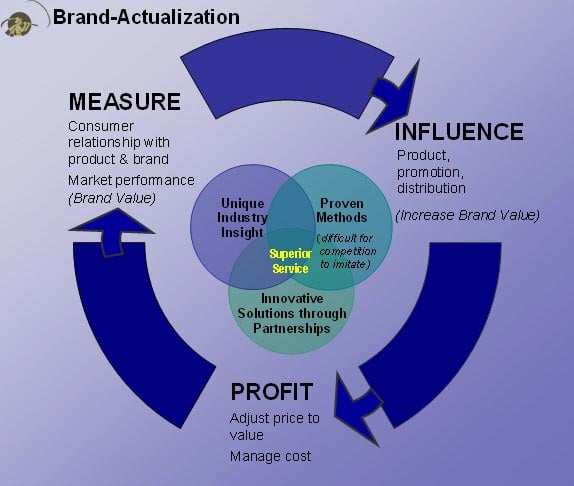
Delivering a consistently positive customer experience can be achieved through SEO and PPC advertising. Use every opportunity and tool available to you to project your brand, because your brand is you.
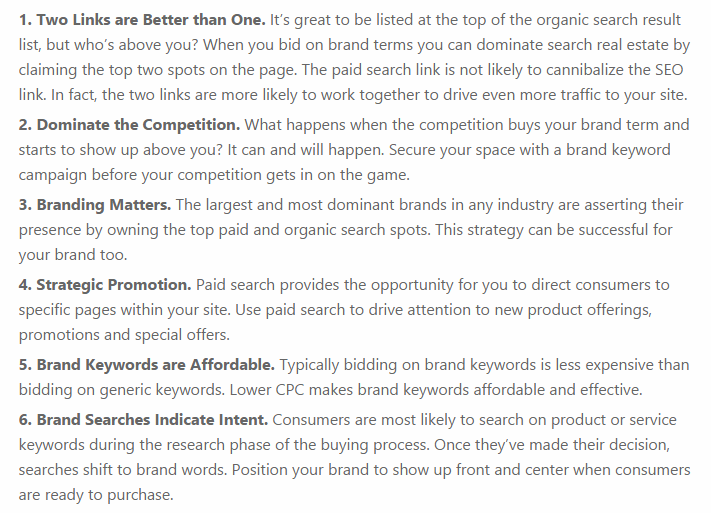
Here’s the importance of bidding on brand search terms:
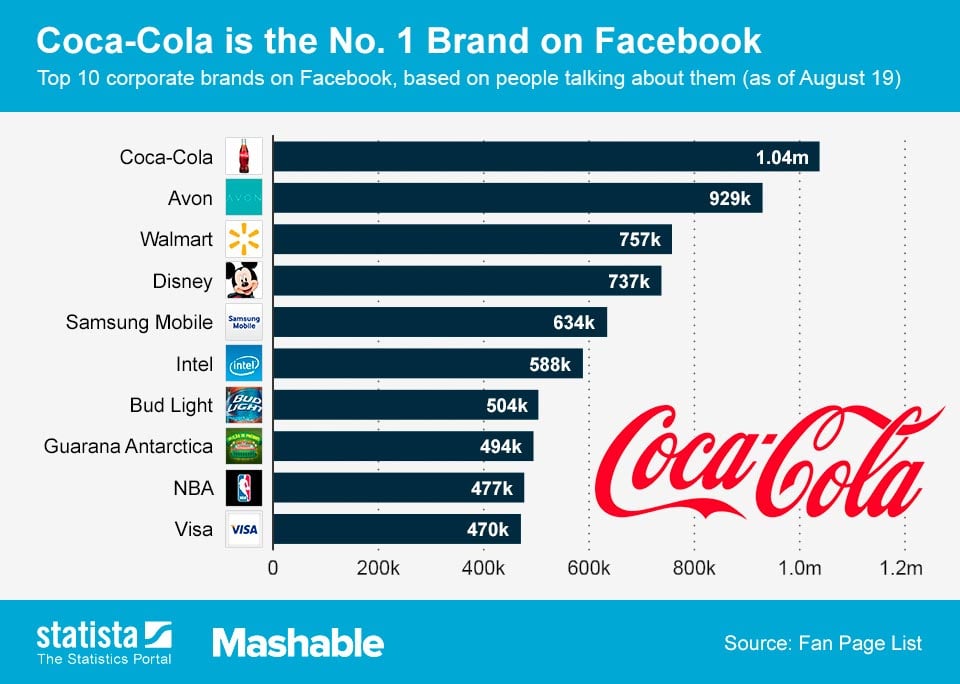
Coca-Cola is the #1 brand on Facebook, because they promote the brand using every available app, as well as their current fanbase. You can and should promote your own brand by bidding on its related terms through Google Ads PPC.
When you bid on your own brand, you’re promoting your business and reaching out to your social media fans and customers.
Advertisers who make the mistake of not bidding on their own brands have seemingly solid reasons why they’re ignoring the opportunity:
- My brand keyword doesn’t get much traffic
- The search volume for my brand keyword is low
- Our brand is ranking #1 right now, so there’s no need to advertise it
All of these are good reasons, but they can still hinder you from growing your business and running a successful campaign. It’s not necessarily about clicks, visitors and impressions – it’s really about revenue.
My own brand keywords have a decent search volume, with a handful of brand keyword variations. Take a look:
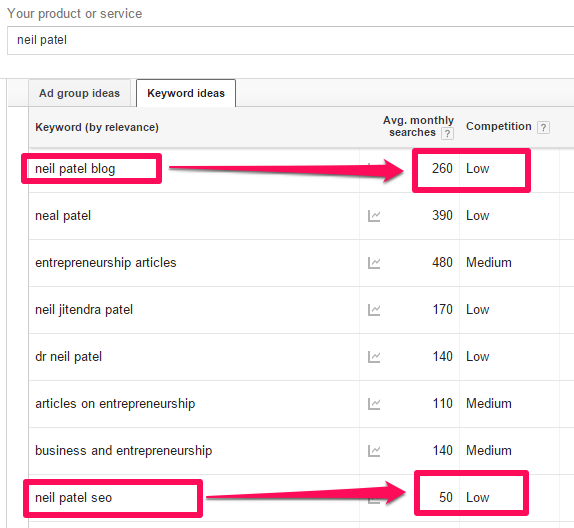
“Neil patel” is searched over 4,000 times per month and the suggested bid is just 0.16, which is great.
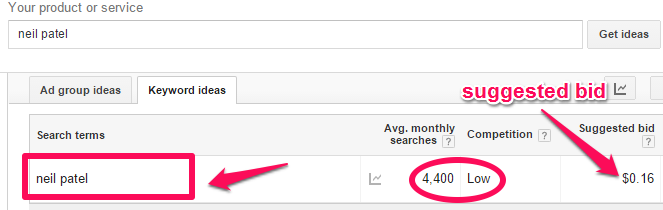
Imagine how much traffic and how many conversions I’d lose by not bidding on my own brand. After all, when someone types your full name into the search engine, it usually means the person already knows and trusts you.
Having customers search for your brand (either your name or domain name) is a great indication that you’re doing a good job. And, according to Forbes, 80% of the revenue of most companies come from 20% of their customers – the ones who are loyal to the brand.
What about your company or business brand? Let’s see how many times my domain name is searched for in a month:
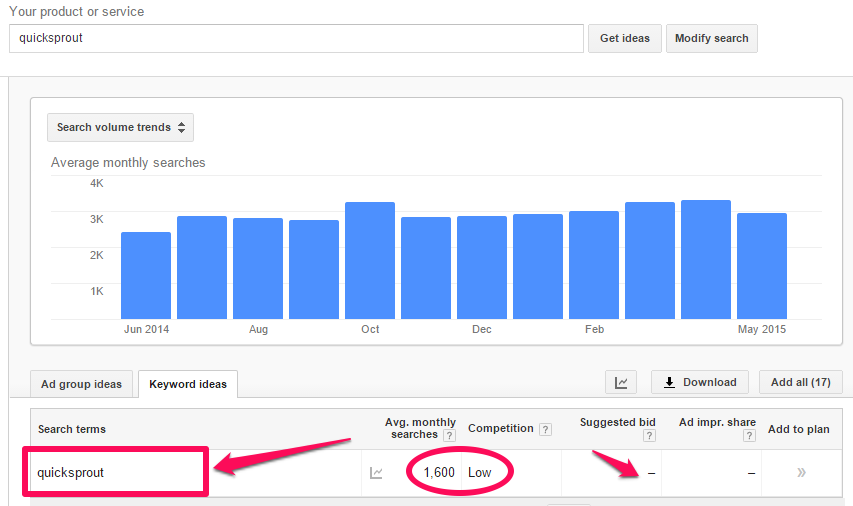
Quicksprout is searched 1,600 times per month. And, Google hasn’t suggested a bid yet. This means that I can easily bid 0.10 – 0.20 per click and drive an insane amount of traffic to my blog, digital marketing university or services page.
Marie Forleo also has a lot of opportunities to bid on her own brand keywords, if she decides to run a campaign. Take a look:
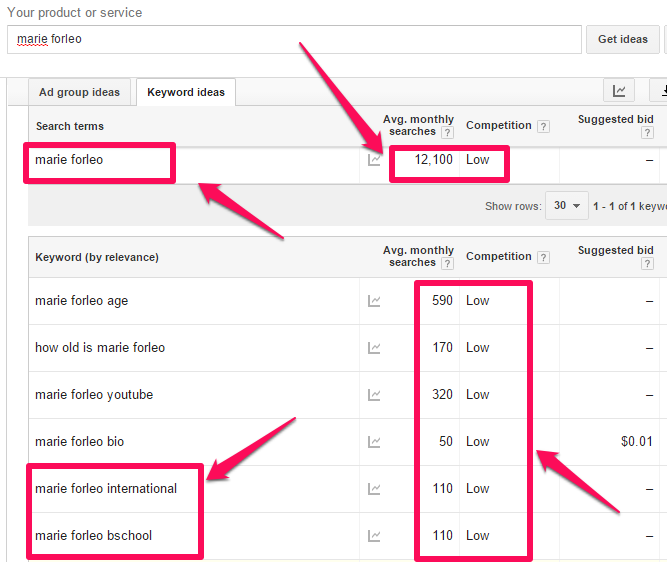
Did you notice that “marie forleo bschool” is searched 110 times in a month? Bschool is Marie’s flagship training course. The fact that people are searching for it means that they’ve either heard about the program from someone they know or they’re Marie’s customers.
The probability of selling to these people is high. According to Econsultancy, the probability of selling to a prospect is 5%-20%, whereas the probability of selling to existing customers is 60%-70%.
1). Prevent competitors from hacking your brand: When you bid on your own brand, you’re also preventing competitors from poaching your business. More importantly, you’re strengthening your brand.
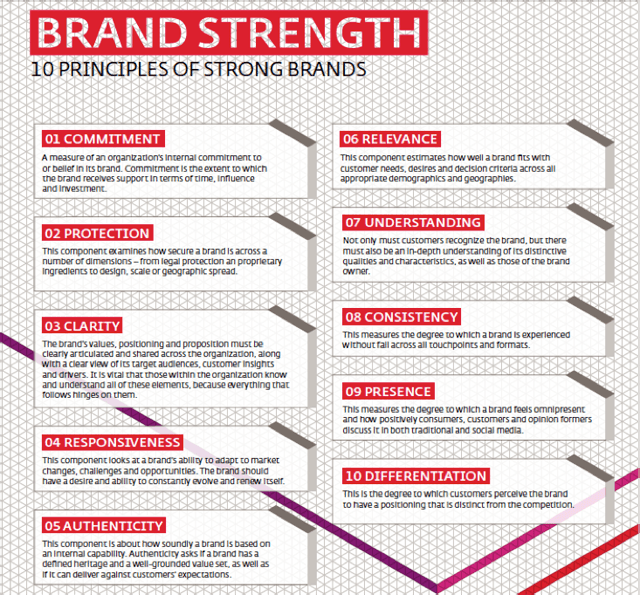
The harsh truth is that if you’re not bidding on your brand, others will. And, these people will probably be your competitors who wouldn’t hesitate to take advantage of your oversight to hijack your prospects and visitors to their sites.
You may continue to rank #1 in Google for your main keyword, but if your competitors poach your brand keyword, they can get ahead of you in organic search.
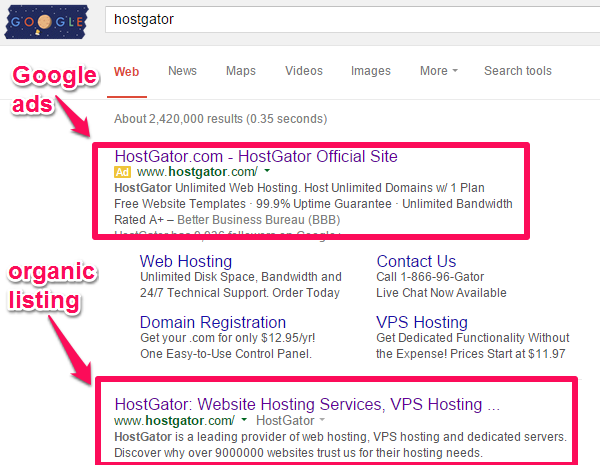
The beauty of bidding on your own brand is that you can often bid very low and still drive a lot of targeted clicks and visitors to your landing page.
Pro tip: When bidding for your own brand name, you should aim for the top, since people who are searching for your brand are the most targeted visitors that you’ll ever get.
Instead of settling for low bids that’ll keep you at the bottom, increase your bid in order to stay at the top and get the majority of the clicks. Spend the most on branded search terms, because they convert very well.
2). Reduce Customer Turnover: Another important aspect of advertising for brand name keywords is the huge improvement that you’ll see in your customer turnover rate.
In the book Leading on the Edge of Chaos, author Emmett C. Murphy expanded on the 10 key elements for success in critical times. He highlighted the fact that when you reduce customer turnover by 5%, it leads to a profit increase of 25%-125%.
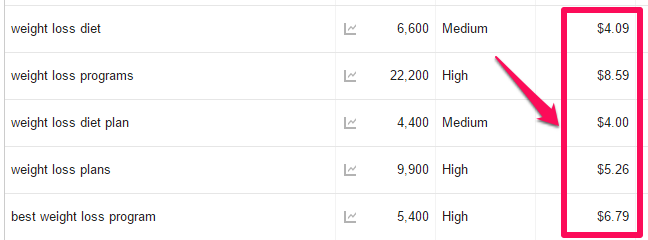
If you’re an internet marketing coach who’s targeting popular keywords, such as internet marketing, online marketing and more, you’re expected to bid $16.61 per CPC (cost per click).
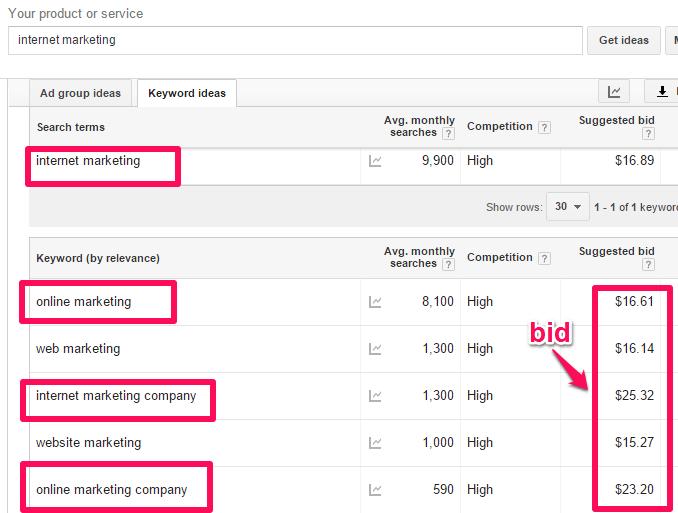
If you get 10 clicks, that costs you over $160, 100 clicks will cost you more than $1,600 and so on. And, the odds you can convert those prospects searching for “online marketing” into paying customers are very slim.
That’s because the search term is not well-defined. These prospects are still in the awareness stage of the customer buying cycle. Consequently, they’re not yet ready to buy.
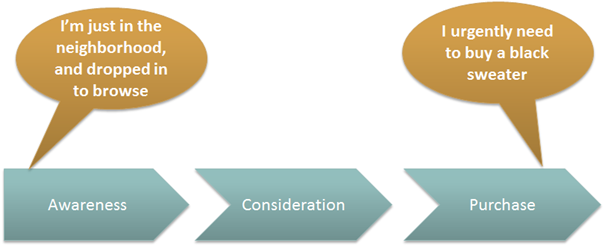
On the other hand, if you’ve been marketing online for quite some time now, your brand has probably gained some momentum.
Consequently, people will be searching for it. Instead of bidding $16.61 and above for keywords related to internet marketing, for example, you could bid for keywords that are closely tied to your product, blog or brand name. Here’s an example, using John Chow:
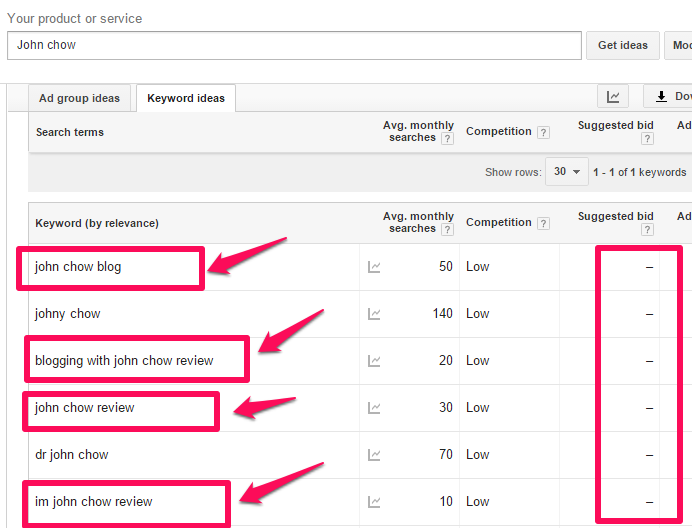
Apart from the first keyword in the screenshot above (john chow blog), every other keyword highlighted in red is a money term. People who are searching for them are likely to be more ready to buy.
Those keywords are for John’s video products, which he sells through Clickbank and other third-party affiliate networks. Although the keywords have fewer than 600 average monthly searches, the fact still remains that John can drive qualified clicks and buyers to his sales page.
Before you set up your next Google ad, use the Google Ads Keyword Planner to find brand name keywords that you can target.
Remember that when you use negative keywords, you’re telling Google not to show your ad to people who are searching with that word or on any display network that actively targets that word (e.g. free, cheap).
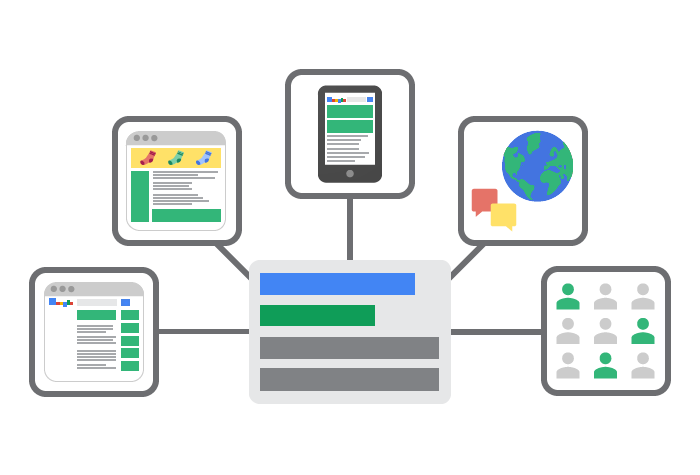
But, when you bid for brand keywords, you’re telling Google to show your ads to prospects and customers in both search networks, when the keywords are searched and in display networks, when your brand name is used in the content (e.g. product review or company news).
Customers want convenience. They want brands that are well represented, at all times. And, losing customers to your competitors is one of the biggest nightmares of internet marketing.
Mistake #6: Not Knowing Your Customer Lifetime Value (CLV)
Do you know the lifetime value of your customers? If you don’t, then you’re wasting both time and money.
How much are you going to spend on Ads to acquire one customer? There’s no utility in guessing. Instead, eliminate the guess work and assumptions by calculating your Customer Lifetime Value.
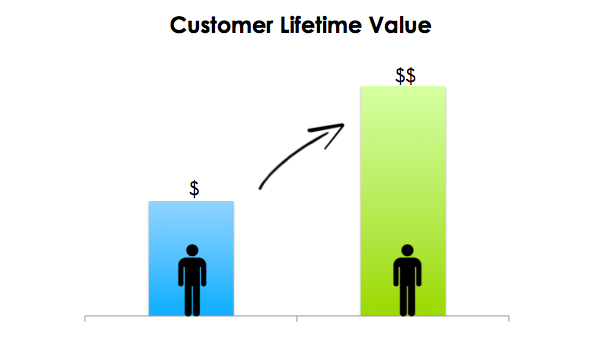
The CLV of your customers is basically how much money a customer is expected to generate over the lifetime of their engagement with your brand.
Here’s how Wouter van der Heijden defined it:
CLV is the Key Performance Indicator that determines the value of a customer. This determines how much you can spend to recruit customers on the long term, keeping in mind the return purchases of the customer.
The lifetime value of a customer is much more complex than ROI (return on investment). But, they are dependent on each other to grow your revenue and your business.
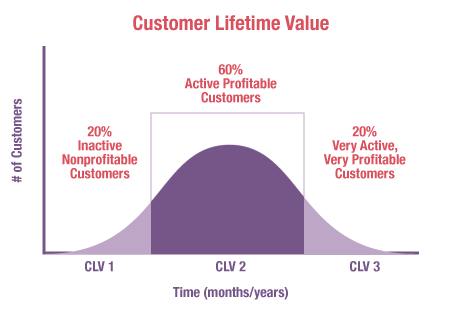
When you’re aware of the customer lifetime value, you can easily adjust your campaigns and bid on the strategic keywords that will drive the right prospects and customers to your landing page.
In this must-read article, David Skok, a venture capitalist, said that the biggest reason why startups die is that their customer acquisition cost versus their customer lifetime value often looks like this:
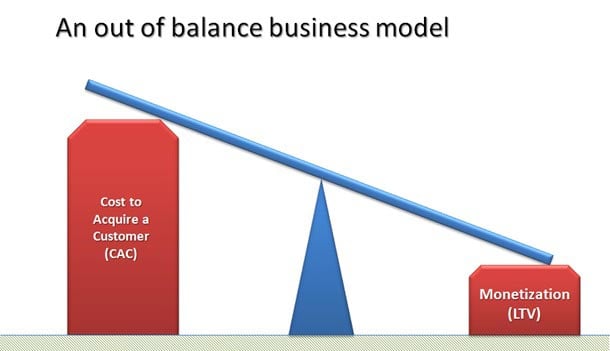
From David Skok’s post, it’s obvious that if you want to still remain in business, the amount you spent on Google Ads PPC to acquire a customer should be recovered in < 12 months.
In other words, if you’ve spent $270 to acquire a customer, you should also have a strategic and well-designed funnel in place to make $270 or more off of that customer in less than one year.
That’s the only way to create a healthy cash flow that will sustain business growth and expansion.
Most big brands, like Moz, use a different strategy to ensure that they recover the cost of acquiring a customer. The standard price plan for Moz’s software is $99/month.
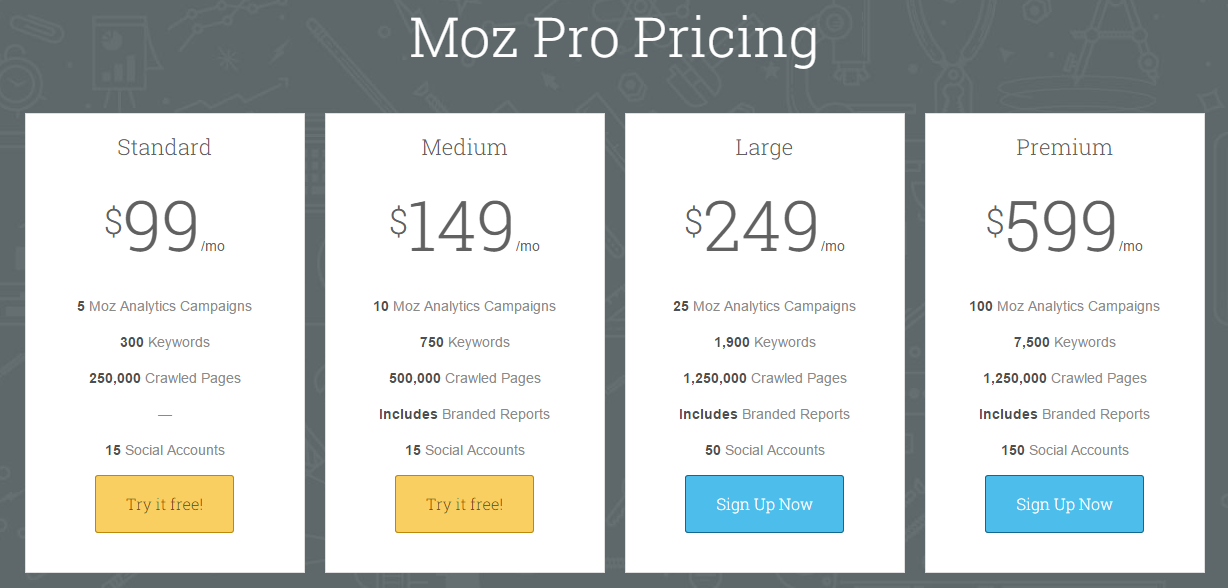
For small business owners, that monthly payment may not be too affordable. As a result, it’d take a lot of education and persuasion to get prospects to buy into the deal.
So, Moz will sometimes spend more than $99 just to acquire the customer. But, they have a definite plan to recover their initial spend and make more in the long-run.
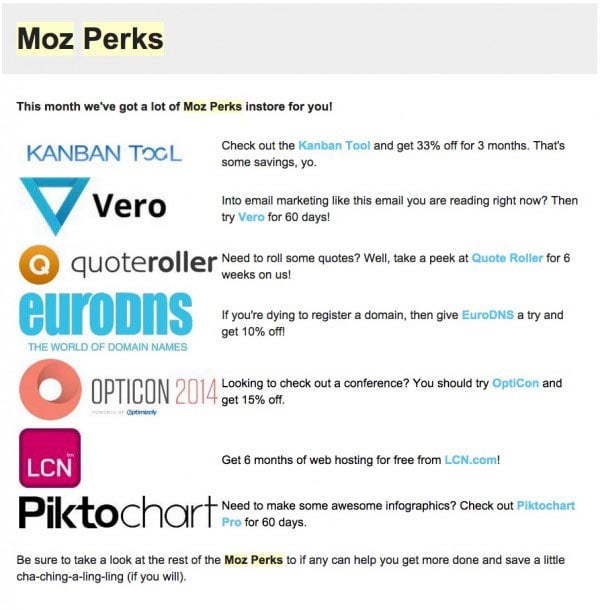
However, Moz also uses a unique strategy to acquire customers and get them to pay. They partner with other companies to offer member-only perks, which is more or less an affiliate program.
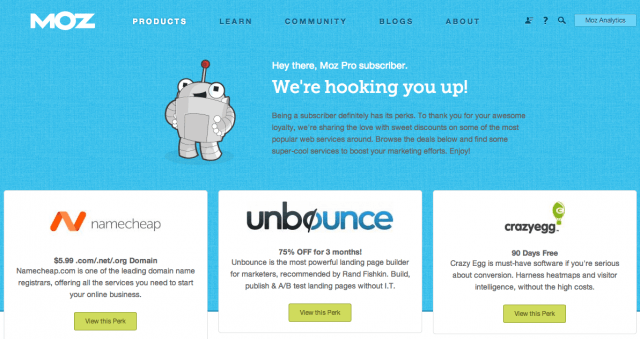
Here’s an extensive list of Moz’s perks:
HubSpot provides a more detailed example of Customer Lifetime Value, where they broke down the cost per customer into 3 components:
- Cost of Customer Visits (CoCV)
- Cost of Lead Acquisition (CoLA)
- Cost of Customer Acquisition (CoCA)
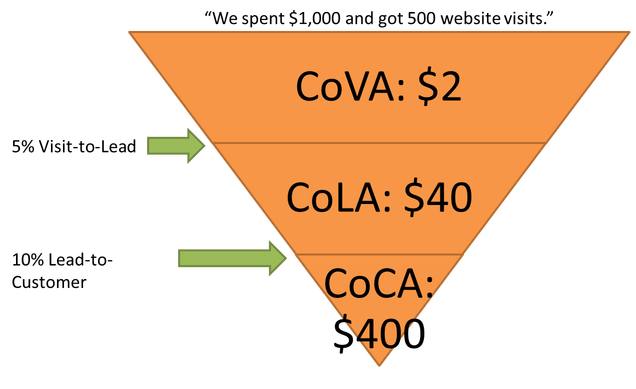
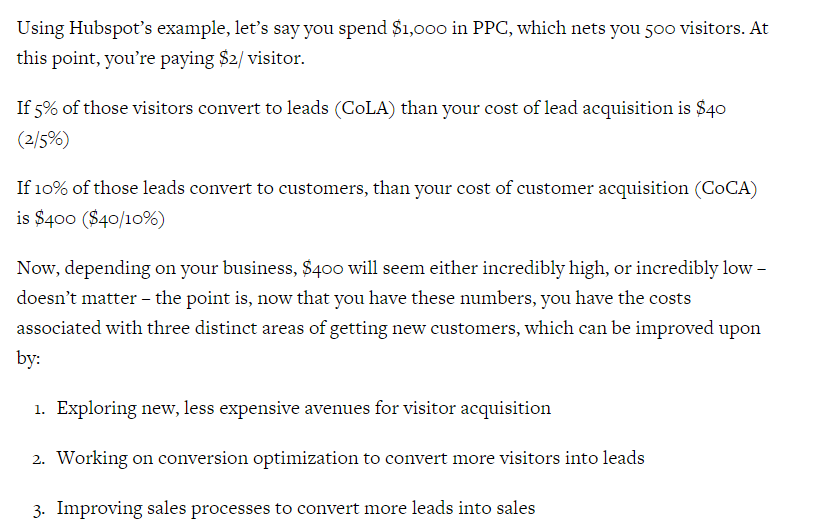
Still using HubSpot’s examples, Peep Laja shows us how to calculate the CLV:
You’re calculating the customer lifetime value, in part, because it helps you run a better Google Ads PPC campaign. If you’re paying $10 to acquire a customer, it means that the lifetime value should be $10+. But, if you’re paying $10 and getting $6, it means that you’re losing $4 for every customer that you acquire. That’s clearly not sustainable.
See also: How to Calculate and Increase Customer Lifetime Value
How to Calculate Your Ecommerce Cost of Customer Acquisition
Mistake #7: Not Testing the Optimal Ad Position
The simple formula that Google uses to rank ads is:
bid x ad quality
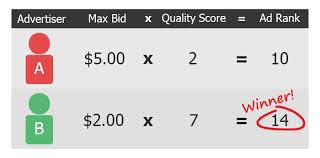
In other words, if you bid more than other advertisers who are targeting the same keywords, your ad’s more likely to appear at the top, assuming you both have the same quality score.
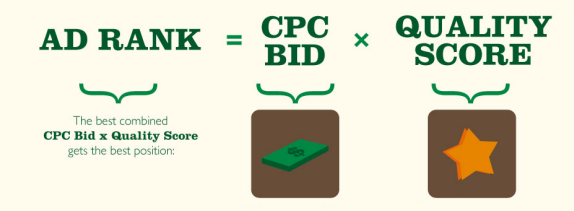
The quality of your ad is largely dependent on the quality of your keywords, click rate and targeted keywords. That score determines where your ads get placed.
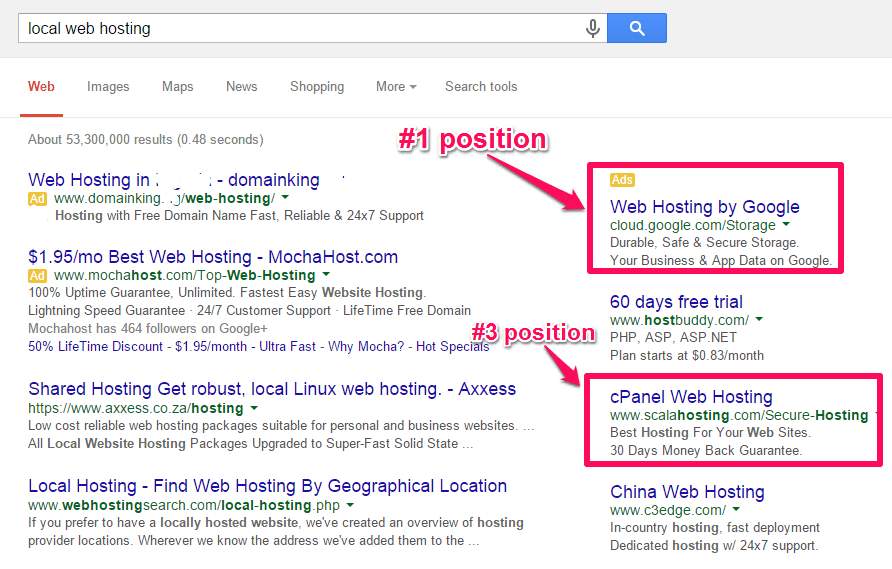
According to WordStream, position #1 may not always be the best position. It’s true that higher ad rankings tend to get the most clicks, but they don’t get the most conversions.
You don’t have to rank #1 for your ads to start generating quality clicks. If your goal is branding, then I’d understand perfectly when your focus is to rank your Google ad at the top. But, if you want to get results (quality clicks, traffic & conversions), being in position 3-5 works best.
Let’s say that you’re selling kitchen wares and your competitor is Home Depot – a top brand with a huge advertising budget.
Your goal shouldn’t be to bid higher than your competitors. Instead, focus on increasing your quality score – because a high quality score will give you a better ad rank position.
Another advantage of targeting positions 3 to 5 is this: people are always excited about the 1-2 positions because they’re easily seen. So, people may decide to click ads at the top, not because they’re really ready to buy, but because they’re curious or for other personal reasons.
In the book, Driving Customer Equity, the authors Roland Rust, Valarie Zeithami and Katherine Lemon expanded on a business’s most important asset – customer lifetime value.
In order to increase the CLV, you’ve got to focus on the customers, by nurturing the relationship that you have with them. The more they grow to trust you, the more you’re able to nudge them into taking the action that’ll grow your business.
When it comes to ad positioning in Google Ads, there is no one-size-fits-all principle. You’ve got to test this for yourself. Being at #1 may work best for you, depending on your industry and ad copy. But, overall, ad positions 3-5 tend to be more effective for most businesses as they’ll yield the best return on investment.
Pro tip: You can and should test your ad copy to find the best position by lowering or increasing your bid or CPC.
When you lower your bid, observe what happens. Google usually provides a specific suggested bid amount. You can start with the suggested bid or increase it a bit. Keep checking your ad positions.
Georgia Eye Associates increased their CTR from 0.95% in September to 2.80% in April, a time period of just six months. They did it by using more strategic targeting and bid optimization and they were also able to reduce the cost-per-click (CPC) from $4.90 to $2.31.

AdWords Mistakes FAQs
What is a common AdWords mistake?
Not using the right keyword type. Remember, there are three main types: broad, phase, and exact.
Why should I add a negative keyword list?
By telling AdWords keywords you DON’T want to appear for, you can cut down on ad spend on worthless clicks that aren’t going to convert.
Should I always be in the top ad position?
Studies have shown that the top ad position isn’t always the best for your specific keyword. Be sure to test this.
How often should I check for AdWords mistakes?
Be sure to monitor your campaigns weekly, quarterly, and monthly.
AdWords Mistakes Conclusion
Your ads should be targeted at the right people. This is how to increase your traffic, generate better leads and increase sales.
And, you’ve got to set a long-term goal, not just one for the short term. If your goal is only to generate quality clicks to your landing page, you’re missing out.
Remember that the customer lifetime value isn’t dependent on the initial conversion rate, but what happens after they become customers.
Effective Google Ads boil down to targeting the right words (in part through match type), reducing your cost per customer acquisition and driving potential customers to your site where you’ve set up a well-crafted funnel that will improve conversions.
What other Google Ads mistakes do you see? Let me know in the comments below.