 Sign In





 Ubersuggest
  AnswerThePublic
 How Does Google Treat AI-Generated Content?
Info
-
Source: NP Digital
-
Date: August 2026
-
Category: AI-Generated Content
-
Study Methodology: Data from Google and Lily Ray's study of 220 websites that published AI-generated content. The sample is limited to one study, so findings should be treated as directional.
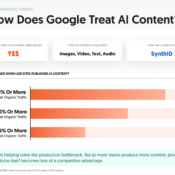
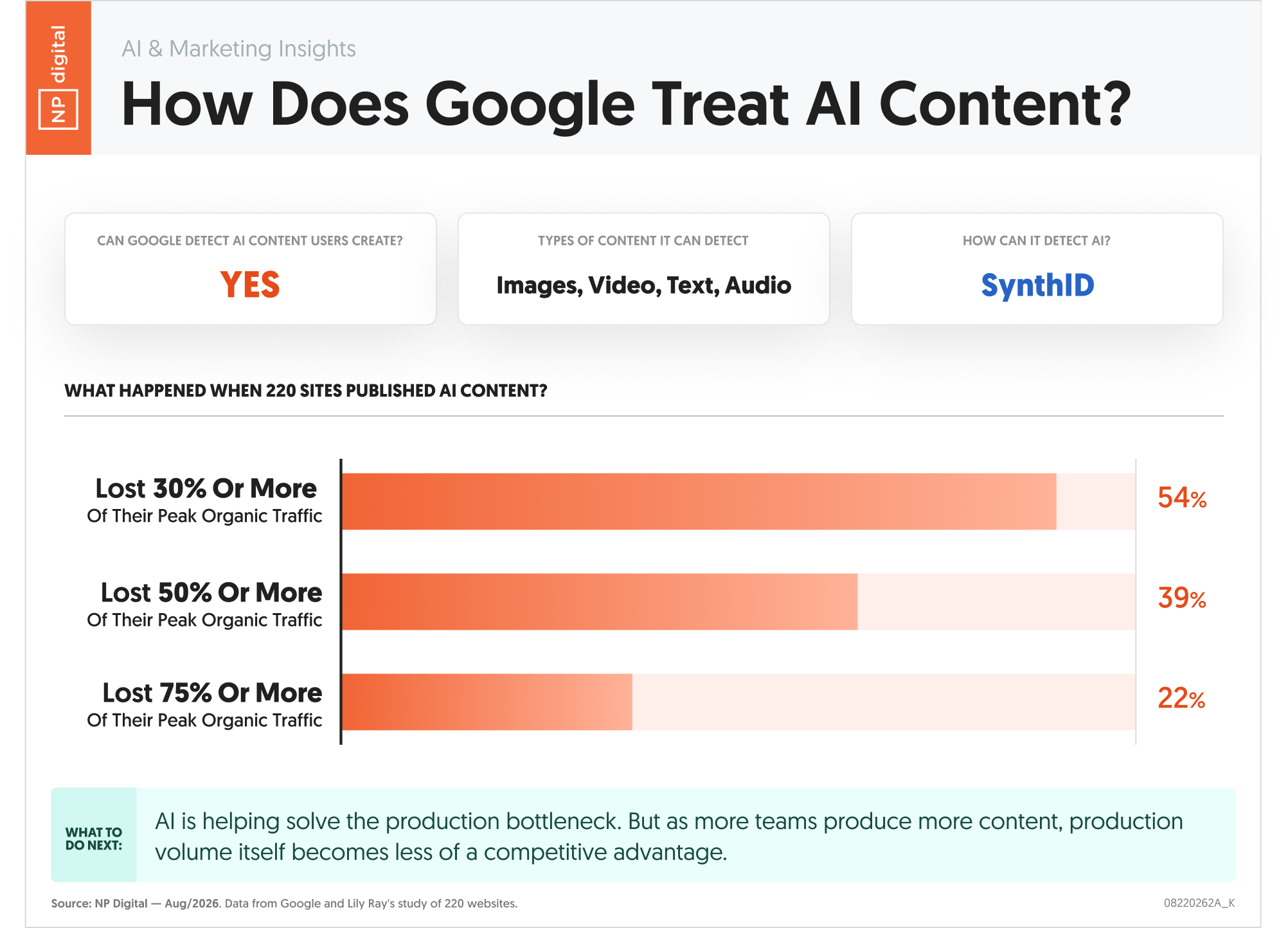
Google has confirmed it can identify AI-generated images, video, text, and audio, largely through SynthID watermarking. That capability matters most once you look at what happened to sites that leaned into AI publishing at scale. A study of 220 websites found steep organic traffic losses tied to AI content adoption. The pattern raises a real question for marketers: is this an active penalty, or is AI content simply failing to hold up against the quality signals Google already rewards? Either way, the traffic damage is the part that should get your attention.
Essential Statistics
- Google can detect AI-generated content across images, video, text, and audio, primarily through SynthID watermarking technology.
- Among 220 websites studied, 54% lost 30% or more of their peak organic traffic after publishing AI content.
- 39% of those same sites lost 50% or more of their peak organic traffic.
- 22% of sites lost 75% or more of their peak organic traffic.
- The scale of these losses points to a pattern across the sample rather than a handful of isolated cases.
Key Takeaways
- The data suggests Google’s detection capability is mature enough to factor into ranking outcomes, even without an explicit AI content penalty being confirmed.
- Heavy traffic losses tend to cluster around sites that scaled AI publishing quickly, which points toward volume without differentiation being the real risk, not AI use itself.
- A majority of sites in the study lost 30% or more of peak traffic, which suggests this is closer to a structural shift than a minor fluctuation.
- Since AI has helped solve the production bottleneck for most teams, raw output volume stops being a competitive advantage once every competitor can produce more too.
- Sites losing 75% or more of peak traffic likely relied on AI content as a primary growth strategy rather than a supplement to expertise-driven work.
- This points toward differentiation mattering more than ever, since detection removes the assumption that AI content is indistinguishable from human-written work.
Actionable Insights
- Audit pages published primarily through AI generation and compare their organic traffic trends against your publishing calendar. If a decline lines up with a spike in AI output, that page is worth a rewrite grounded in original data or firsthand experience.
- Treat AI as a drafting or research tool rather than a finishing tool. Since detection technology is active, content that reads as purely AI-generated with no human judgment layered in carries more downside risk than upside.
- Prioritize adding elements AI cannot easily replicate, like proprietary data, client results, or expert commentary. These are the differentiators most likely to separate content that holds traffic from content that fades.
- Slow your publishing cadence if your team scaled AI output without a matching increase in editorial review. Testing a smaller, better-vetted volume against your current pace is worth doing before committing further.
- Watch for provenance and watermarking signals becoming part of how search engines evaluate trust, not just origin. Building a content review process now is worth prioritizing before this becomes a bigger ranking factor.
- Revisit any strategy built on the assumption that AI content is undetectable. That assumption no longer holds, and plans built on it are worth reconsidering.
If your content strategy depends on Google not noticing it’s AI-written, you already have a problem. Build for quality, not for invisibility.’ – Neil Patel