 Sign In









The Biggest Barriers to Effective Localization
Info
-
Date: September 2026
-
Category: Lead Gen & B2B
-
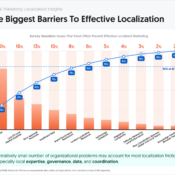
Study Methodology: Data from 600 survey respondents. Bars show share of respondents; the line shows cumulative share of all responses.
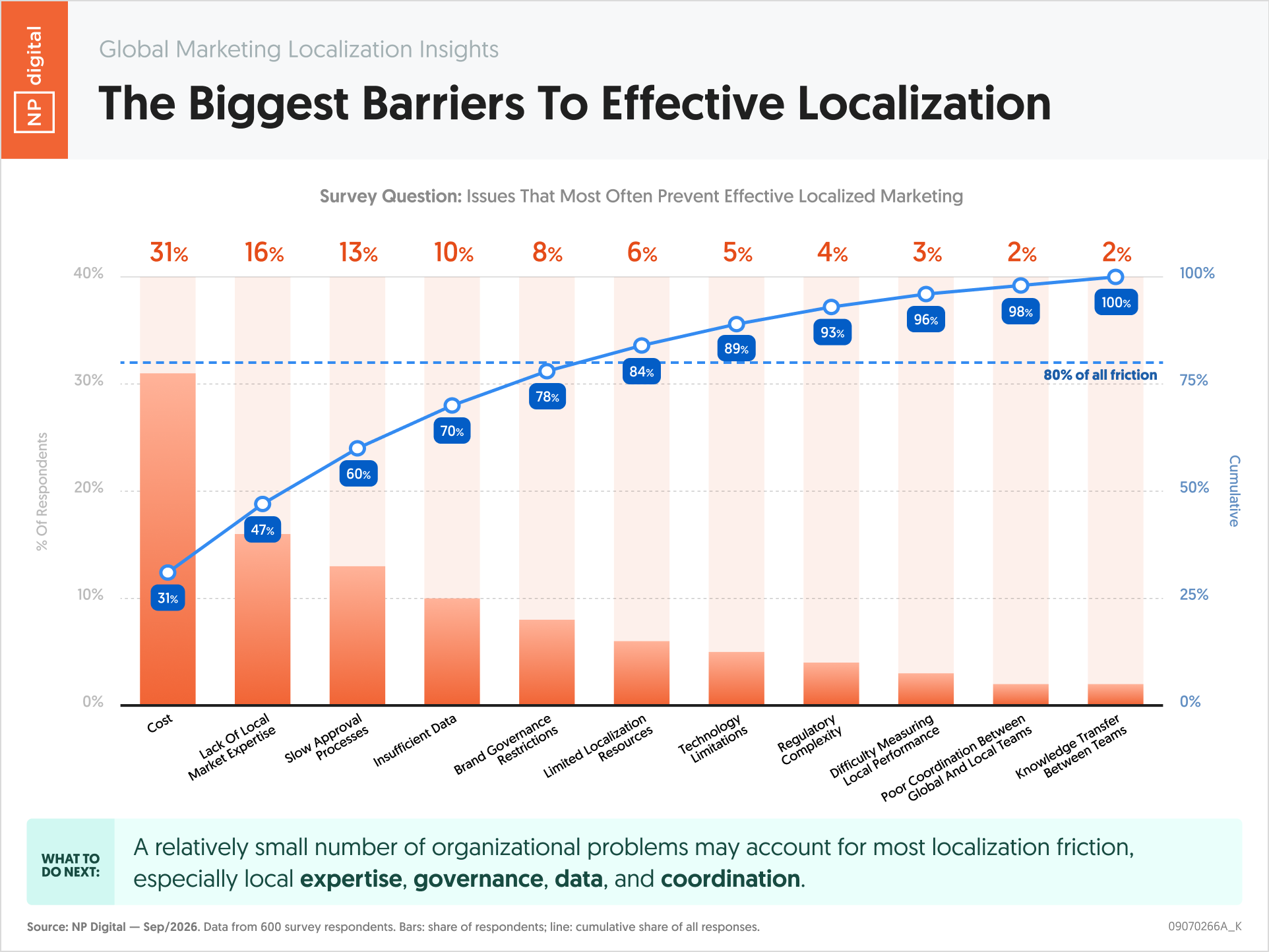
Localization friction tends to concentrate around a small set of recurring problems rather than being spread evenly across dozens of causes. A survey of 600 marketers ranked the issues that most often prevent effective localized marketing, and the top four factors, cost, lack of local market expertise, slow approval processes, and insufficient data, account for 70% of all reported friction. Everything past that point contributes a shrinking share, down to knowledge transfer between teams at the very bottom.
Essential Statistics
- Cost is cited by 31% of respondents as the top barrier to effective localization.
- Lack of local market expertise follows at 16%.
- Slow approval processes account for 13%, and insufficient data accounts for 10%.
- The top four barriers combined account for 70% of all reported friction.
- Poor coordination between global and local teams and knowledge transfer between teams each account for only 2%, the smallest shares measured.
Key Takeaways
- Cost ranking as the single largest barrier suggests budget constraints, not lack of will or awareness, are the primary obstacle to deeper localization for most organizations.
- The top four barriers accounting for 70% of all friction suggests most organizations would see outsized returns from focusing on a small number of fixes rather than spreading effort across every possible issue.
- Lack of local market expertise ranking second suggests many organizations may be trying to localize decisions from a central team without enough on-the-ground knowledge to do it well.
- Slow approval processes and brand governance restrictions both appearing in the top half suggests internal process bottlenecks are as significant a barrier as external resource constraints.
- Coordination and knowledge transfer issues ranking lowest suggests that once the bigger structural barriers are addressed, most organizations don’t struggle much with basic team communication.
Actionable Insights
- Address cost constraints first, since this data shows it as the single largest reported barrier. This might mean building a phased localization roadmap that spreads investment over time rather than requiring a large upfront commitment.
- Invest in local market expertise, whether through hiring, partnerships, or dedicated regional teams, since this ranks as the second-largest barrier and is a gap that’s directly fixable with the right resourcing.
- Review and streamline your approval processes for localized content, since slow approvals rank in the top four barriers and are often addressable through clearer governance rather than additional budget.
- Focus improvement efforts on the top four barriers, cost, expertise, approval speed, and data, since these account for 70% of all reported friction and are likely to deliver the biggest return on effort.
- Don’t over-invest in solving coordination and knowledge transfer issues before addressing the bigger structural barriers, since these rank lowest in this data and may resolve naturally once the larger issues are fixed.
‘Most localization problems aren’t mysterious. It’s cost, expertise, and slow approvals, in that order. Fix those four things and you’ve solved most of the actual friction.’ – Neil Patel