 Sign In






Does Human Review Actually Fix AI Content Inaccuracies?
Info
-
Source: NP Digital
-
Date: August 2026
-
Category: AI-Generated Content
-
Study Methodology: Data from surveying 100 companies. Numbers rounded to the closest whole digit.
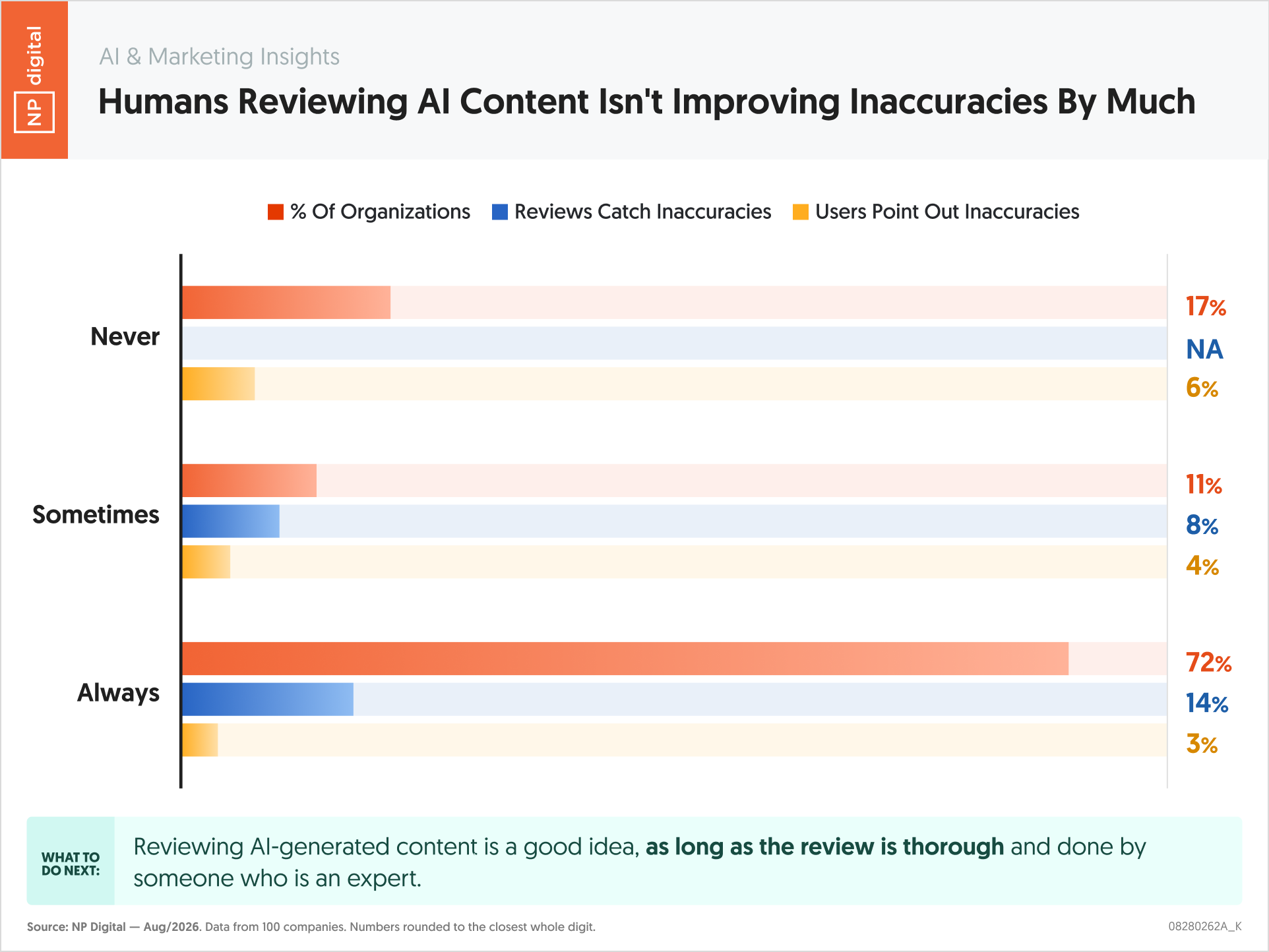
Reviewing AI content before it publishes sounds like a solid safeguard, but a survey of 100 companies suggests the safeguard isn’t catching much. Most organizations say they always review AI-generated content, yet the rate at which those reviews actually catch inaccuracies stays low regardless of how often review happens. Meanwhile, users end up flagging errors that internal reviews miss. The gap between review frequency and error detection is the real finding here.
Essential Statistics
- 72% of organizations say they always review AI-generated content before publishing.
- Among companies that always review content, only 14% of reviews actually catch inaccuracies.
- Only 3% of inaccuracies in always-reviewed content are ultimately flagged by users.
- Among companies that never review content, 17% still report inaccuracies being caught, though not through an internal review process.
- Even in the sometimes-review group, inaccuracy detection sits at just 8%, only slightly better than companies with no review process at all.
Key Takeaways
- The data suggests review frequency alone isn’t a reliable predictor of catching AI content inaccuracies, which is a meaningful gap if your process depends on review as the main safeguard.
- Since even companies that always review content catch inaccuracies only 14% of the time, the quality of the review may matter more than whether a review happens at all.
- A low user-flagged inaccuracy rate suggests most errors likely go unnoticed rather than unreported, which is a riskier interpretation than it first appears.
- This pattern points toward reviews needing to be more structured and expertise-driven rather than a quick read-through before publishing.
- Teams relying on review as their sole quality control step may be overestimating how much protection that step actually provides.
Actionable Insights
- Build a structured fact-checking checklist for AI-generated content rather than relying on a general review pass. Specific verification steps for statistics, claims, and sourcing are worth testing against your current process.
- Assign AI content review to someone with subject matter expertise in the topic rather than a general editor. The data suggests expertise, not just review frequency, is likely the missing piece in catching inaccuracies.
- Set up a feedback loop where user-flagged errors get logged and analyzed for patterns. If certain types of mistakes keep surfacing, that’s worth using to sharpen your review checklist.
- Spot-check a sample of already-published AI content against your sources to see how many inaccuracies your current review process may have missed. This is worth doing quarterly rather than assuming your process is catching everything.
- Don’t treat ‘we review everything’ as equivalent to ‘our content is accurate.’ Those are two different claims, and the data suggests the gap between them is worth taking seriously.
Reviewing content and reviewing it well are not the same thing. If your review process isn’t catching errors, having a review process at all is just theater. – Neil Patel