 Sign In







 Ubersuggest
  AnswerThePublic
 Map Pack Visibility Tracking: How Often Are You Doing It?
Info
-
Source: NP Digital
-
Date: May 2026
-
Category: Lead Gen & B2B
-
Study Methodology: Sample size: 180 local businesses. Collection method: Online survey. Numbers rounded for clarity.
The Map Pack is the highest-converting real estate in local search. Businesses that appear in the three-pack for their target keywords consistently generate more calls, direction requests, and website visits than businesses that rank below it. Yet this survey of 180 local businesses finds that 59 percent are not tracking their Map Pack visibility at all. They are investing in Google Business Profile optimization, review generation, and local SEO without any mechanism to verify whether those efforts are affecting their pack position.
Essential Statistics
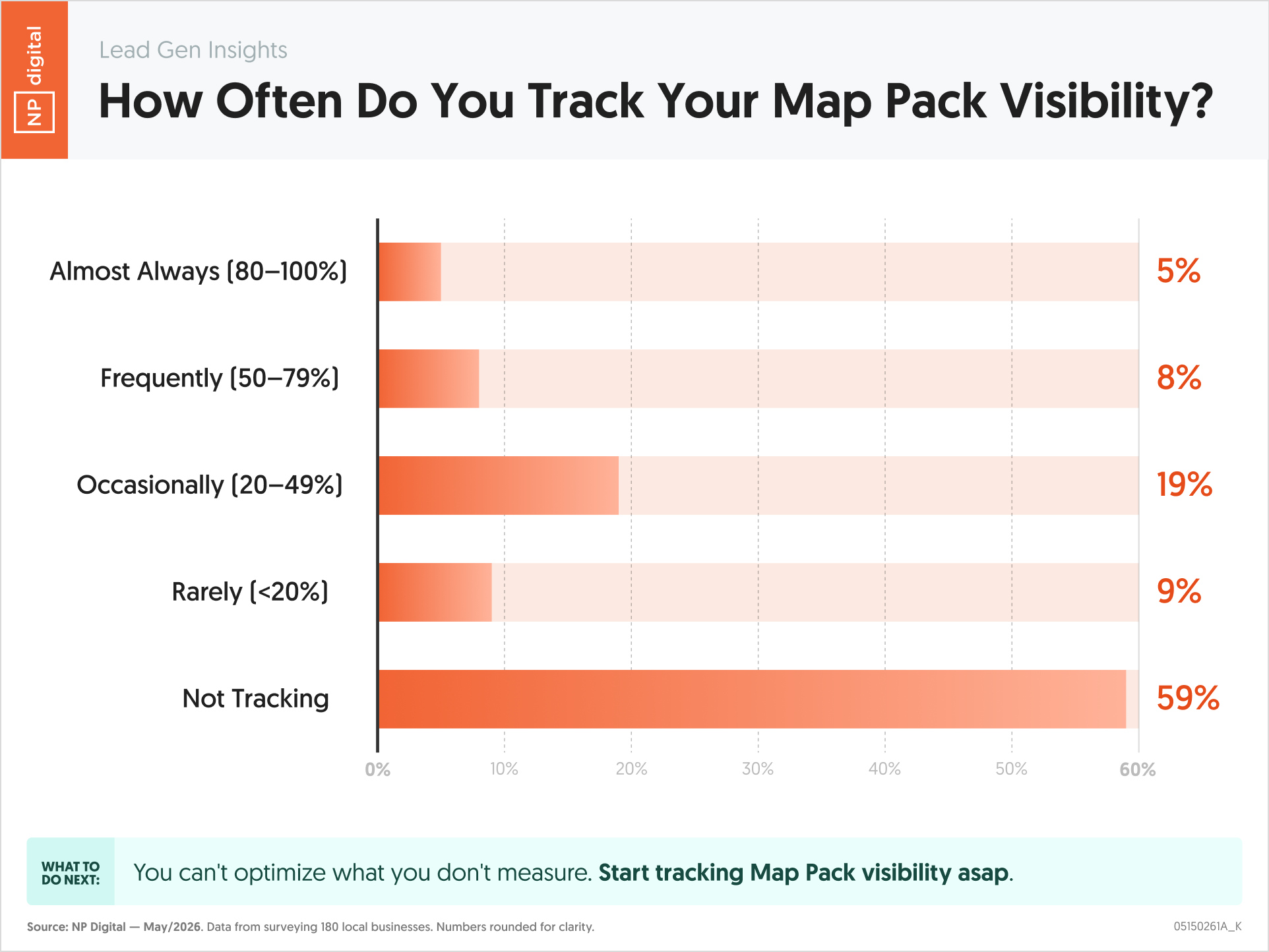
- 59 percent of local businesses do not track their Map Pack visibility at all, making it the dominant response by a wide margin.
- Only 5 percent track Map Pack visibility almost always, covering 80 to 100 percent of their ranking opportunities.
- 8 percent track frequently, covering 50 to 79 percent of tracking opportunities.
- 19 percent track occasionally, in the 20 to 49 percent frequency range.
- 9 percent track rarely, at less than 20 percent frequency.
- A combined 13 percent of businesses track with any meaningful regularity, defined as frequently or almost always.
Key Takeaways
- The 59 percent not tracking at all are missing the ability to know whether their local SEO investments are working. Every change they make to their GBP, every review response they write, every citation they build is going into a black box. Without tracking, there is no way to know if a competitor displaced them last month, if a Google algorithm update affected their pack position, or if their optimization work is producing any measurable result.
- The 13 percent tracking with meaningful regularity have a structural competitive advantage over the 87 percent who are not. Local pack rankings fluctuate in response to competitor activity, algorithm updates, and proximity signal changes. Businesses that catch a ranking drop within a week can respond before losing significant lead volume. Businesses not tracking may not notice a drop for months, by which point the competitor that displaced them has accumulated reviews and engagement signals that are harder to overcome.
- Occasional tracking at 19 percent is better than nothing but inadequate for competitive local markets. Once-a-month or once-a-quarter checks are sufficient to spot dramatic position changes but will miss the gradual position erosion that typically precedes a pack exit.
- The fundamental barrier for the 59 percent not tracking is not technical complexity. Local pack rank tracking is available in most local SEO tools, and basic manual checking requires nothing more than a search from an incognito browser near the target location. The barrier is awareness of the value of the data and the habit of checking it. Both are addressable without significant investment.
- Map Pack tracking data has compounding value over time. A single rank check tells you where you are today. Twelve months of weekly checks tells you how your position responds to specific optimization actions, which competitor movements tend to displace you, and which algorithm updates affect your local visibility. That longitudinal data is the foundation of a repeatable local SEO playbook.
Actionable Insights
- Set up Map Pack rank tracking this week for your top five local target keywords at the zip code or city level, not just the broad regional level. The 59 percent not tracking have no baseline from which to measure the impact of any optimization they do going forward. Most local SEO tools support hyperlocal rank tracking that shows your position within a specific radius of your business address.
- Create a weekly Map Pack position report and assign a specific person to review it and flag changes. Most of the 87 percent not tracking consistently lack a reporting habit rather than a tool. A weekly review of five keyword positions takes less than ten minutes and creates the feedback loop that makes local SEO optimization rational rather than speculative.
- Correlate your Map Pack rank tracking data with your GBP activity log to build an evidence-based local SEO playbook specific to your business and market. Once tracking is in place, log every action you take on your GBP alongside the date. Over 60 to 90 days, patterns emerge that show which activities consistently correlate with position improvements in your specific market.
- Add competitor Map Pack tracking for your two to three closest direct competitors alongside your own position tracking. Your own position data tells you where you are. Competitor position data tells you whether you are gaining or losing share. Most local SEO tools support multi-competitor tracking within the same dashboard, and this context is essential for distinguishing between a position drop caused by your own profile weakness versus one caused by a competitor’s active optimization.
- For the 19 percent tracking occasionally, increase frequency to at least weekly and set up automated alerts for position changes greater than one rank. Position changes in competitive local markets happen at the week-to-week level, not the month-to-month level. Automated alerts mean you are notified when something changes without having to remember to check.
“If you are not tracking your Map Pack position, you have no way to know whether your local SEO work is actually doing anything. That is not a tracking problem but a decision-making problem. You cannot optimize a channel you are not measuring.” – Neil Patel