 Sign In






 Ubersuggest
  AnswerThePublic
 Human vs AI Content: Which Holds Reader Attention Longer?

Info
-
Source: NP Digital
-
Date: August 2026
-
Category: AI-Generated Content
-
Study Methodology: Data from 100 companies covering 3011 pieces of content analyzed.
Time on page is one of the clearer signals of whether content actually holds a reader’s attention, and the difference between human and AI-written content is significant. Across 3011 pieces of content from 100 companies, human-written content kept readers engaged noticeably longer than content written by AI, even when that AI content was later modified by a human. The gap narrows with editing but never fully closes, which is worth understanding before scaling AI-first production.
Essential Statistics
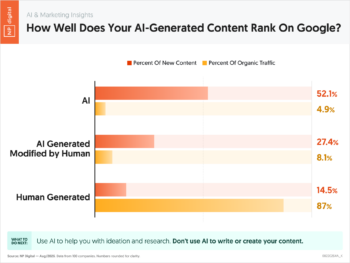
- Human-written content, making up 14.5% of the content sample, averaged 2 minutes 31 seconds of reader time on page.
- Content written by AI and then modified by a human, making up 33.3% of the sample, averaged 1 minute 59 seconds on page.
- Content written entirely by AI, making up 52.2% of the sample, averaged 1 minute 54 seconds on page.
- The gap between human-written content and AI-modified content is roughly 32 seconds.
- The gap between human-written content and fully AI-written content is roughly 37 seconds.
Key Takeaways
- The consistent time-on-page advantage for human content suggests readers engage differently with writing shaped by a real point of view, even when the topic and structure are similar.
- The relatively small gap between AI-modified and fully AI-written content suggests light editing alone may not be enough to close the engagement gap with human writing.
- Since fully AI-written content makes up the majority of the sample yet holds attention the least, teams optimizing for volume may be trading engagement for output.
- This pattern points toward human involvement mattering most in the substance of the content, not just a final editing pass.
- The data suggests time on page is a useful metric for testing whether your own AI content workflow is actually working as well as it looks on paper.
Actionable Insights
- Track time on page by content origin, human-written, AI-modified, and fully AI-written, across your own site for the next quarter. If you see a similar pattern, that’s a signal to shift more of your content mix toward human-led writing.
- Treat AI-modified content as a starting point rather than a finished product. The data suggests substantive human input, not just light editing, is what narrows the engagement gap.
- If you’re publishing fully AI-written content at volume, prioritize adding it to lower-stakes pages rather than your most important conversion or authority content.
- Test rewriting a sample of your lowest-performing AI-written pages with a human-led approach and compare time on page before and after. This is worth doing on a small batch before committing broader resources.
- Reconsider content investment allocation if your team is spending equal resources on AI and human content despite the engagement gap. Shifting more editorial time toward human-led pieces is worth testing against your current split.
Readers can feel the difference even if they can’t articulate it. Time on page is telling you that human writing still does something AI content, even edited, hasn’t matched yet. – Neil Patel