 Sign In









Most Global Marketing Still Stops at Translation
Info
-
Source: NP Digital
-
Date: September 2026
-
Category: Lead Gen & B2B
-
Study Methodology: Data from 600 survey respondents. Levels are cumulative practices rather than a full 100% distribution.
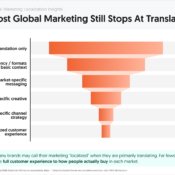
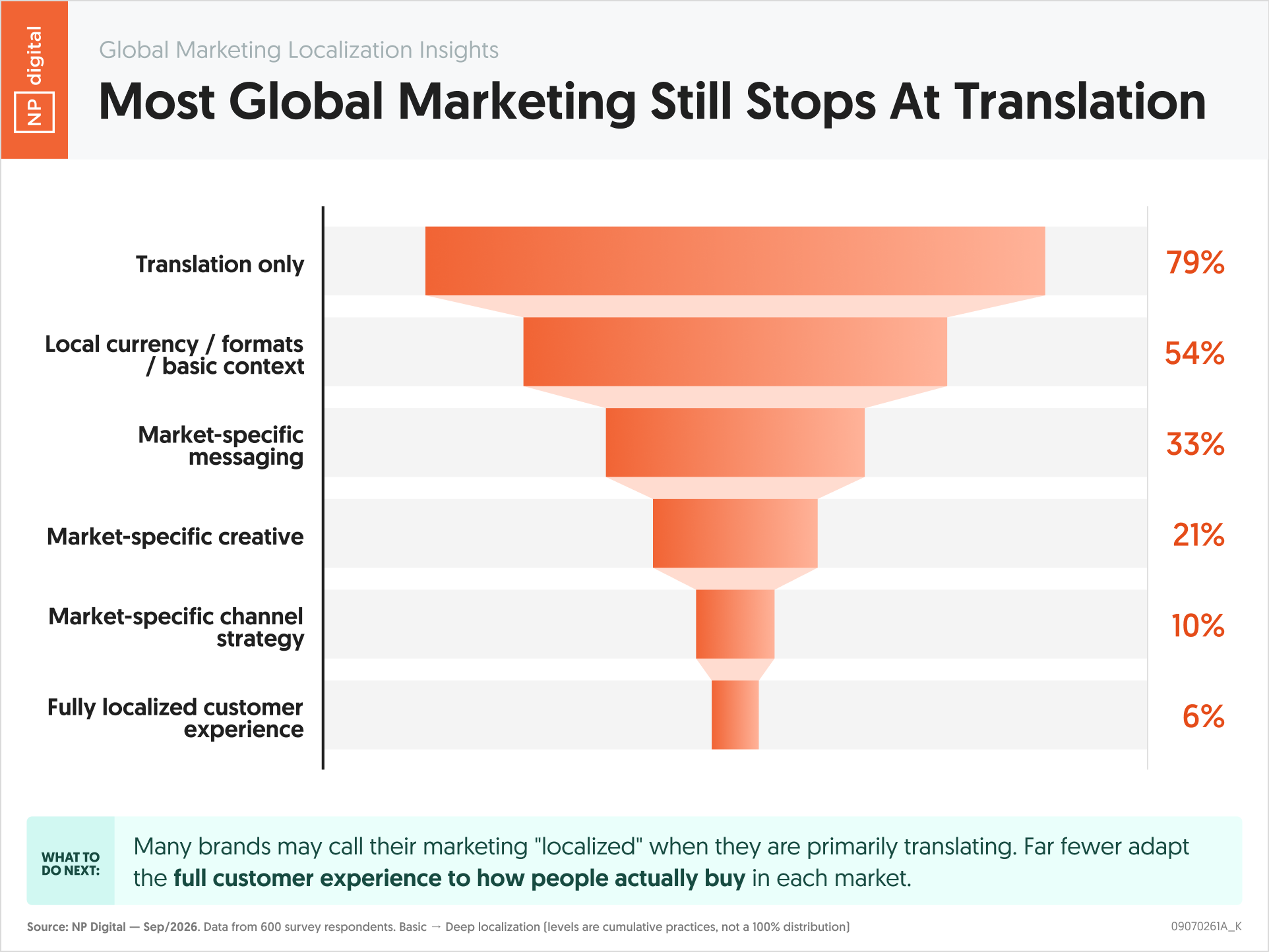
Plenty of brands describe their global marketing as localized, but a survey of 600 marketers suggests most of that localization stops well short of adapting the actual customer experience. The data breaks localization into six cumulative levels, from basic translation up to a fully localized customer experience, and the drop-off between levels is steep. Nearly 80% of marketers report doing translation, but only 6% report reaching a fully localized customer experience.
Essential Statistics
- 79% of marketers report translating content as part of their global marketing practice.
- 54% report adapting local currency, formats, or basic context.
- 33% report using market-specific messaging.
- 21% report using market-specific creative, and 10% report using a market-specific channel strategy.
- Only 6% report reaching a fully localized customer experience, the deepest level measured.
Key Takeaways
- The steep drop-off from translation to fully localized experience suggests most brands treat localization as a language problem rather than a full customer experience problem.
- More than half of marketers stopping at basic currency and format adaptation suggests a large portion of the market may be significantly underinvesting in deeper localization relative to what’s available.
- The small percentage reaching market-specific channel strategy suggests most brands are still applying a single global channel mix across very different markets.
- Since only 6% reach full localization, brands that do invest in this level may have a meaningful and largely uncontested advantage in the markets where they operate.
- This pattern suggests the term localization is being used loosely across the industry, and it’s worth clarifying internally what level your own organization is actually operating at.
Actionable Insights
- Audit your own localization practices against these six levels to identify exactly where your organization currently sits, rather than assuming translation alone counts as full localization.
- If you’re only translating content today, prioritize adapting local currency, formats, and basic context next, since this is the level over half of surveyed marketers have already reached.
- Consider market-specific messaging as a meaningful next investment if your current localization stops at formatting, since this level shows a real drop-off and represents a differentiation opportunity.
- Treat a fully localized customer experience as a long-term goal rather than an immediate target, given how few marketers currently reach this level. Building toward it incrementally through the levels in between is a more realistic path.
- Reassess any internal claims that your marketing is fully localized against this framework, since this data suggests that language may be used more loosely than the underlying practice supports.
‘Translating your website isn’t localization. It’s the first step. Most brands stop there and call it done. The data shows almost nobody goes further, which is exactly why going further is worth it.’ – Neil Patel