 Sign In






 Ubersuggest
  AnswerThePublic
 Local Personalization Maturity Gap: Multi-Location Data
Info
-
Source: NP Digital
-
Date: May 2026
-
Category: Lead Gen & B2B
-
Study Methodology: Sample size: 39 companies with multiple locations per business. Collection Method: Online survey.
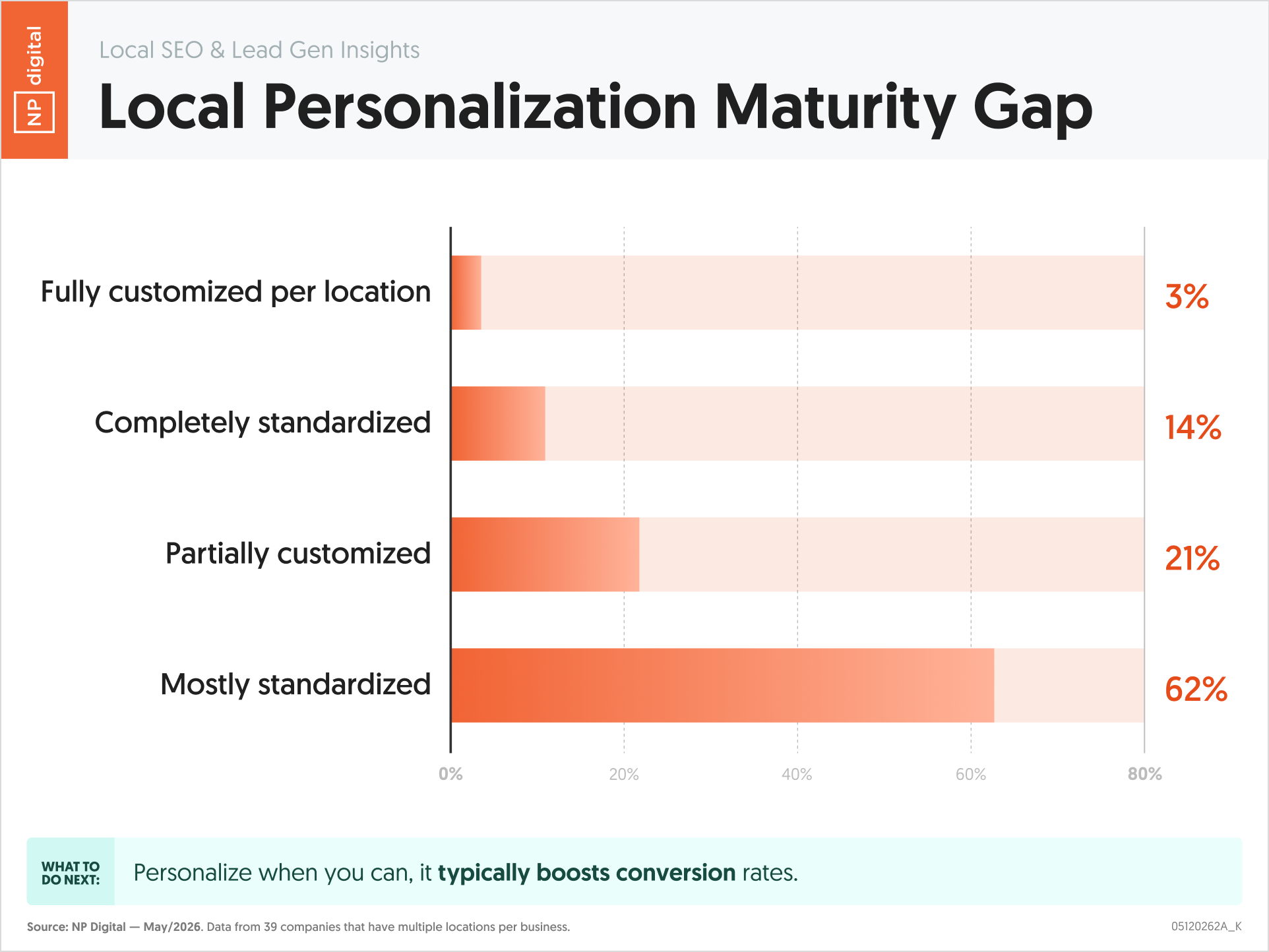
Multi-location marketing sits at the intersection of two competing pressures: the operational efficiency of standardized content and the conversion performance of localized content. This data from 39 multi-location businesses shows how those pressures are currently resolved, overwhelmingly in favor of standardization. 62 percent use mostly standardized content, and only 3 percent have achieved full per-location customization. That 3 percent number is not just a benchmark. It represents the competitive ceiling that most multi-location brands are not approaching.
Essential Statistics
- 62 percent of multi-location businesses use mostly standardized content across all locations, making it the dominant approach by a wide margin.
- 21 percent have partially customized content, applying some local variation but without a consistent or systematic process.
- 14 percent run completely standardized content with no location-specific variation of any kind.
- Only 3 percent of multi-location businesses have fully customized content tailored to each individual location.
- A combined 76 percent of multi-location businesses use content that is mostly or completely standardized with no meaningful local differentiation.
Key Takeaways
- The 62 percent mostly-standardized segment is doing local SEO with one hand tied behind its back. Mostly standardized content can rank for broad category terms, but it consistently underperforms fully localized content for geo-modified queries, near-me searches, and local pack placement, which are exactly the query types that drive highest-intent local traffic and leads.
- The 3 percent with full per-location customization represent the competitive benchmark in local search. In markets with three or four businesses targeting the same local keywords, full location-level customization is often the factor that determines which business earns the local pack position. The scarcity of this approach means it remains a genuine competitive advantage.
- Partial customization at 21 percent is a strategically ambiguous position. These businesses have recognized that localization matters and made a first attempt, but without a repeatable system, the customization is likely inconsistent in quality and incomplete in coverage. Partial customization that is not systematized tends to drift back toward standardization over time as team bandwidth gets redirected.
- Completely standardized content at 14 percent is serving identical pages to markets that may have different competitive landscapes, seasonal demand patterns, and service-area vocabularies. Google’s local algorithm rewards geographic relevance signals, and completely standardized content provides none of them beyond the address data in the business listing.
- The maturity gap is primarily a systems problem, not a strategy problem. Most multi-location marketers know personalization converts better. The 62 percent using standardized content are not unaware of localization’s value. They lack the production workflow to execute it at scale without proportionally scaling headcount.
Actionable Insights
- Identify your top five revenue-generating locations and build fully customized location pages for those before attempting any broader rollout. Only 3 percent of multi-location businesses have achieved full customization, and most did not get there by customizing everything at once. Start with the locations where the revenue impact of improved local pack rankings is largest. A strong location page includes locally relevant service descriptions, local landmarks and neighborhood references in the copy, staff names where applicable, location-specific reviews, and a locally framed FAQ section.
- Separate your location page template into a locked global structure and a fillable local content layer. A template with locked structural elements and fillable local fields lets a centralized team or local managers produce compliant, optimized pages without starting from scratch each time.
- Audit your existing location pages for the five local SEO signals that most directly affect local pack rankings: locally modified title tags, locally modified H1s, location-specific body copy beyond just the address, embedded Google Maps, and LocalBusiness schema with complete address and service-area fields.
- Build conversion rate tracking separately for standardized versus partially localized versus fully localized pages across your location portfolio. Without performance data segmented by localization level, it is difficult to make the internal business case for the investment required to move from mostly standardized to fully customized.
- For those with partial customization, the priority is systematizing what already works rather than expanding the scope of customization. Identify which location pages perform best, reverse-engineer what local content elements they contain that the underperforming pages lack, and build those elements into a mandatory checklist that all locations must meet.
“The difference between 62 percent standardized and 3 percent fully customized is not a knowledge gap. Marketers know personalization converts better. It is a systems gap. The businesses winning in local search built a repeatable production process for localized content over bigger budgets.” – Neil Patel