 Sign In










Best Lead Sources for Local Businesses
Info
-
Source: NP Digital
-
Date: May 2026
-
Category: Lead Gen & B2B
-
Study Methodology: Sample size: 180 local businesses. Collection method: Online survey. Numbers rounded for clarity.
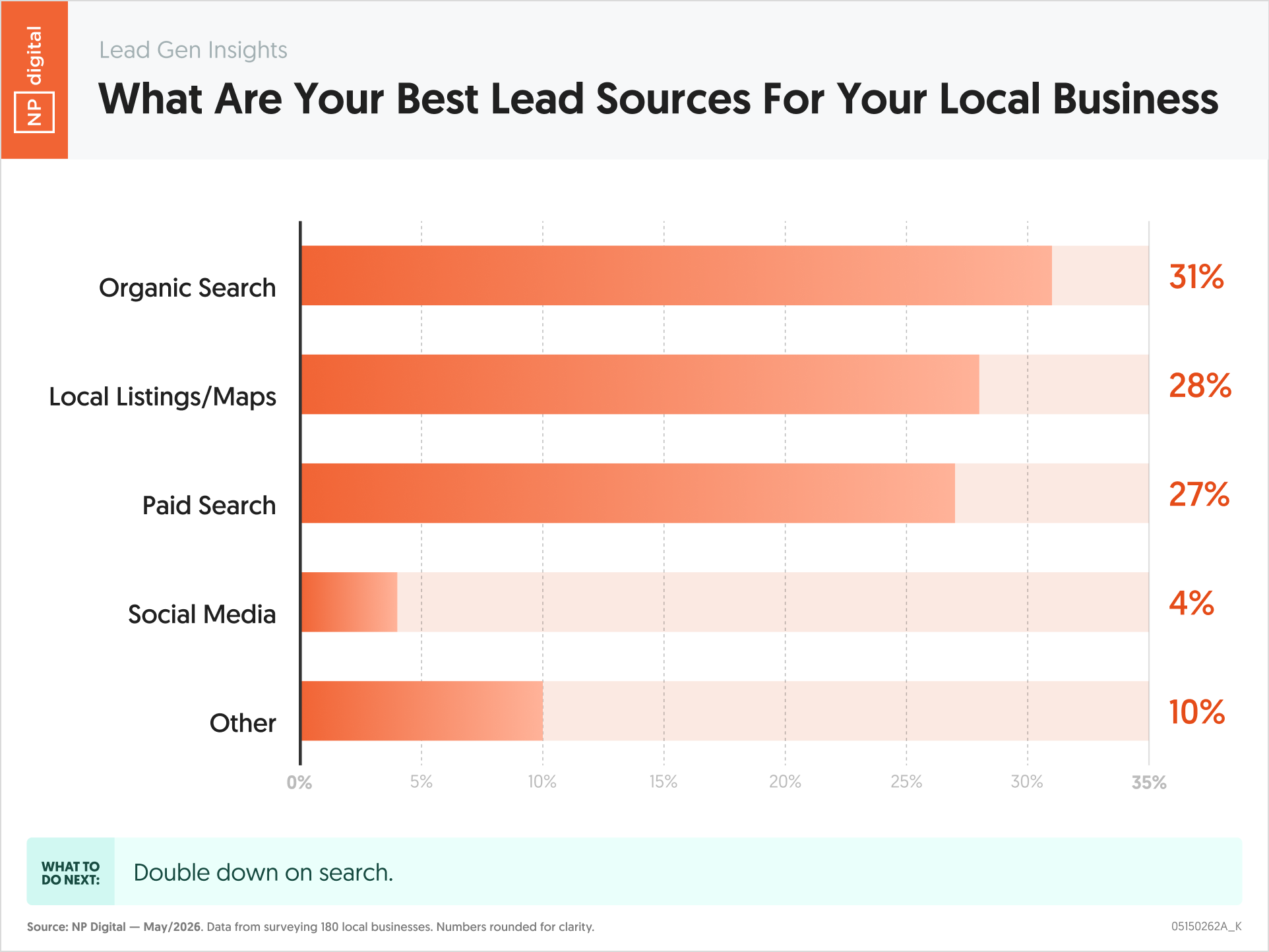
Search dominates local business lead generation, and this survey of 180 local businesses makes that dominance concrete. The practical implication is not just about where to invest but what it means for channel risk. When three search channels generate nearly all of a local business’s leads, the performance of each one has outsized impact on total lead volume, and the loss of any single one is difficult to absorb.
Essential Statistics
- Organic search is the top lead source for local businesses at 31 percent, ranking first among all channels.
- Local listings and maps generate 28 percent of leads, ranking second and within 3 percentage points of organic search.
- Paid search accounts for 27 percent of leads, nearly equal to both organic search and local listings.
- Search channels combined — organic search, local listings, and paid search — account for 86 percent of all local business leads.
- Social media generates only 4 percent of leads for local businesses despite receiving significant marketing investment from many brands.
- Other sources account for the remaining 10 percent of reported lead volume.
Key Takeaways
- The near-equal distribution across the three search channels, 31 percent, 28 percent, and 27 percent, is the most strategically significant finding in this dataset. It means there is no single dominant search channel, and that local businesses need all three working simultaneously. A local SEO strategy that optimizes for organic search but neglects GBP optimization and paid search is leaving roughly 55 percent of search-driven lead volume under-optimized.
- Local listings and maps at 28 percent is only 3 percentage points behind organic search, and deserves more investment attention than most local businesses give it. GBP optimization is faster to implement, faster to produce measurable results, and more directly controllable than organic SEO. For businesses earlier in their local marketing maturity, GBP is the highest-ROI starting point before organic SEO compound effects begin to accumulate.
- Social media at 4 percent is not a viable primary lead generation channel for most local businesses, regardless of how much content a business posts or how many followers it accumulates. Social plays a role in brand awareness and review generation, but allocating significant marketing budget to social media for local lead generation is inconsistent with what the data shows about where local buyers actually come from.
- The 86 percent search concentration creates a portfolio risk that most local businesses have not adequately addressed. A single Google algorithm update, a GBP suspension, or a competitive shift in paid search CPCs can materially affect total lead volume when three channels are delivering nearly all of it. Building even modest lead volume from non-search channels creates resilience against that concentration risk.
- The 10 percent in other sources likely includes word-of-mouth referrals, repeat customers, and channel types not specified in the survey. Understanding what comprises that 10 percent for any individual business often reveals high-close-rate lead sources that are under-invested relative to their quality.
Actionable Insights
- Treat GBP optimization as an equal priority to organic SEO, not a secondary task. At 28 percent of local leads, local listings are nearly equivalent in lead volume to organic search but respond to optimization changes on a much shorter timeline. A fully optimized GBP with complete profile fields, active review management, regular Google Posts, accurate service listings can affect local pack rankings within weeks rather than months.
- Allocate paid search budget specifically to local-intent keywords with location modifiers rather than broad category terms. Paid search at 27 percent is producing results, but the conversion quality depends heavily on query specificity. Keywords like a specific service type in a specific city convert at significantly higher rates than broad category terms because they capture users at the moment of highest local intent. Use location extensions, call extensions, and local bid modifiers to concentrate paid spend on queries most likely to produce same-day or same-week conversions.
- Audit your organic search performance specifically for local landing pages and address any that are thin, duplicate, or missing key local relevance signals. Many local businesses have organic rankings that are fragile because their location pages lack the depth to withstand competitor optimization or algorithm updates. A strong local landing page has unique locally relevant content, embedded reviews from that location’s customers, local business schema markup, and a locally modified title tag and H1.
- Set a cap on social media marketing investment for direct lead generation and redirect any budget above that cap toward the three search channels. Social media at 4 percent cannot support a meaningful direct lead generation budget. The marginal dollar redirected from social to local search will produce better lead volume outcomes.
- Build a channel diversification strategy that targets growing the 10 percent other category as an insurance policy against search concentration risk. Referral programs with existing customers, partnerships with complementary local businesses, and email capture from current customers are channels not subject to Google algorithm changes and provide resilience against the 86 percent search concentration.
“The top AI search mistakes all trace back to the same error: optimizing for what worked in traditional SEO without accounting for what AI engines actually reward. Mass content, weak brand positioning, and ignored authority building are 2012 SEO tactics applied to a 2026 channel.” – Neil Patel