 Sign In







 Ubersuggest
  AnswerThePublic
 How Multi-Location Businesses Budget Their Marketing
Info
-
Source: NP Digital
-
Date: May 2026
-
Category: Lead Gen & B2B
-
Study Methodology: Sample size: 180 local businesses. Collection method: Online survey. Numbers rounded for clarity.
Budget allocation is the decision that determines whether a multi-location marketing strategy succeeds or fails at the portfolio level. Distributing spend incorrectly across locations misallocates resources away from high-opportunity markets and toward low-demand ones, with direct effects on total lead volume and return on marketing investment. This survey of 180 local businesses reveals that the dominant approach reflects the right instinct, but 25 percent are still adjusting manually each month, and only 7 percent have adopted AI or automation to drive allocation. The gap between current practice and best practice is significant.
Essential Statistics
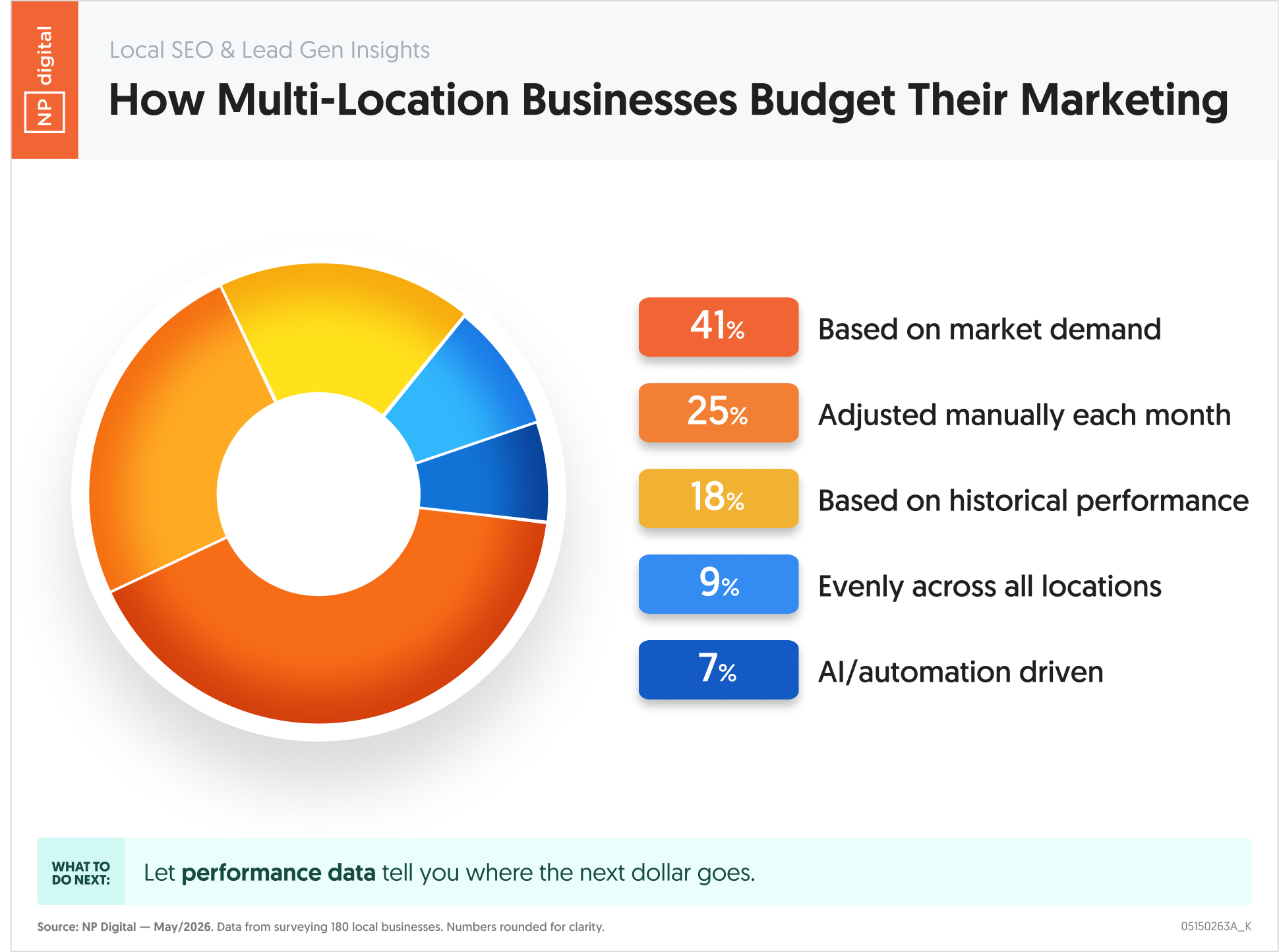
- 41 percent of multi-location businesses base marketing budget allocation on market demand, making it the most common approach.
- 25 percent adjust their marketing budgets manually each month without a systematic demand or performance framework.
- 18 percent base budget allocation on historical performance data from previous periods.
- 9 percent distribute budgets evenly across all locations regardless of market size or performance differences.
- Only 7 percent use AI or automation to drive budget allocation decisions across their location portfolio.
Key Takeaways
- Market demand-based budgeting at 41 percent is the most sophisticated approach in the dataset, but it is only as good as the demand signals informing it. Teams using this method need reliable local search volume data, foot traffic trends, competitive density metrics, and lead flow by location to make accurate allocation decisions. Without those inputs, market demand budgeting is informed guesswork rather than data-driven allocation.
- Manual monthly adjustments at 25 percent introduce a specific category of error: the adjustment reflects last month’s conditions, not current ones. Local market conditions change faster than monthly review cycles can track. Budgets adjusted manually each month are always one cycle behind the market, consistently underfunding locations experiencing demand surges and overfunding those past their peak.
- Historical performance at 18 percent is a backward-looking method that works in stable, predictable markets. In markets with significant competitive activity, local events, or seasonal demand patterns, historical performance from prior periods is a poor predictor of current opportunity. This method performs adequately for budget maintenance but is poorly suited to capturing emerging opportunities or responding quickly to competitive threats.
- Even distribution at 9 percent ignores the fundamental reality that local markets are not equal. Market size, competitive density, consumer demand, and location-level conversion rates vary significantly across any multi-location portfolio. Evenly distributed budgets systematically underfund high-opportunity locations and overfund low-opportunity ones.
- AI and automation adoption at 7 percent is strikingly low given that the major paid media platforms already offer location-level automated bidding that adjusts in near-real-time based on performance signals. Most multi-location businesses could access AI-driven budget optimization within their existing platforms without building custom infrastructure.
Actionable Insights
- If you are using market demand-based budgeting, audit the quality and recency of the demand signals you are using to make allocation decisions. Market demand budgeting produces good outcomes only when the demand data is granular, current, and location-specific. Local search volume data from tools like Semrush or BrightLocal, combined with Google Trends data filtered to the city or DMA level and supplemented by your own lead flow data by location, gives you the multi-signal picture needed to allocate confidently.
- Replace manual monthly budget adjustments with a performance trigger framework that defines the specific conditions under which a location’s budget is increased or decreased. For those adjusting manually each month, define the triggers explicitly: if a location’s cost per lead increases by more than 20 percent over two consecutive weeks, flag it for review. If lead volume exceeds the monthly target by 15 percent before the 20th, authorize a budget increase. Defined triggers remove guesswork and lag from the allocation process.
- Build a location performance tier that groups your locations by revenue potential before setting budgets, and assign budget ranges to tiers rather than absolute budgets to individual locations. A three-tier model based on market size, competitive density, and historical close rate gives you a structured basis for differential allocation without requiring the analytical infrastructure of a fully data-driven model.
- Pilot AI-driven automated bidding at the location level on your paid search campaigns before building or buying any custom AI allocation tooling. Smart Bidding with location-specific target CPA or ROAS settings gives you automated, real-time budget optimization within a controlled total spend envelope. Run a 60-day pilot on your top three locations and compare performance against manually adjusted locations to build the internal evidence base for broader adoption.
- Track and report budget efficiency by location on a monthly rather than quarterly cadence, with cost per lead and lead-to-opportunity conversion rate as the primary metrics. Multi-location teams reviewing budget performance quarterly are consistently making decisions based on data that is 60 to 90 days behind the market. Monthly reporting forces earlier identification of underperforming locations and creates more decision points for reallocation within each budget period.
“Most multi-location teams are allocating budgets based on last cycle’s performance or intuition about what each market needs. The 7 percent using AI-driven allocation built a feedback loop that removes the human lag from the process. Performance data should drive where the next dollar goes, not memory.” – Neil Patel