 Sign In






Email Revenue by Source: Campaigns vs. Automation by Company Size
Info
-
Source: NP Digital
-
Date: July 2026
-
Category: Email Marketing
-
Study Methodology: Source: NP Digital, July 2026. Data from 193 companies and survey results of 820 marketers.
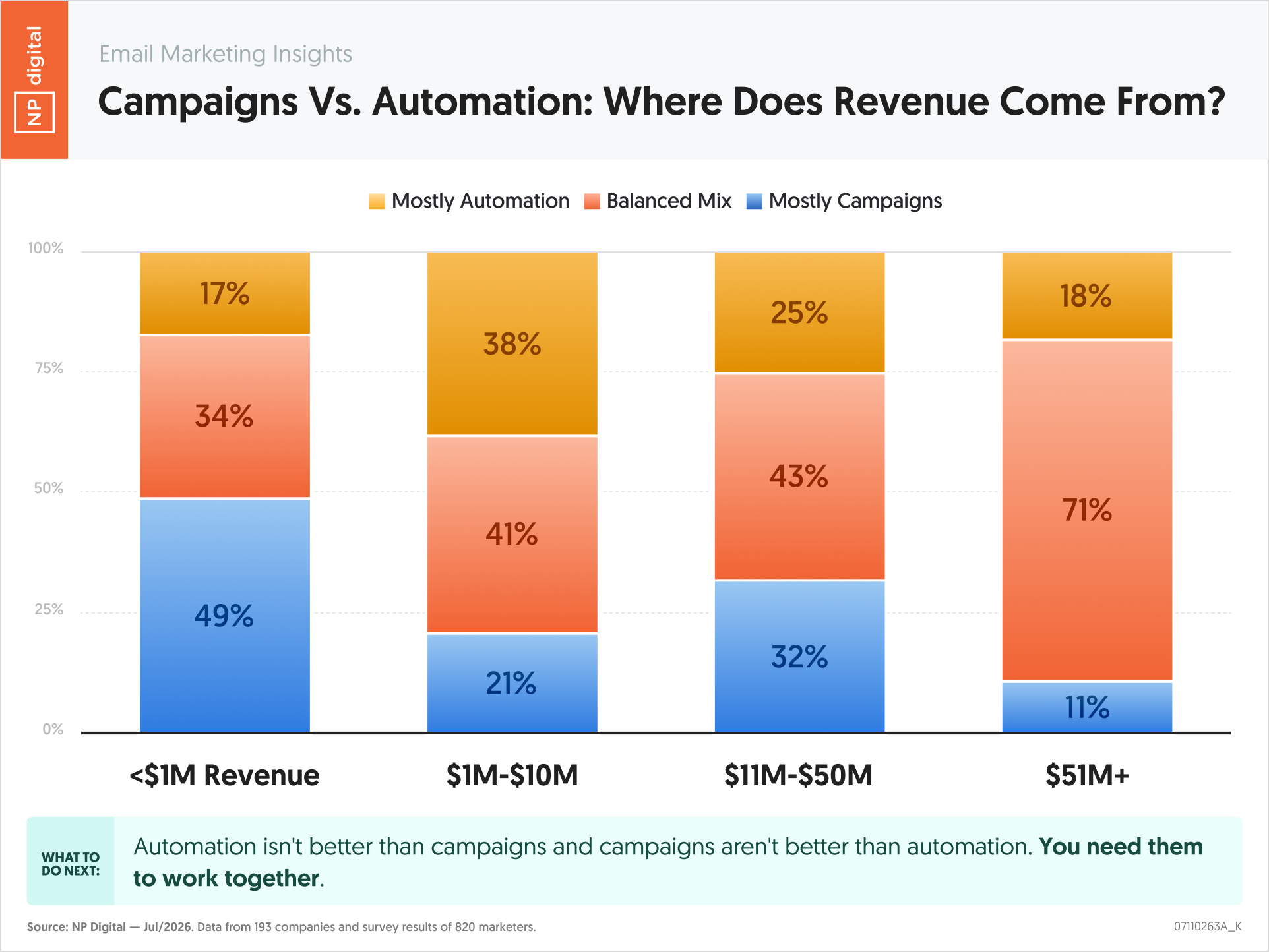
Where email revenue comes from shifts as companies grow. This data from 193 companies and 820 marketers breaks down the mix of mostly automation, balanced mix, and mostly campaigns by revenue band, and the pattern is consistent: smaller companies rely more heavily on campaign sends while larger companies have built more automation infrastructure. But the data also shows that the balanced mix approach dominates at every revenue tier above $1 million, suggesting that neither automation nor campaigns alone produces optimal email revenue at scale.
Essential Statistics
- Companies with less than $1 million in revenue derive 49 percent of email revenue from mostly campaigns, 34 percent from a balanced mix, and 17 percent from mostly automation.
- Companies with $1 million to $10 million in revenue shift toward automation, with 38 percent mostly automation, 41 percent balanced mix, and 21 percent mostly campaigns.
- Companies with $11 million to $50 million in revenue show 25 percent mostly automation, 43 percent balanced mix, and 32 percent mostly campaigns.
- Companies with $51 million or more in revenue show 18 percent mostly automation, 71 percent balanced mix, and 11 percent mostly campaigns.
- The balanced mix approach is the most common approach at every revenue tier above $1 million, peaking at 71 percent for companies with $51 million or more in revenue.
Key Takeaways
- The dominance of the balanced mix at scale reflects how email revenue actually works: automation handles high-intent behavioral moments like welcome series and abandoned cart, while campaigns handle promotional events, seasonal timing, and new product announcements. Neither replaces the other because they serve different revenue-generating moments in the customer lifecycle.
- The high campaign dependence at under $1 million, at 49 percent mostly campaigns, reflects both resource constraints and list immaturity. Smaller companies typically do not have the behavioral data history or list segmentation infrastructure to build effective automation programs, making campaign sends the practical starting point.
- The shift toward balanced mix as companies grow confirms that automation investment compounds over time. Companies in the $1 million to $10 million tier have begun building automation infrastructure, and the $51 million-plus tier has reached a point where automation and campaigns are treated as equally important, complementary revenue streams.
- The 71 percent balanced mix at the highest revenue tier is the strongest signal in the data. Companies at scale have learned through experience that optimizing one approach at the expense of the other reduces total email revenue, which is why the vast majority maintain both streams actively.
- The declining mostly-campaigns share from 49 percent at the smallest tier to 11 percent at the largest is a maturity indicator. Companies that still derive most email revenue from campaigns at scale either have not invested in automation infrastructure or are operating in a category where behavioral triggers are less applicable.
Actionable Insights
- If you are a smaller company deriving most email revenue from campaigns, prioritize building three foundational automations before adding more campaign sends: a welcome series, an abandoned cart sequence for e-commerce or lead nurture sequence for B2B, and a win-back automation for lapsed subscribers. These three automations address the highest-value behavioral moments in almost every email program and produce revenue continuously without requiring ongoing campaign production effort.
- If you are in the $1 million to $10 million tier, resist the temptation to move primarily to automation. The 38 percent mostly-automation share at that tier is the highest in the dataset, suggesting that some companies overcorrect toward automation at the expense of campaign sends. The 41 percent balanced mix at the same tier is the majority approach and the one that produces the best long-term email revenue results.
- Use the 71 percent balanced mix at the $51 million-plus tier as your strategic target model, regardless of your current revenue size. The largest and most sophisticated email programs have converged on a balanced approach, which means building toward that mix from early in your email program development avoids the oscillation between campaign-heavy and automation-heavy approaches that most companies go through before reaching the balanced state.
- Audit whether your current email revenue reporting separates campaign and automation contribution. Most email platforms attribute revenue to campaigns and automated sends separately, but many reporting dashboards combine them. Splitting the attribution reveals which stream is growing, which is stagnating, and where your next investment will produce the highest incremental return.
- Build your automation investment plan around the highest-value behavioral triggers in your specific category. Automation’s revenue share does not grow automatically with company size. It grows because larger companies have invested in identifying and instrumenting the behavioral moments where automated sends produce the highest return. Mapping your customer journey to find the three to five highest-intent moments and building automations around them is the practical implementation of the balanced mix strategy.
”The largest email programs run a balanced mix of campaigns and automation. That is not a coincidence. Automation handles the high-intent behavioral moments and campaigns handle timing and promotional events. You need both because they serve different revenue-generating moments in the customer lifecycle. Optimizing one at the expense of the other reduces total email revenue.” – Neil Patel