 Sign In








What Inbox Providers Actually Prioritize vs. What Marketers Think
Info
-
Source: NP Digital
-
Date: July 2026
-
Category: Email Marketing
-
Study Methodology: Data from 193 companies and survey results of 820 marketers.
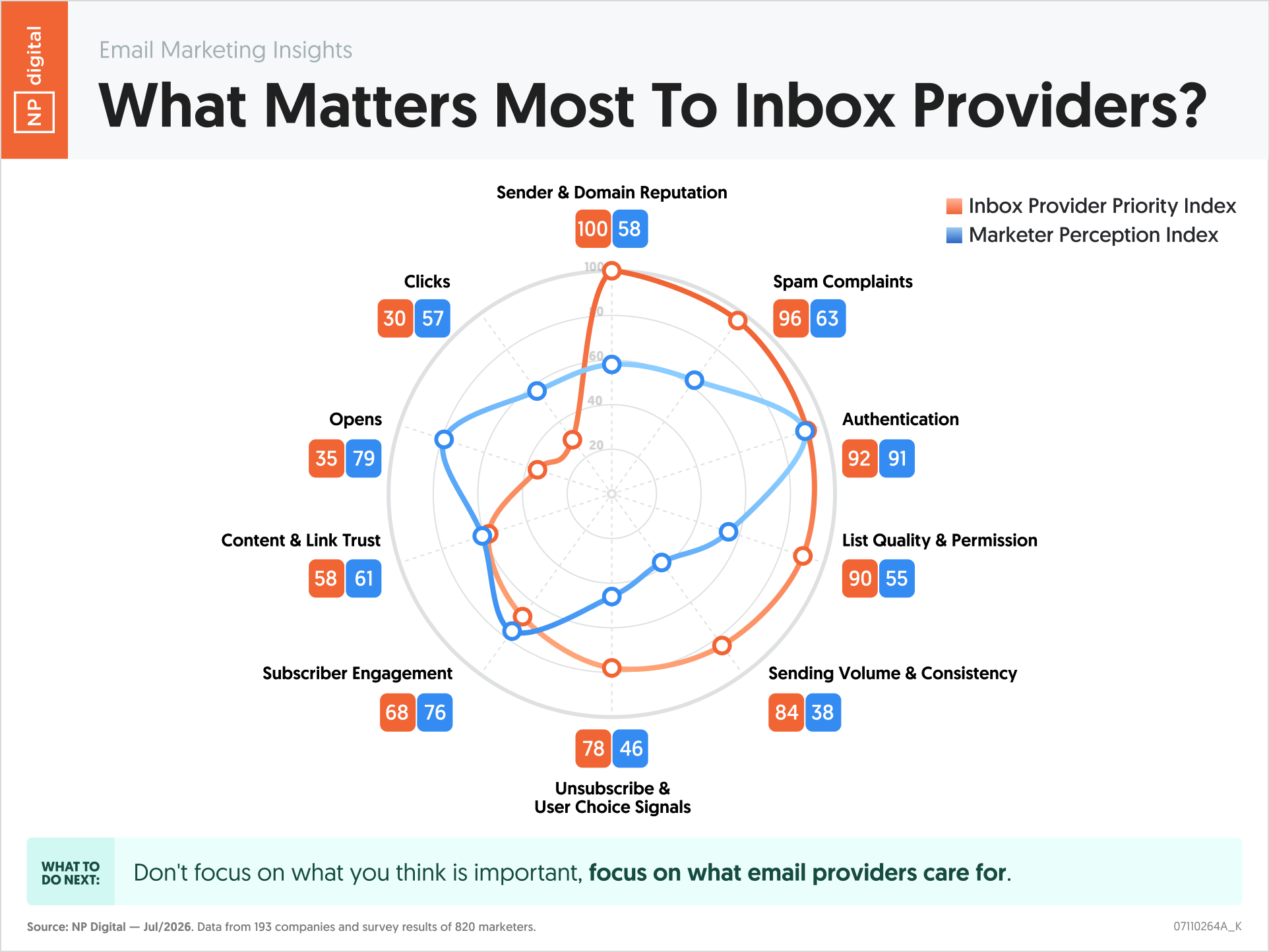
Marketers and inbox providers do not agree on what determines email deliverability. This radar chart from 193 companies and 820 marketers plots inbox provider priority scores against marketer perception scores across nine deliverability signals, and the gaps reveal a consistent pattern: marketers overweight engagement metrics like opens and clicks while underweighting infrastructure signals like sender reputation, spam complaints, and list quality. Closing those perception gaps is the most direct path to improved deliverability.
Essential Statistics
- Sender and domain reputation scores 100 on the inbox provider priority index and 58 on the marketer perception index, the largest absolute gap in the dataset at 42 points.
- Spam complaints score 96 on the provider index and 63 on the marketer index, a 33-point gap.
- List quality and permission scores 90 on the provider index and 55 on the marketer index, a 35-point gap.
- Sending volume and consistency scores 84 on the provider index and 38 on the marketer index, the second-largest absolute gap at 46 points.
- Opens score 35 on the provider index and 79 on the marketer perception index, a 44-point gap in the opposite direction, meaning marketers overweight opens relative to what inbox providers actually use as a signal.
- Authentication scores 92 on the provider index and 91 on the marketer index, the only signal where marketer perception closely matches provider priority.
Key Takeaways
- The sender and domain reputation gap at 42 points is the most commercially significant finding. Inbox providers weight sender reputation as the primary deliverability signal, but marketers perceive it at only 58 percent of its actual importance. This explains why many teams focus on subject line and content optimization while their inbox placement suffers from reputation problems that those tactics cannot fix.
- The opens gap running in the opposite direction at 44 points reveals a specific misconception: marketers believe open rates signal engagement to inbox providers at a much higher rate than providers actually use that signal. This has been reinforced by years of open rate reporting as the primary email performance metric, but inbox providers have been publicly downweighting open signals as Apple Mail Privacy Protection and similar features inflate open rates with bot-generated data.
- Sending volume and consistency at a 46-point gap confirms that most marketers do not think about the regularity and volume of their sends as a deliverability input. Inbox providers use sending pattern data to establish expected behavior baselines. Sudden volume spikes, irregular send patterns, and warm-up failures all trigger filtering responses that marketers typically attribute to content or subject line problems rather than sending pattern anomalies.
- List quality and permission at a 35-point gap reflects the underinvestment in list hygiene that is endemic in email marketing. Inbox providers score permission and list cleanliness very highly because high bounce rates, spam traps, and unengaged subscribers are signals of poor list management that directly affect sender reputation.
- Authentication being the only well-calibrated signal at a 1-point gap confirms that DKIM, SPF, and DMARC implementation is well understood by most marketing teams. This is likely because authentication requirements have been made increasingly explicit by inbox providers through policy enforcement.
Actionable Insights
- Audit your sender and domain reputation before any other deliverability optimization. Check your domain reputation in Google Postmaster Tools and Microsoft SNDS at least monthly. If your reputation score is below Good, address it before running any open rate or click rate optimization tests, because those tests will produce unreliable results on a reputation-impaired sender.
- Build a spam complaint rate dashboard and set an alert threshold at 0.1 percent. Most teams are not monitoring this signal with the priority that inbox providers assign to it. A spam complaint rate above 0.1 percent will trigger filtering at Gmail. A rate above 0.3 percent will cause significant deliverability degradation. Most email platforms surface this metric but few teams track it as a primary KPI.
- Implement a sending consistency policy that avoids large volume spikes between sends. Build send cadence rules that limit how much volume can increase between sends, typically no more than a 30 to 50 percent week-over-week increase, and apply dedicated IP warm-up protocols any time volume increases significantly from a new or rested IP address.
- Run a quarterly list hygiene pass to remove unengaged, bounced, and permission-questionable subscribers. A list with 20 percent unengaged subscribers is not a 100,000-subscriber list for deliverability purposes. It is a 80,000-subscriber list with 20,000 reputation liabilities. Removing the unengaged portion improves inbox placement for the active segment immediately.
- Stop using open rate as your primary deliverability diagnostic. Replace open rate with inbox placement rate and spam complaint rate as your primary deliverability KPIs, and use opens only as a relative engagement signal between campaigns rather than as an absolute deliverability indicator.
”Inbox providers weight sender reputation at 100. Marketers perceive it at 58. That 42-point gap is the primary reason so many email programs have deliverability problems that subject line testing and content changes cannot fix. Reputation is not a campaign-level metric. It is infrastructure. Treat it like infrastructure.” – Neil Patel