 Sign In







Where Email Teams Are Most and Least Ready for AI
Info
-
Source: NP Digital
-
Date: July 2026
-
Category: Email Marketing
-
Study Methodology: Data from 193 companies and survey results of 820 marketers. Row percentages may not total 100% due to rounding.
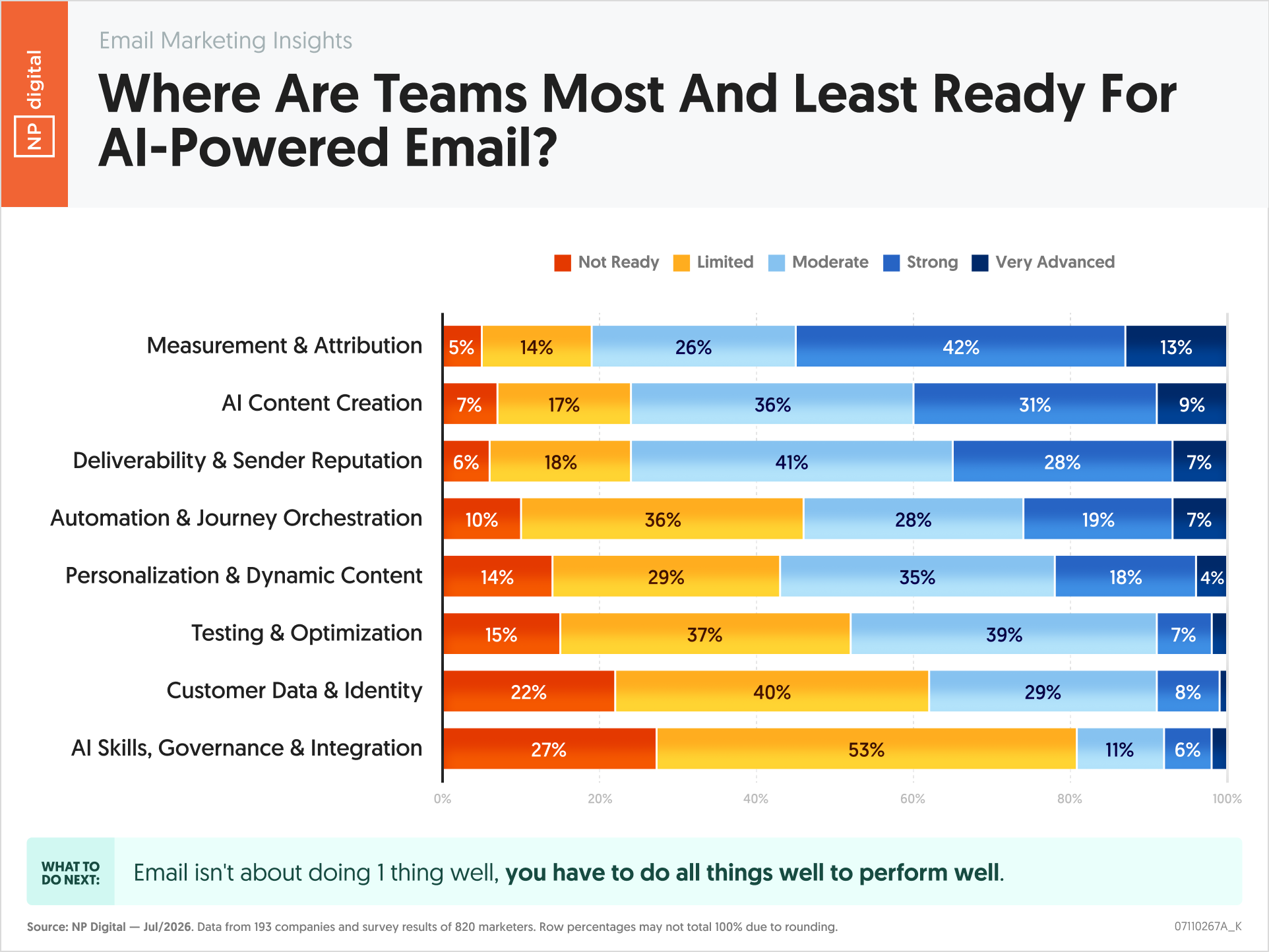
Email teams are not uniformly ready for AI-powered email. This readiness assessment from 193 companies and 820 marketers evaluates eight capability areas across five readiness levels, from not ready through very advanced. The results show significant variation: measurement and attribution leads readiness with a majority reporting strong or very advanced capability, while AI skills, governance, and integration trail with 80 percent reporting not ready or limited capability. The capability gap defines exactly where AI email investment will either succeed or stall.
Essential Statistics
- Measurement and attribution is the most ready capability with 55 percent of teams reporting strong or very advanced readiness and only 19 percent reporting not ready or limited.
- AI content creation shows 40 percent strong or very advanced readiness and 24 percent not ready or limited.
- Deliverability and sender reputation shows 35 percent strong or very advanced and 24 percent not ready or limited.
- Automation and journey orchestration shows 26 percent strong or very advanced and 46 percent not ready or limited.
- Personalization and dynamic content shows 22 percent strong or very advanced and 43 percent not ready or limited.
- AI skills, governance, and integration is the least ready capability with only 17 percent strong or very advanced and 80 percent not ready or limited, the highest not-ready rate in the dataset.
Key Takeaways
- Measurement leading AI email readiness at 55 percent strong or very advanced is a positive foundation finding. Teams with strong measurement capability have the attribution infrastructure needed to evaluate AI email initiatives accurately, which means they can learn from AI experiments faster than teams without that foundation.
- AI skills, governance, and integration trailing at 80 percent not ready or limited is the most significant constraint in the dataset. Implementing AI email initiatives requires a team that understands how to apply AI tools, a governance framework for AI-generated content, and the technical integration skills to connect AI platforms with email infrastructure. Without these, AI email investments stall at the pilot stage regardless of how good the tools are.
- Automation readiness at 46 percent not ready or limited signals that a large portion of email teams do not yet have the journey orchestration infrastructure that AI-powered automation requires. AI lifecycle automation is built on top of existing automation architecture. Teams that have not yet implemented robust behavioral triggers and lifecycle flows will find AI automation difficult to implement effectively.
- Personalization readiness at 43 percent not ready or limited reflects the data infrastructure gap identified in the broader AI personalization data. Dynamic content and AI recommendations require clean, connected data across behavioral, transactional, and CRM systems that most teams have not yet unified.
- The pattern across the eight capabilities reveals a two-tier readiness structure: measurement and content creation are relatively mature, while the operational capabilities, automation, personalization, testing, data, and AI skills, are predominantly not ready or limited. AI email success requires the operational tier to catch up with the measurement tier.
Actionable Insights
- Use the readiness assessment framework to identify your own team’s capability gaps before committing to specific AI email initiatives. Map your team’s readiness across the same eight capability areas using the five-level scale in this chart, then sequence your AI email investments to start with capabilities where you are already at moderate or strong readiness rather than starting with the capabilities where you are not ready.
- Address AI skills, governance, and integration as a prerequisite for any serious AI email program. The 80 percent not-ready rate is not a tool problem. It is a people and process problem. Assigning one team member to develop specific AI email skills, establishing a content governance policy for AI-generated email, and building the integration pathway between your AI tools and your email platform are the three concrete steps that move this capability from not ready to limited in 60 days.
- Build automation and journey orchestration capability before layering AI onto it. The 46 percent not-ready rate for automation means that AI lifecycle automation, which is the highest-impact AI email initiative per the companion ranking chart, cannot be effectively implemented without the underlying behavioral trigger and journey architecture. Investing 90 days in building foundational automation flows before adding AI to them produces better outcomes than skipping to AI automation on a bare infrastructure.
- Leverage your measurement and attribution readiness as the foundation for AI email business case building. If 55 percent of your team has strong or very advanced measurement capability, use it to establish baseline performance metrics for each email capability area before implementing AI. Post-implementation measurement then produces credible before-and-after comparisons that justify continued AI investment to leadership.
- Sequence your AI email roadmap from highest-readiness to lowest-readiness capability areas. Starting with AI applications in areas where your team is already strong produces faster wins and builds organizational confidence in AI email before tackling the harder capability areas. A team with strong measurement and deliverability readiness should start AI email investment in measurement enhancement and deliverability optimization before attempting AI personalization or journey automation.
”AI skills, governance, and integration is the least ready capability in email at 80 percent not ready or limited. That is not an AI problem. It is an organizational readiness problem. You cannot implement AI-powered email if your team does not know how to use AI tools, has no governance policy for AI content, and has no integration between your AI platforms and your email system. Fix the foundation before buying the technology.” – Neil Patel