 Sign In




Which Email Automation Generates the Most Revenue?
Info
-
Source: NP Digital
-
Date: July 2026
-
Category: Email Marketing
-
Study Methodology: Source: NP Digital, July 2026. Data from 193 companies and survey results of 820 marketers.
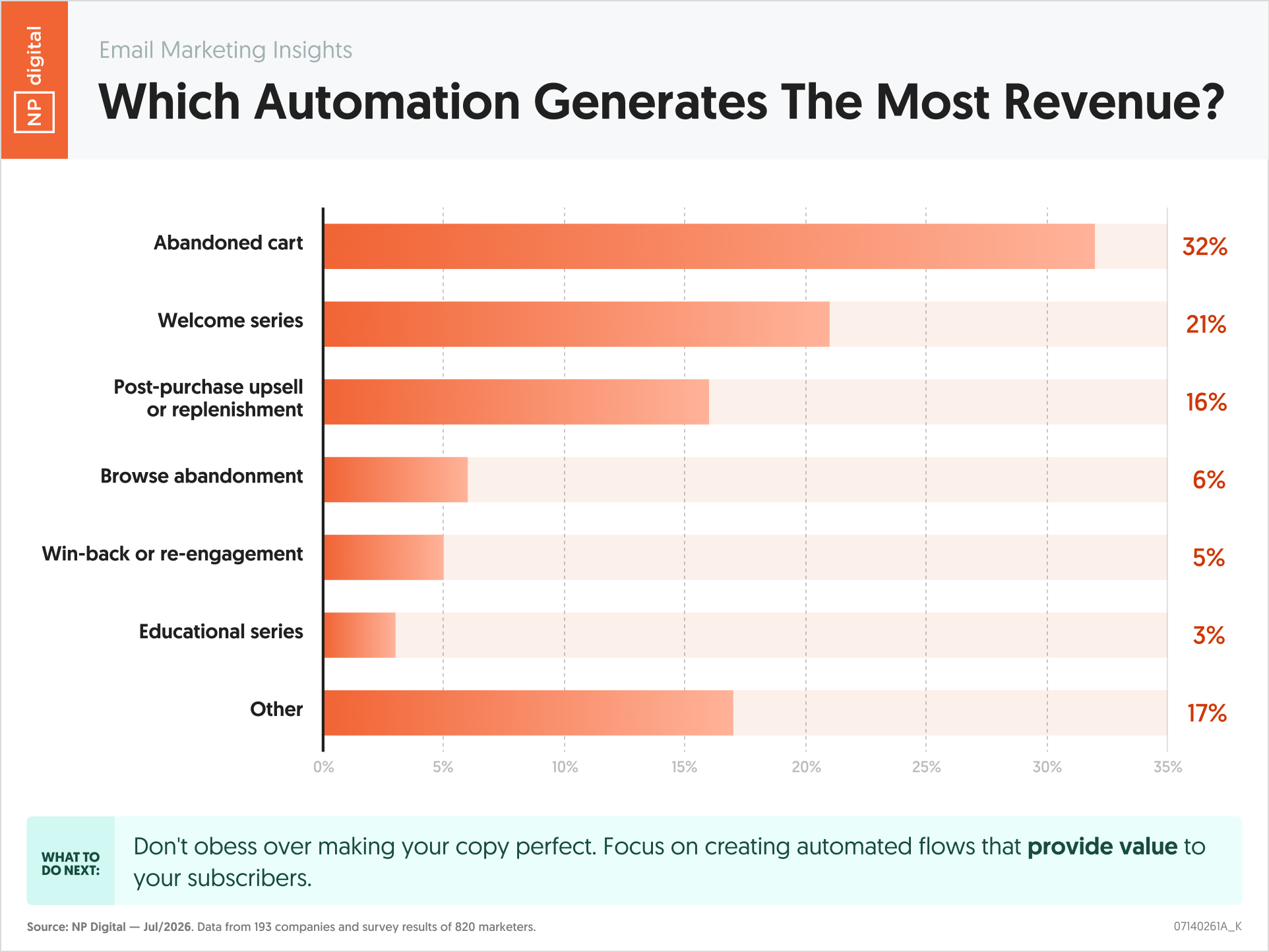
Email automation revenue is concentrated in a small number of high-impact flow types. This survey of 193 companies and 820 marketers ranks seven automation types by revenue generation share, and the results confirm what practitioners consistently experience: abandoned cart and welcome series account for more than half of all email automation revenue. Understanding this concentration is the first step in deciding where to invest automation development time and resources for maximum commercial return.
Essential Statistics
- Abandoned cart automation generates 32 percent of email automation revenue, the top-ranked flow type by a wide margin.
- Welcome series generates 21 percent of email automation revenue, the second-ranked flow type.
- Together, abandoned cart and welcome series account for 53 percent of total email automation revenue.
- Post-purchase upsell or replenishment flows generate 16 percent of automation revenue, the third-ranked type.
- Browse abandonment, win-back or re-engagement, and educational series generate 6 percent, 5 percent, and 3 percent respectively.
- Other automation types account for 17 percent of revenue, representing a broad category that likely includes loyalty, milestone, and survey flows specific to individual business models.
Key Takeaways
- Abandoned cart automation leading at 32 percent reflects the high commercial intent of the trigger event. A subscriber who adds a product to a cart and exits has demonstrated the strongest purchase intent available in an e-commerce context. Converting even a fraction of that intent through a timely, friction-reducing email produces revenue that is directly attributable to the automation.
- Welcome series at 21 percent reflects the lifetime value of first-impression optimization. The welcome moment is when subscribers are most engaged, most likely to open, and most receptive to establishing a brand relationship. Welcome series that effectively set expectations, deliver immediate value, and introduce key products or services produce compounding revenue impact across the subscriber’s lifetime, not just at the welcome moment.
- Post-purchase upsell and replenishment at 16 percent captures the second-highest commercial intent moment after cart abandonment: the window immediately following a purchase when the subscriber has confirmed they trust the brand enough to buy. This moment is underutilized relative to its revenue potential in most email programs.
- Browse abandonment at 6 percent is lower than many practitioners expect given its intuitive logic. The intent signal from browsing is weaker than from cart addition, which means browse abandonment emails require more compelling offers or social proof to convert the lower-intent trigger into a purchase.
- Educational series at 3 percent reflects the longer conversion timeline of content-based automation rather than a lack of value. Educational flows build product understanding and brand trust over weeks rather than hours, which produces revenue that often appears in the attributable window of a later campaign or automation rather than in the educational flow itself.
Actionable Insights
- If you do not have an abandoned cart automation, build it before any other email automation investment. At 32 percent of email automation revenue, it is the highest single revenue contribution available in email automation. A three-email abandoned cart sequence, sent at one hour, 24 hours, and 72 hours after abandonment, captures the majority of recoverable cart revenue with minimal ongoing maintenance once built.
- If you have an abandoned cart automation, audit its sequence depth and offer structure before building new flows. Most teams have a single abandoned cart email rather than a multi-email sequence. Adding a second and third email to an existing single-email sequence typically increases cart recovery revenue by 40 to 60 percent over the one-email version, often with less effort than building a new automation type.
- Prioritize post-purchase upsell and replenishment as your third automation after abandoned cart and welcome series. At 16 percent of automation revenue, it captures a high-intent commercial moment that most programs underinvest in. For e-commerce, this means a sequence that introduces complementary products 3 to 7 days after purchase. For subscription or consumable products, it means a replenishment reminder timed to the average consumption cycle.
- Build your welcome series before your browse abandonment automation, despite browse abandonment being more commonly discussed. Welcome series generates 21 percent of automation revenue versus browse abandonment’s 6 percent. If your program lacks a welcome series, the investment in building one produces more revenue impact than adding browse abandonment to an already functional welcome flow.
- Use the 17 percent other category as a prompt to audit what automation types are specific to your business model. The other bucket likely contains loyalty milestone emails, subscription renewal reminders, and business-model-specific triggers that do not appear as named categories in the standard taxonomy. For some businesses, these niche flows may contribute meaningfully above the industry averages shown for the named categories.
”Abandoned cart and welcome series together account for 53 percent of email automation revenue. If you have both of those built and optimized, you have captured more than half the available automation revenue with two flows. Everything else is incremental. Start with those two, optimize them fully, then build the rest of your automation library.” – Neil Patel