 Sign In








 Ubersuggest
  AnswerThePublic
 Average ROI Increase From Omnichannel Marketing
Info
-
Source: NP Digital
-
Date: July 2023
-
Category: Ad Spend & Budgets
-
Study Methodology: Sample size: 925 customers worldwide; Collection method: Surveyed companies on ROI impact after implementing omnichannel marketing strategies.
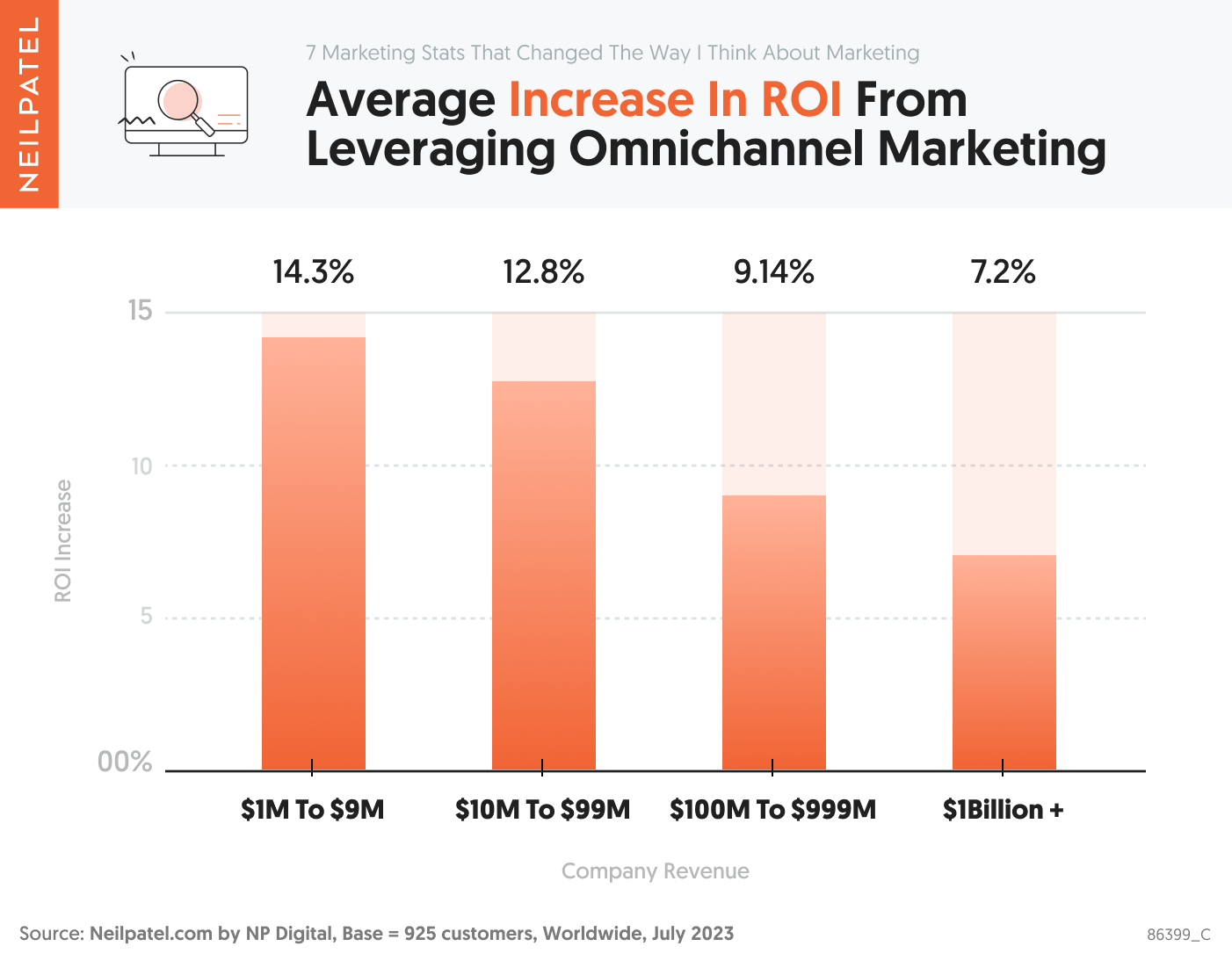
This chart shows how omnichannel marketing impacts ROI across different company sizes. Smaller and mid-sized companies see the largest percentage lift, while enterprise gains remain meaningful but smaller. The data highlights where channel coordination delivers the most leverage.
Essential Statistics
- Companies earning $1M to $9M see a 14.3% ROI increase.
- Companies earning $10M to $99M see a 12.8% ROI increase.
- Companies earning $100M to $999M see a 9.14% ROI increase.
- Companies earning $1B+ see a 7.2% ROI increase.
- ROI lift declines as company size increases.
Key Takeaways
- Omnichannel impact is strongest for smaller companies.
- Coordination delivers diminishing returns at scale.
- Mid-market companies still see meaningful gains.
- Enterprise ROI gains come from efficiency, not growth.
- Channel alignment matters most early in maturity.
Actionable Insights
- Adopt omnichannel early, because smaller companies see the biggest ROI lift. Coordination creates leverage before complexity sets in.
- Focus on integration over expansion, because adding channels without alignment reduces returns. Prioritize consistency across touchpoints.
- Use omnichannel to accelerate growth, because ROI gains are highest in lower revenue tiers. Treat it as a scaling mechanism.
- For enterprise teams, optimize efficiency, because ROI gains flatten at scale. Use omnichannel to reduce waste, not chase growth.
- Benchmark ROI by company size, because expectations should vary by maturity. Set goals that reflect realistic impact.
Omnichannel works best before complexity slows you down. The earlier you align channels, the more upside you get. – Neil Patel