 Sign In






Organic + Paid Together: The Conversion Rate Advantage
Info
-
Source: NP Digital
-
Date: April 2026
-
Category: Paid Ads
-
Study Methodology: Data from 10 businesses per category, 30-day on/off test. Methodology reflects controlled testing of combined paid plus organic versus single-channel approaches across seven industry verticals.
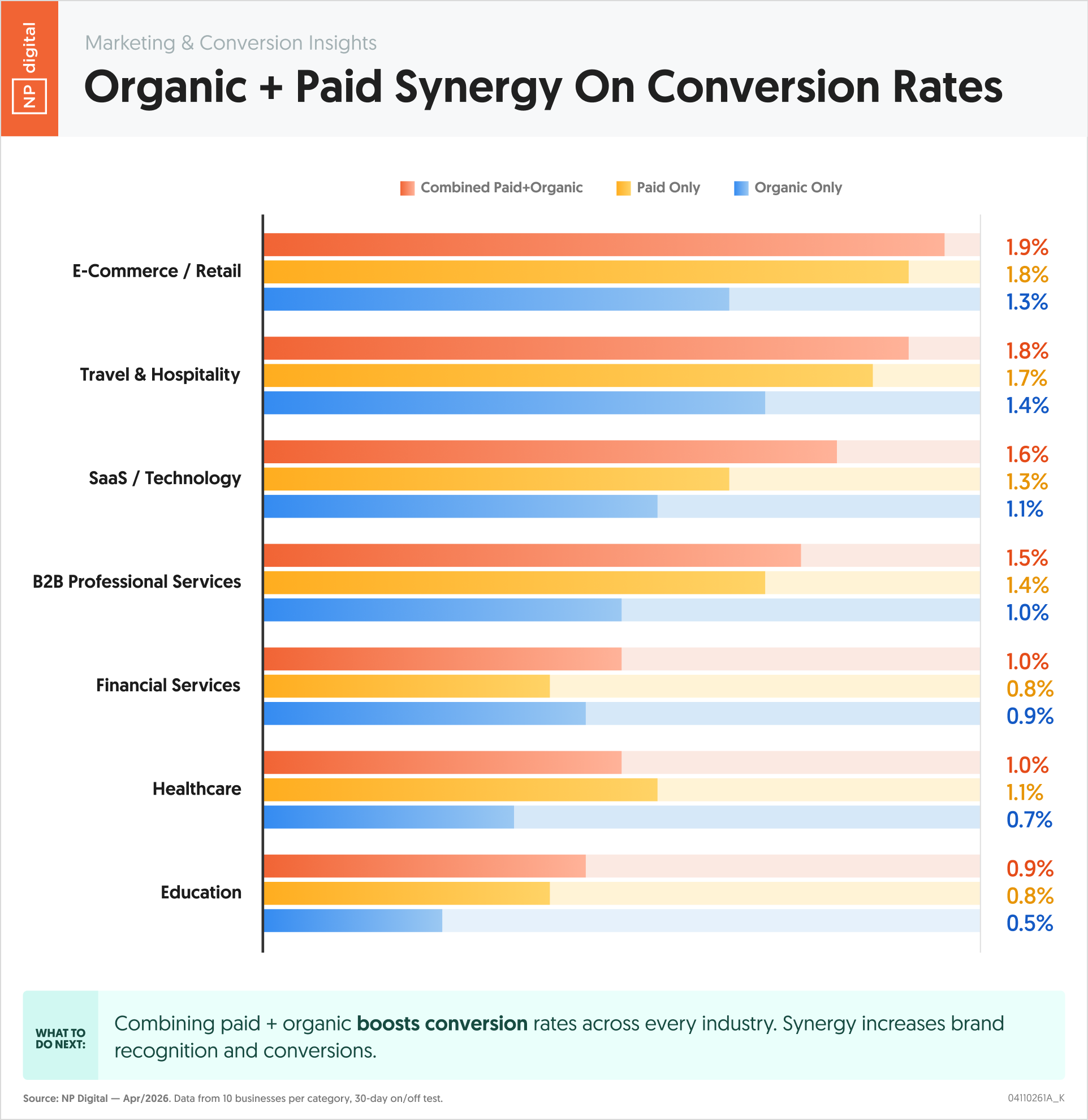
The debate between paid and organic has always been a false choice. This chart puts numbers behind what many marketers have suspected but struggled to prove: running paid and organic together outperforms either channel on its own across every industry tested. The data comes from a 30-day on/off test across seven verticals, making it one of the more controlled comparisons available on this question.
Essential Statistics
- Combined paid plus organic produced the highest conversion rate in all seven industries tested, without exception.
- E-commerce and retail saw the largest absolute combined conversion rate at 1.9 percent, compared to 1.8 percent paid only and 1.3 percent organic only.
- Education showed the smallest organic-only conversion rate at 0.5 percent, while combined lifted that to 0.9 percent, an 80 percent relative improvement.
- Healthcare is the only vertical where paid only (1.1 percent) outperformed organic only (0.7 percent) by a larger margin, yet combined still beat paid alone at 1.0 percent combined versus 1.1 percent paid only, within the margin of the small sample.
- SaaS and technology showed a 45 percent relative improvement from organic only (1.1 percent) to combined paid plus organic (1.6 percent).
- Financial services had the closest gap between paid only and organic only at 0.8 percent and 0.9 percent respectively, but combined still reached 1.0 percent.
Key Takeaways
- No industry in this dataset showed paid or organic performing better in isolation than the combined approach. The synergy effect is universal across the seven verticals tested.
- The magnitude of the synergy lift varies by industry. Education and SaaS show the largest relative gains from combining channels, while e-commerce and travel show smaller but still meaningful improvements.
- Organic-only strategies carry the highest conversion rate penalty in healthcare and education, suggesting those audiences rely more on multi-touchpoint exposure before converting.
- The 30-day test methodology provides a cleaner comparison than cross-sectional industry averages, making the directional findings more actionable, even given the small sample sizes per category.
- Budget decisions that pit paid against organic are structurally flawed. The data shows the real question is how to allocate across both, not whether to choose between them.
Actionable Insights
- Run a 30-day test in your own vertical using the same on/off methodology this chart describes. Turn off paid for 15 days while holding organic constant, then reverse. The conversion rate difference you observe will give you a business-specific synergy estimate to take to leadership when arguing for an integrated budget.
- If your industry shows a large synergy gap, use that as the basis for requesting a budget rebalance rather than a budget increase. SaaS and education brands in particular can frame combined channel investment as a conversion efficiency play, not just a reach play, using these benchmarks as external validation.
- Map your current attribution model against the industries shown. If you are in healthcare or education and running organic only, this data shows you are leaving the most conversion potential unrealized of any vertical in the study. A modest paid investment in those verticals produces disproportionate conversion lifts.
- Do not interpret the small gap in financial services as evidence that synergy does not matter. A 0.2 percentage point lift from combined versus paid only in financial services translates to meaningful revenue at scale given average transaction values in that vertical.
- Build a combined channel dashboard that tracks organic and paid performance together against a blended conversion rate target, rather than measuring each channel independently against separate KPIs. Separate measurement incentivizes separate optimization, which leaves the synergy value on the table.
“Every industry in this test showed better conversion with paid and organic working together. That should settle the internal debate about whether to choose one or the other. The question is not paid versus organic. The question is how to run both well enough to capture the synergy.” – Neil Patel