 Sign In










Sporadic vs. Continuous Creative Testing: The Performance Gap
Info
-
Source: NP Digital
-
Date: April 2026
-
Category: Paid Ads
-
Study Methodology: Data from 50 companies running Google and Meta ads. Findings compare average CPA, test win rate, and monthly test volume between sporadic and continuous testing approaches.
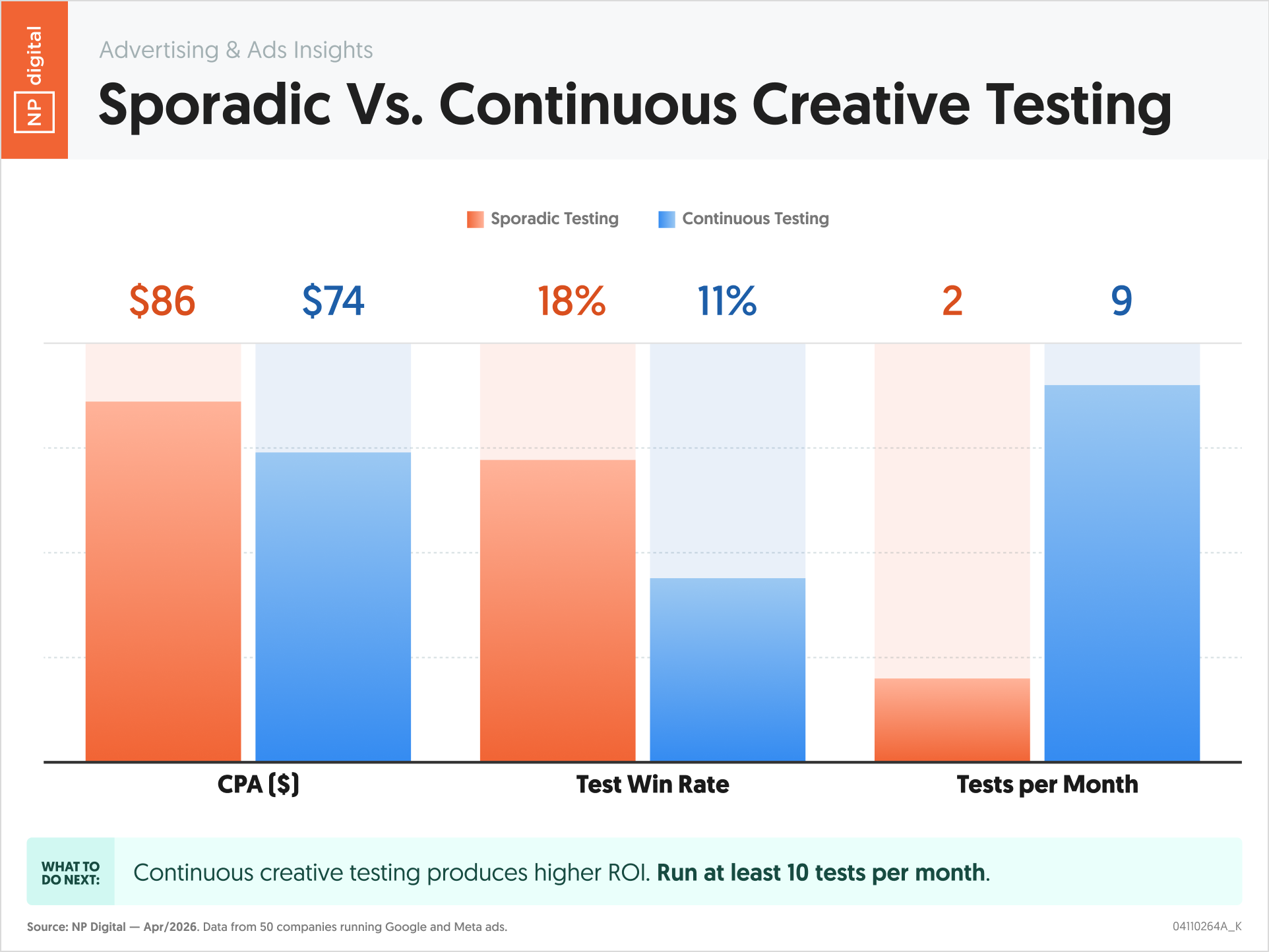
Running a creative test every quarter is not a testing program. It is a habit. This chart compares the outcomes of sporadic versus continuous creative testing across 50 companies on Google and Meta, measuring CPA, test win rate, and tests run per month. The differences across all three metrics favor continuous testing, and the gap in monthly test volume explains most of the performance advantage.
Essential Statistics
- Sporadic creative testing produced an average CPA of $86, while continuous testing reduced CPA to $74, a $12 or roughly 14 percent improvement.
- Sporadic testing achieved an 18 percent test win rate, compared to 11 percent for continuous testing.
- Continuous testers ran an average of nine tests per month versus two tests per month for sporadic testers, a 4.5 times higher test volume.
- Despite a lower individual test win rate, continuous testers generated more total winning creatives per month due to their higher test volume.
- The $12 CPA advantage of continuous testing represents meaningful savings at scale, with impact growing proportionally as monthly ad spend increases.
Key Takeaways
- Continuous testing produces lower CPA despite a lower individual test win rate, because volume of testing generates more total winners than batting average alone.
- The 18 percent win rate for sporadic testers versus 11 percent for continuous testers does not mean sporadic testing is more effective. Sporadic testers run fewer tests and are likely cherry-picking higher-confidence hypotheses, which inflates individual win rate without improving overall performance.
- Nine tests per month versus two is the defining difference in this data. The CPA advantage of continuous testing flows directly from test volume, not from any single test being better designed or more sophisticated.
- A $12 CPA reduction on high-volume campaigns compounds significantly. At 10,000 conversions per month, that gap represents $120,000 in monthly savings, making the case for resourcing continuous testing a financial argument, not just a methodological one.
- Teams that test sporadically tend to treat creative testing as a project. Teams that test continuously treat it as a system. The infrastructure difference, creative pipelines, approval workflows, and rotation rules, is what separates the two groups in practice.
Actionable Insights
- Define a minimum monthly test count and treat it as a non-negotiable operations target. The data shows continuous testers run nine tests per month. Start by committing to at least four to five per month if you currently test sporadically, and build from there as your creative pipeline scales.
- Reframe test win rate as a secondary metric and test volume as the primary one. A team that runs nine tests at 11 percent win rate generates more winners per month than a team that runs two tests at 18 percent. Present test volume alongside win rate in your performance reports to shift internal focus toward cadence.
- Build a lightweight creative brief template that reduces time-to-test for each new variant. The operational bottleneck for most teams shifting from sporadic to continuous testing is brief-writing and creative production, not platform setup. A one-page brief format that can be completed in under 30 minutes removes the biggest friction point in your testing pipeline.
- Calculate your current CPA against the $74 benchmark for continuous testers and use the gap to quantify your testing program’s cost. If your CPA is above $74 and you are testing sporadically, you can estimate the revenue impact of closing that gap and use it to justify creative production investment.
- Set up an always-on creative rotation rule that automatically enters new test variants into delivery as soon as they are approved. Continuous testing breaks down when approved creatives sit in a queue waiting for manual activation. Automating the rotation step removes the human delay that turns continuous programs into sporadic ones.
“The win rate data here is deceptive if you read it the wrong way. Sporadic testers win 18 percent of tests, continuous testers win 11 percent. But continuous testers run 4.5 times more tests per month, so they find more winners, learn faster, and compound those learnings into lower CPA. Volume beats batting average every time in creative testing.” – Neil Patel