 Sign In













Key Takeaways
- Intent beats volume in B2B. Long-tail, comparison, integration, and pain-point keywords bring the highest-quality traffic because they mirror how real buyers evaluate solutions.
- Your best keywords come from conversations, not tools. Sales teams and customers surface language and questions that keyword tools can’t predict.
- B2B funnels require keyword mapping. TOFU, MOFU, and BOFU terms attract different stakeholders at different readiness levels. If you skip a stage, you break your pipeline.
- Clusters win in B2B SEO. Organizing keywords into pillars and supporting clusters builds authority and guides buyers naturally through research and evaluation.
- Keyword lists are only valuable when activated. Use them for on-page optimization, schema, content hubs, repurposed formats, and now LLMO to appear in AI-generated answers.
When targeting businesses vs. customers with your SEO tactics, there are different formulas that come into play.
But the answer is always the same: “Content matters.”
This is especially true in the world of B2B, where conversions tend to take longer to occur, and customers typically have a deeper understanding of their specific niche.
The right keywords mean people can find you when searching for products and services like yours. And, in the modern marketplace, it’s all about personalization.
Choosing keywords worth targeting, meaning ones that will actually lead to conversions, means matching your research to your target audience. Gone are the days where you can simply focus on target keywords for a given industry. You need to get clear on who your ideal customer is (a customer persona is the best way), work backwards from there, and conduct your keyword research accordingly.
Let’s see how you can use it to supercharge the conversions in your business.
- Intent beats volume in B2B. Long-tail, comparison, integration, and pain-point keywords bring the highest-quality traffic because they mirror how real buyers evaluate solutions.
- Your best keywords come from conversations, not tools. Sales teams and customers surface language and questions that keyword tools can’t predict.
- B2B funnels require keyword mapping. TOFU, MOFU, and BOFU terms attract different stakeholders at different readiness levels. If you skip a stage, you break your pipeline.
- Clusters win in B2B SEO. Organizing keywords into pillars and supporting clusters builds authority and guides buyers naturally through research and evaluation.
- Keyword lists are only valuable when activated. Use them for on-page optimization, schema, content hubs, repurposed formats, and now LLMO to appear in AI-generated answers.
B2B vs B2C Keyword Research
With both B2B and B2C keyword research, your ideal user or customer should be at the center of what you do.
With B2B marketing, you focus on various decision-makers, like a team lead, manager, or even the CEO. These keywords are typically lower volume, but are higher value when you rank well for them.
With B2C marketing, the only decision-maker you’re worried about is the customer. Your marketing should be geared directly towards them, which makes understanding your target audience even more important.
One of the challenges with B2B marketing is the sales cycle. Business-to-business conversions generally take longer than B2C. There’s a big difference between someone buying a pair of socks versus investing in a software suite for a whole company.
There are some parallels, but by and large, B2B buyers have different behavior. This is where accurate intent mapping comes into play. Understanding which keywords are ranking is only half the battle. Matching the intent behind the search for each query gives a much clearer picture of what will move your target customers further along their buyer journey, ultimately leading to a conversion.
The good news is that in some ways, your best practices stay the same.
Know your product, then move to understand your market and competition to build the best B2B keyword list.
B2B keyword research helps you win over the decision-makers at hand, but this can be tricky.
There’s a different drive to the transaction. You need to take a different approach to earn their buyer intent.
To address their unique needs, you need to demonstrate your expertise not only in the niche but also in the specific pain points within that niche. That means picking the right keywords for your content and pages. To inspire your B2B keyword research, ask yourself:
- What kind of businesses am I targeting? How big are their teams? Are they in industries I can flourish in?
- Am I trying to reach businesses at the executive, manager, or employee level?
- Of the decision-makers I’m targeting, what challenges are they up against? How is their current system failing them?
If you don’t keep these questions in mind during your keyword research, you’ll have a tough time reaching your B2B SEO goals.
Taking the time to get it right is critical to long-term growth.
What Makes the B2B Buyer Journey Unique (and how it impacts keywords)
B2B buyers don’t search like consumers. They ask more questions and involve more decision-makers. That means your keyword strategy needs to map to every stage of the funnel, because each stage comes with its own unique intent.
At the top of the funnel (TOFU), people are looking to understand the problem. Think keywords like “what is lead nurturing” or “how to qualify B2B leads.”
In the middle (MOFU), they’re evaluating options. That’s where terms like “best B2B CRM platforms” or “HubSpot vs. Salesforce” show up.
At the bottom (BOFU), they’re ready to buy. They’ll search for things like “HubSpot onboarding consultant” or “best CRM for B2B SaaS.”
If you skip a stage, you risk confusing or losing your audience. Match your keywords to where buyers actually are, not where you hope they are.
How To Find High-Intent B2B Keywords That Actually Convert
To drive real leads, you need more than traffic. Here’s how to find keywords that match intent and move B2B buyers toward a decision.
Step 1. Interview Your Sales Team and Customers
If you want high-intent keywords, talk to the people on the front lines.
Your sales team knows exactly what questions prospects ask before they buy. They hear the same objections, pain points, and decision criteria repeatedly. That language? It’s keyword fuel. Ask them: What are the top questions you hear? What phrases come up in discovery calls? What signals buying intent?
Then talk to a few current customers. Ask what they Googled before they found you. What words did they use to describe their problem? Why did they choose you over a competitor?
These conversations don’t have to be formal. A quick 15-minute chat can uncover terms your audience actually uses that your keyword tool might miss.
Log every phrase, question, and pain point. You’ll use them later to validate topics and shape content that speaks directly to your buyer’s intent.
Step 2. Use Tools To Expand Your Keyword Set
Once you’ve got seed terms from sales and customers, plug them into keyword tools to scale.
Start with Ubersuggest or Semrush to find related phrases, autocomplete suggestions, and questions your audience is already searching for.
AnswerThePublic is great for uncovering long-tail keywords phrased as real questions—perfect for B2B blog content and landing pages.
Focus on commercial-intent keywords, terms that suggest the searcher is in buying mode. Look for modifiers like “best,” “vs,” “top,” or “software for [industry].”
Don’t just chase volume. Check keyword difficulty to make sure you can rank, and look at CPC (cost per click) to gauge how valuable a keyword is to advertisers. High CPC usually means it’s converting for someone.
This is where you turn insights into opportunity. The right tools help you see the full landscape and find the gaps your competitors missed.
Step 3. Spy on Competitors (Especially in Niche B2B)
If your competitors are already ranking, reverse-engineer what’s working for them.
Tools like Semrush and Ahrefs let you plug in a competitor’s domain and see the exact keywords they rank for, along with positions, search volume, and traffic estimates. This gives you a fast snapshot of what’s driving their visibility.
Look for content gaps. Are there high-value keywords they missed? Are there topics they cover that you could go deeper on, with more data, better examples, or stronger CTAs?
In niche B2B markets, you won’t find millions of searches—but that’s the point. The right long-tail keyword with even 100 searches a month could drive qualified leads if the intent is strong and the competition is low.
Don’t copy what they’ve done. Use it as a launchpad. Then build something more useful, more specific, and more aligned with your buyer’s needs.
Step 4. Analyze Intent, Not Just Volume
In B2B, high search volume doesn’t always mean high value.
A keyword like “lead generation” might pull in thousands of searches, but it’s broad and packed with top-of-funnel traffic. Instead, go after long-tail keywords that signal real buying intent.
Look for terms like:
- “SOC 2 vs ISO 27001” – These comparison searches show the buyer is actively evaluating solutions.
- “Lead scoring software for SaaS” – This one’s specific, solution-aware, and vertical-focused. A perfect match for bottom-of-funnel content.
Intent > volume. That’s the rule.
Use keyword tools to filter by modifiers like “vs,” “best,” “alternatives,” or “[industry] software.” These often have lower volume, but they attract leads who are closer to buying and more likely to convert.
Build your keyword strategy around relevance and readiness, not raw traffic. That’s how you attract the right people at the right time.
Step 5. Group Keywords Into Pillars and Clusters
Don’t just build a list, build a structure.
Once you’ve nailed down your keyword set, organize it into pillars and clusters. A pillar page targets a broad, high-value topic like “email marketing software.” Around it, you build supporting content, think clusters like “email automation for B2B,” “lead nurturing workflows,” and “best B2B email sequences.”
This approach does two things:
- It strengthens your SEO by signaling topical authority.
- It aligns with the B2B buyer journey, letting prospects go deeper as they move from problem-aware to solution-ready.
Each cluster targets a long-tail, intent-driven keyword and links back to the pillar. The result? Better rankings and clearer paths to conversion.
Use tools like Ubersuggest or SEMrush’s keyword grouping to speed this up. Just make sure every piece has a purpose in your funnel.
B2B Keyword Types You Should Actually Focus On
Not all keywords are created equal, especially in B2B. Some attract the right audience, move them through the funnel, and convert. Others just bring “fluff traffic” that never turns into leads.
Here are the four keyword types that consistently deliver in B2B:
Comparisons
These are high-intent gold. When someone searches “HubSpot vs Salesforce” or “SOC 2 vs ISO 27001,” they’re in evaluation mode. They’re comparing options and looking for a clear winner.
Create content that breaks down the pros and cons honestly. Side-by-side features, pricing, integrations, and who it’s best for. This is where trust gets built and decisions get made.
Integrations
In B2B, tools rarely stand alone. That’s why keywords like “Slack integration with project management software” or “CRM that integrates with QuickBooks” pull in traffic that’s ready to act.
These searches signal product fit and technical alignment—key for conversion. If your product integrates with other tools, optimize for those terms.
Use-Case Specific
Broad keywords miss the mark. “Lead scoring software” is nice, but “lead scoring software for SaaS” is better. Even better? “lead scoring software for early-stage B2B SaaS.”
The more specific the use case, the higher the intent. Create content that addresses your audience’s specific needs and concerns.
Pain Point Phrases
These are often phrased as questions: “How to reduce churn in B2B SaaS” or “Why aren’t my sales qualified leads converting?” These aren’t just TOFU, they’re strong entry points for solution-aware buyers.
Targeting these keywords helps you show up early in the journey and guide buyers toward your solution.
What to Do After You Have Your Keywords?
Now what?
You know your keyword opportunities. It’s time to put them to work.
Use them to make on-page optimizations in the meta description or body copy.
In addition, by implementing keywords appropriately in areas such as schema markup like FAQs or price listings for e-commerce, you can both have a more optimized and useful listing. Use Ubersuggest or AnswerThePublic to pinpoint the questions your target decision-makers may have. (Hint: They’re already searching for them, and these tools will show you what they are.)
As far as working more B2B SEO keywords into your content, make sure the content is directly related to your existing target B2B keywords.
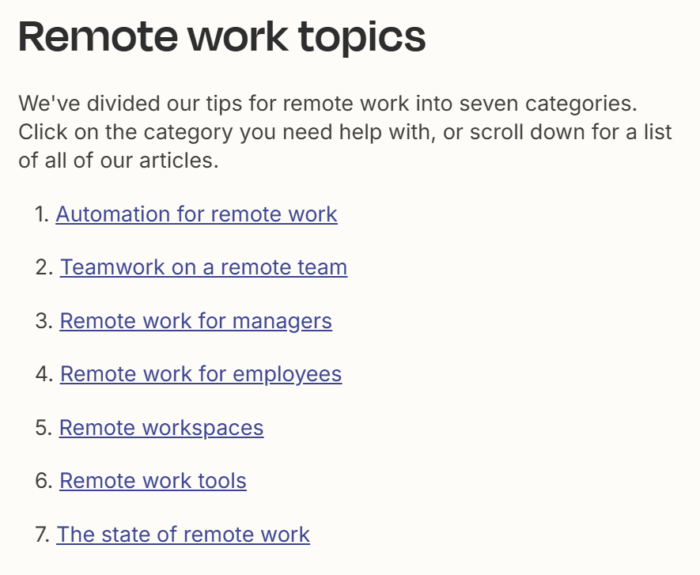
Another quick way to optimize for your target keywords is to structure your internal links in a way that creates content hubs on your site for pieces relevant to your B2B content strategy.
Below you can see Zapier’s Remote Work Guide as a content hub touchpoint example. This page acts as a content hub, with many “spokes” out to different resources around tools and tactics for the main subject: remote work.
Today, your B2B keyword strategy is more about being the source across search, AI, and voice.
Fortunately, you can also use your keyword list to guide large language model optimization (LLMO). Tools like ChatGPT, Gemini, and Claude often cite content when answering B2B queries. If your page is optimized for specific long-tail or question-based keywords, you increase the odds of being surfaced in AI-generated answers.
Using your keywords to shape new content formats is another smart move. Turn question-based terms into short-form video or slideshows. Repurposing like this builds topical authority across channels and sends strong signals back to your core site.
Finally, don’t let your keyword list sit in a spreadsheet. Plug it into your editorial calendar. Map keywords to specific goals, funnel stages, and audience segments. That’s how you turn SEO research into actual business growth.
FAQs
Does SEO work for B2B?
Yes, SEO is a valuable tactic to use to win over buyers. Good organic visibility throughout the sales funnel is a proven technique to drive growth and, in turn, increase interest.
Why is SEO important for B2B?
SEO generates valuable leads and makes it easier for potential buyers to find you. When they’re searching for products or services in relation to yours, you’re more likely to show up in their search results thanks to SEO tactics like using B2B SEO keywords.
How do I create a B2B SEO strategy?
<
<
<
If you want a solid B2B SEO strategy, follow these quick tips:
1. Conduct B2B keyword research. (Hint: Use Ubersuggest to help you get valuable results.)
2. Understand what matters to your target decision-makers and nurture them through your sales funnel.
3. Optimize your site to target your ideal audience by updating aspects like meta descriptions and internal linking.
4. From the B2B keywords, formulate content to position yourself as the answer to your audience’s needs.
5. Promote your content and grow your audience and domain authority through backlinks.
Conclusion
Now that you know how to conduct B2B keyword research using Ubersuggest, you can unlock hidden opportunities for your brand.
Getting the lay of the land in your niche will help. From your competitor analysis on your target B2B keywords, ask yourself: Where do you stand? How can you satisfy buyers in a way that your competitors aren’t?
The goal with B2B content tactics is to position yourself as the answer decision-makers need.
Your keyword research will reveal the topics that reel in buyers, and the content you create will help secure conversions.
Folding B2B SEO keywords into your strategy is a core step in gaining the attention and influence of the brands you’re targeting.