 Sign In





 Ubersuggest
  AnswerThePublic
 AI Adoption by Marketing Function for Local Businesses
Info
-
Date: May 2026
-
Category: AI In Marketing
-
Study Methodology: Sample size: 180 local businesses. Data source: NP Digital survey. Collection method: Online survey. Numbers rounded for clarity.
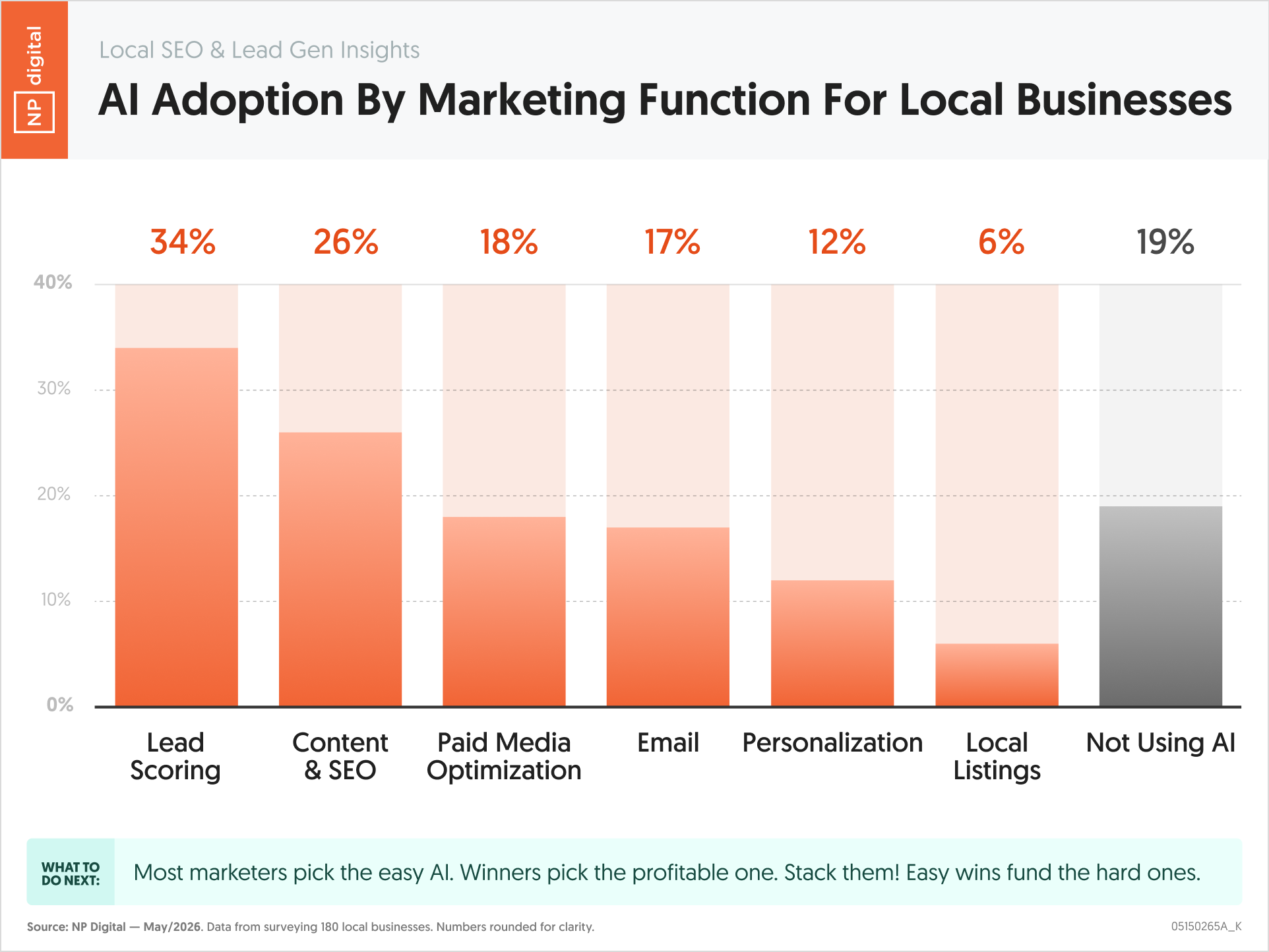
AI adoption in local business marketing is concentrated in the functions where the feedback loop between AI output and business outcome is shortest. Lead scoring leads at 34 percent, content and SEO follows at 26 percent, and the functions at the bottom of the adoption curve are the ones where measuring AI’s specific contribution is more difficult. The 19 percent not using AI at all are not necessarily behind on strategy but might be behind on implementation. Understanding where AI delivers the clearest ROI in local marketing is the prerequisite for building an adoption roadmap that produces measurable results rather than tool proliferation.
Essential Statistics
- 34 percent of local businesses use AI for lead scoring, making it the highest-adoption AI use case across all marketing functions surveyed.
- 26 percent apply AI to content and SEO workflows, ranking second.
- 18 percent use AI for paid media optimization, ranking third.
- 17 percent apply AI to email marketing functions.
- 12 percent use AI for personalization applications.
- Only 6 percent use AI for local listings management, the lowest adoption rate among active marketing functions.
- 19 percent of local businesses report not using AI in any marketing function.
Key Takeaways
- Lead scoring’s position at the top of the adoption curve is not coincidental. It is the function where the gap between AI-assisted and manual performance is most measurable within a single sales cycle. A business can implement a lead scoring model, run it for 60 days, compare close rates on scored versus unscored leads, and have a concrete ROI calculation. That short feedback loop accelerates adoption in a way that functions with longer attribution cycles cannot match.
- Content and SEO at 26 percent reflects both the volume advantages AI offers in content production and the obvious applications in keyword research, brief generation, and on-page optimization. The businesses getting the most value from AI in content and SEO are using it to accelerate production workflows, not to replace editorial judgment.
- Paid media optimization at 18 percent is the most surprising underpenetration in the dataset. The major ad platforms have native AI bidding and targeting optimization built into their campaign structures. Performance Max, Advantage+, and Smart Bidding are all AI-driven. The businesses not using AI for paid media optimization may be running manual bidding campaigns that are foregoing the efficiency gains automated bidding consistently produces.
- Local listings at 6 percent represents the most significant missed opportunity in this dataset, particularly given that local listings drive 28 percent of local business leads per companion survey data. AI tools that monitor NAP consistency, flag duplicate listings, surface review anomalies, and suggest profile updates can maintain the listing quality that local pack rankings require with minimal ongoing management time.
- The 19 percent not using AI at all are making the same mistake: evaluating AI as a category rather than as a specific tool applied to a specific repeatable task. AI adoption produces value when it is targeted at one well-defined function with a clear success metric instead ofd as a platform philosophy.
Actionable Insights
- Start AI adoption with lead scoring and define a specific success metric before you begin. Implement a basic scoring model in your CRM using three to five behavioral signals: page visits, content downloads, email engagement, form completions, and time on site. Run it alongside your existing qualification process for 60 days without changing how sales handles leads. At 60 days, compare close rates for leads that scored above threshold against leads that did not. That comparison is your ROI calculation.
- Use AI for content briefs, keyword clustering, and outline generation rather than full-draft production for your content and SEO workflows. The 26 percent using AI for content and SEO are getting the most value when AI handles research and structural work rather than final writing. A well-structured AI-generated brief that specifies the target keyword, the questions the piece must answer, and the competitor content it should outperform cuts the human writer’s preparation time significantly without sacrificing the editorial quality that determines ranking performance.
- Activate your ad platform’s native AI bidding features on any campaigns currently running manual bid strategies. The 18 percent using AI for paid media and the 82 percent not doing so are often separated by whether they have turned on Smart Bidding in Google Ads or Advantage+ in Meta Ads. These features use AI to optimize bids and targeting in real time based on conversion likelihood signals that manual bidding cannot process at the same speed or scale.
- Implement an AI-powered local listings monitoring tool that checks NAP consistency and flags profile issues across your directory portfolio. At 6 percent adoption for an application that protects a channel driving 28 percent of local leads, this is the most underinvested AI application in local marketing. Tools like Yext, BrightLocal, and Moz Local use AI to monitor listing accuracy across dozens of directories simultaneously and alert you to new duplicate listings as they appear.
- For the 19 percent not using AI in any function, select one specific repeatable task and implement one tool for that task before evaluating anything else. The barrier to AI adoption is almost never capability but scope. Start with whichever task your team finds most repetitive and time-consuming: email subject line testing, review response drafting, ad copy variant generation, or keyword research. Implement one tool, measure the time saved and quality outcome, and build from that foundation.
“Lead scoring leads AI adoption in local marketing because the feedback loop is short. You implement it, run it for 60 days, compare close rates, and you have your answer. Every other AI adoption decision should start the same way: what is the specific task, and how will I know in 60 days whether it worked?” – Neil Patel