 Sign In









Which Industries Are Seeing the Biggest AI Search Disruption?
Info
-
Source: NP Digital
-
Date: June 2026
-
Category: AI In Marketing
-
Study Methodology: Data from WebFX, Conductor, Search Engine Land. Plus a survey of 500 marketers and business owners.
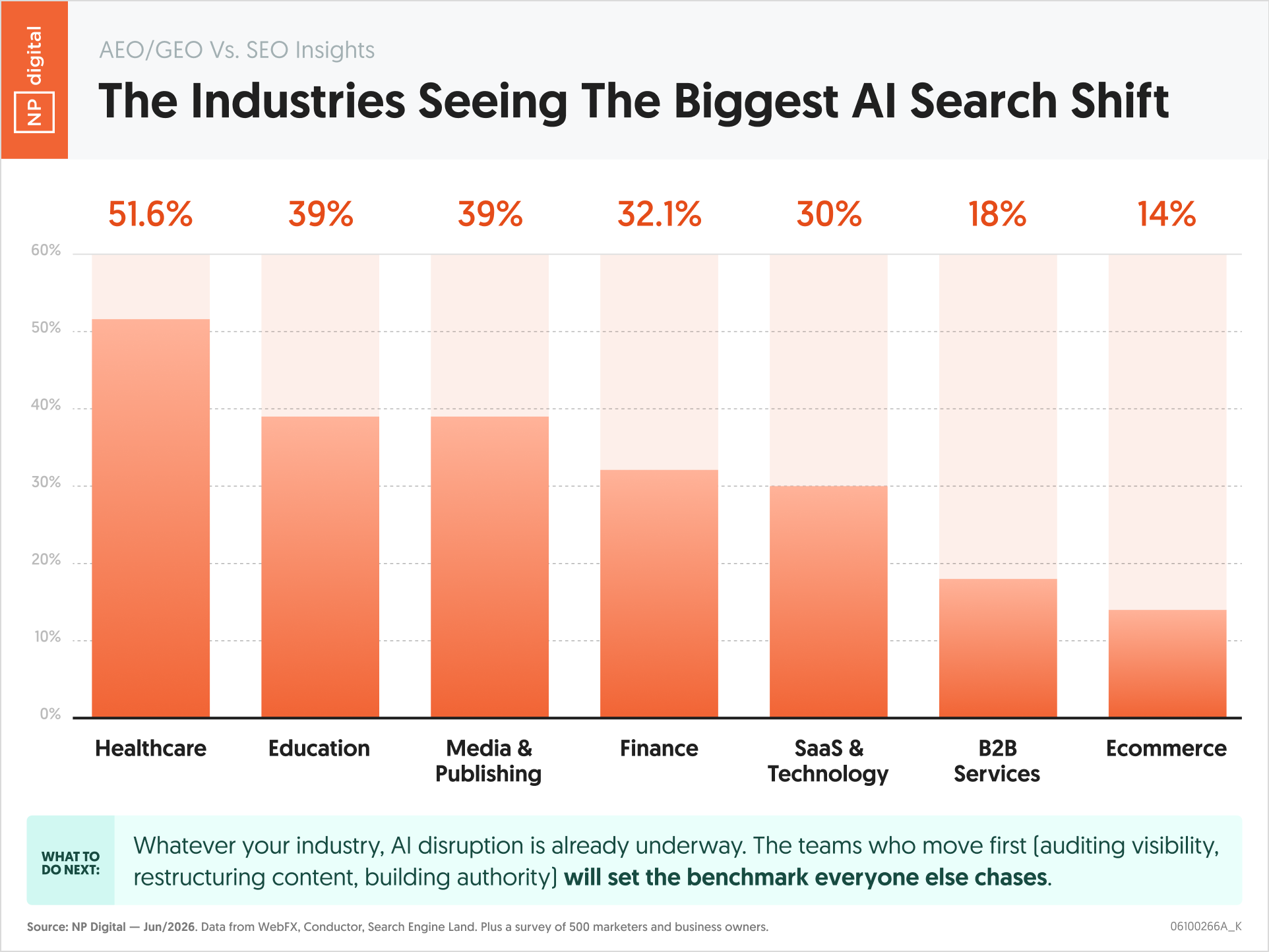
AI search disruption is not evenly distributed across industries. Healthcare is experiencing the most significant shift at 51.6 percent, followed by Education and Media and Publishing at 39 percent each. Finance at 32.1 percent, SaaS and Technology at 30 percent, B2B Services at 18 percent, and Ecommerce at 14 percent round out the dataset. The industries at the top of this ranking share a common profile: high research intensity, informational query dominance, and audiences that trust AI-generated answers at rates higher than the average consumer.
Essential Statistics
- Healthcare sees the largest AI search disruption at 51.6 percent, the highest rate in the dataset by a significant margin.
- Education, Media, and Publishing are tied at 39 percent AI search disruption, the second and third highest vertical rates.
- Finance experiences 32.1 percent AI search disruption and SaaS and Technology 30 percent, the two mid-range verticals in the dataset.
- B2B Services at 18 percent and Ecommerce at 14 percent show the lowest disruption rates among the seven verticals measured.
- The spread from Healthcare at 51.6 percent to Ecommerce at 14 percent represents a 37.6 percentage point range across the seven industries, confirming significant variation in how much AI search is affecting different business categories.
Key Takeaways
- Healthcare’s 51.6 percent disruption rate reflects the high research intensity of health-related queries. Patients, caregivers, and professionals turn to AI tools for symptom information, treatment options, and medication guidance at high rates. Despite concerns about AI accuracy in medical contexts, the usage data shows AI is already the preferred answer source for a majority of health search behavior.
- Education, Media and Publishing at 39 percent reflect two different but related disruption drivers. Education queries have always been heavily informational, making them natural candidates for AI summarization. Media and Publishing disruption reflects AI tools increasingly synthesizing news and long-form content in ways that reduce direct publication visits.
- SaaS and Technology at 30 percent is lower than many practitioners would expect given the tech-forward profile of that audience. The relatively moderate disruption rate may reflect that SaaS buyers use AI tools for product research but still visit vendor sites for demos, pricing, and trial sign-ups, preserving more direct traffic than pure informational categories.
- Ecommerce at 14 percent showing the lowest disruption rate confirms that transactional categories retain more direct traffic through AI search than informational ones. Users researching products through AI tools still need to visit retailer sites to complete purchases, limiting the click interception that informational content experiences.
- B2B Services at 18 percent reflects a similar pattern to Ecommerce: complex purchase decisions in B2B require human interaction and direct vendor engagement that AI tools cannot replace, preserving more of the traditional search-to-site traffic flow than purely informational verticals.
Actionable Insights
- If you operate in Healthcare, Education, or Media and Publishing, treat AI search disruption as an active present-tense threat rather than a future concern. At 39 to 51.6 percent disruption rates, these verticals are already experiencing the largest AI-driven behavior changes in search. The teams in these industries that have not yet audited their AI citation share are working without awareness of how much of their traditional search traffic is being intercepted.
- For Healthcare marketers specifically, build a GEO strategy that focuses on symptom-to-treatment content clusters and condition-specific FAQ formats that align with how patients query AI tools. The 51.6 percent disruption rate means that more than half of the AI search behavior in healthcare is already shaping which brands and sources users encounter. Being the cited source in those AI responses is the highest-leverage visibility investment available in the vertical.
- SaaS and Technology teams at 30 percent disruption should focus GEO investment on comparison and evaluation-stage content where AI citations can accelerate the product discovery to trial funnel. The conversion data from this batch shows comparison pages convert AI traffic at 6.8 percent. SaaS categories, where comparison and evaluation are central to the buying process, are particularly well-positioned to benefit from that conversion rate advantage.
- Ecommerce teams at 14 percent disruption should monitor the trend line rather than deprioritizing GEO entirely. Ecommerce disruption is the lowest in the dataset today, but the directional trend across all verticals is upward. Building GEO infrastructure now, while the disruption rate is still relatively low, positions Ecommerce brands ahead of the curve before the disruption accelerates to rates comparable to other verticals.
- Use your industry’s disruption rate as a calibration benchmark when building your GEO budget case. A Healthcare brand requesting GEO investment can point to 51.6 percent industry disruption as external validation of urgency. An Ecommerce brand making the same request should frame it as proactive positioning rather than crisis response, referencing the early-mover advantage that the industries now at 30 to 50 percent disruption failed to capture before their own disruption accelerated.
“Healthcare is at 51 percent AI search disruption. Education and Media are at 39 percent. These are not future projections. They are current measurements of how much search behavior in those verticals has already shifted to AI tools. The teams in these industries that are still running SEO-only strategies are optimizing for a version of their search landscape that already belongs to the past.” – Neil Patel