 Sign In






 Ubersuggest
  AnswerThePublic
 Where Marketing Teams Are Investing in AI Today
Info
-
Source: NP Digital
-
Date: July 2026
-
Category: AI In Marketing
-
Study Methodology: Data from 193 companies and survey results of 820 marketers. Effectiveness level rated 1 (low) to 5 (high), bubble size represents relative investment.
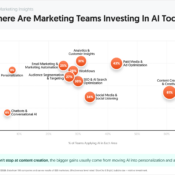
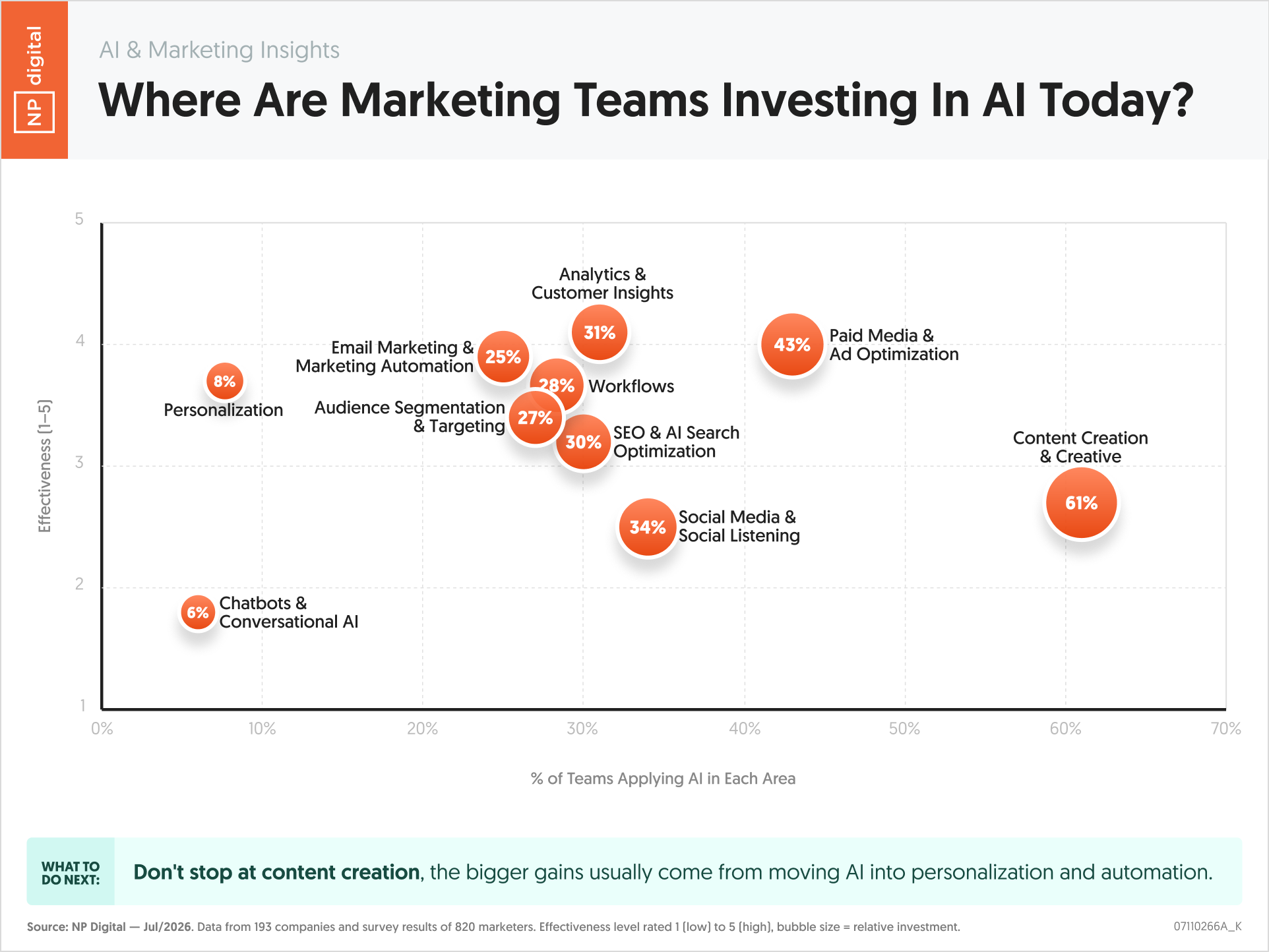
Most marketing teams are investing in AI for content creation. Far fewer are investing in the AI applications that practitioners rate as most effective. This bubble chart from 193 companies and 820 marketers maps eleven AI use cases across two dimensions: the percentage of teams actively applying AI in each area and their rated effectiveness. The gap between where investment concentrates and where effectiveness is highest defines the opportunity that most teams have not yet captured.
Essential Statistics
- Content creation and creative leads AI investment at 61 percent of teams applying AI in this area, the highest adoption rate in the dataset.
- Paid media and ad optimization is applied by 43 percent of teams and rates approximately 4.0 on effectiveness, among the highest effectiveness scores in the dataset.
- Analytics and customer insights is applied by 31 percent of teams at approximately 4.2 effectiveness, the highest effectiveness rating among mid-adoption applications.
- Social media and social listening is applied by 34 percent of teams at approximately 2.4 effectiveness, one of the lower effectiveness scores despite moderate adoption.
- Personalization is applied by only 8 percent of teams but rates approximately 3.7 on effectiveness, indicating underinvestment relative to perceived value.
- Chatbots and conversational AI is applied by only 6 percent of teams and rates approximately 2.0 on effectiveness, the lowest effectiveness score in the dataset.
Key Takeaways
- Content creation leading adoption at 61 percent reflects the accessibility of AI writing and image generation tools rather than a judgment about where AI produces the highest returns. Most teams started with AI for content because the tools are easy to access and the output is immediately visible, not because content creation is necessarily where AI drives the most commercial impact.
- The effectiveness gap between content creation and higher-rated applications like analytics, paid media optimization, and personalization is the central finding in this chart. Teams that apply AI primarily to content creation are capturing the most accessible but not necessarily the most commercially impactful use cases.
- Personalization at 8 percent adoption, despite 3.7 effectiveness, is the most significant underinvestment signal in the dataset. AI-driven personalization, whether in email, website experience, or ad creative, consistently produces high commercial returns but requires data infrastructure that most teams have not yet built, which explains the adoption gap relative to its effectiveness rating.
- Social media and social listening at 34 percent adoption but only 2.4 effectiveness suggests that many teams are applying AI to social workflows but not finding it produces meaningful commercial outcomes. This may reflect the gap between AI-generated social content quality and the authenticity that social audiences respond to.
- Chatbots and conversational AI at the lowest effectiveness score despite reasonable industry hype reflects the gap between chatbot promise and chatbot delivery in most marketing implementations. Teams applying AI to chatbot experiences report low effectiveness, suggesting that most implementations are not yet producing the customer experience improvements that would justify the investment.
Actionable Insights
- Redirect a portion of your AI content creation investment toward analytics and customer insights. AI-powered analytics produces commercial returns that most teams have not yet captured. AI tools for customer segmentation analysis, campaign performance attribution, and predictive audience modeling are more directly connected to revenue outcomes than AI for content drafting.
- Evaluate AI investment in paid media optimization if you are not already applying it. AI-driven bid optimization, creative performance prediction, and audience signal enhancement produce measurable CPC and ROAS improvements that justify the investment more directly than most content creation AI applications.
- Build the data infrastructure required for AI personalization before investing in the personalization tools themselves. Most teams lack the clean behavioral data, product catalogs, and customer identity infrastructure that AI personalization requires to function. A three-month data infrastructure project focused on unifying behavioral signals across email, website, and CRM systems is the prerequisite for AI personalization that produces the 3.7 effectiveness scores reflected in this data.
- Audit your AI social media investment against actual effectiveness metrics before expanding it. Most teams are not getting meaningful commercial returns from AI in this area. Review what specific social AI applications your team is using, whether it is content generation, scheduling, or listening, and measure their impact on engagement and conversion rather than on output volume before allocating more resources.
- Do not abandon AI for content creation, but extend your AI stack beyond it. Content creation remains useful for accelerating production and maintaining publishing cadence. The insight from this chart is not that content AI has no value, but that teams limiting their AI investment to content creation are missing higher-effectiveness applications in analytics, paid media, and personalization that produce more direct revenue impact.
”Sixty-one percent of teams are using AI for content creation. That is where most AI investment in marketing has gone. But the highest effectiveness ratings are in analytics, paid media optimization, and personalization. Teams that move AI beyond content into those higher-return applications are getting more commercial value from the same underlying investment in AI capability.” – Neil Patel