 Sign In






 Ubersuggest
  AnswerThePublic
 The New AI Visibility Stack: 7 Layers From Technical SEO to Measurement
Info
-
Source: NP Digital
-
Date: June 2026
-
Category: AI & GEO Optimization
-
Study Methodology: Base: 500 teams. Percentage of marketing teams reporting active investment in each layer.
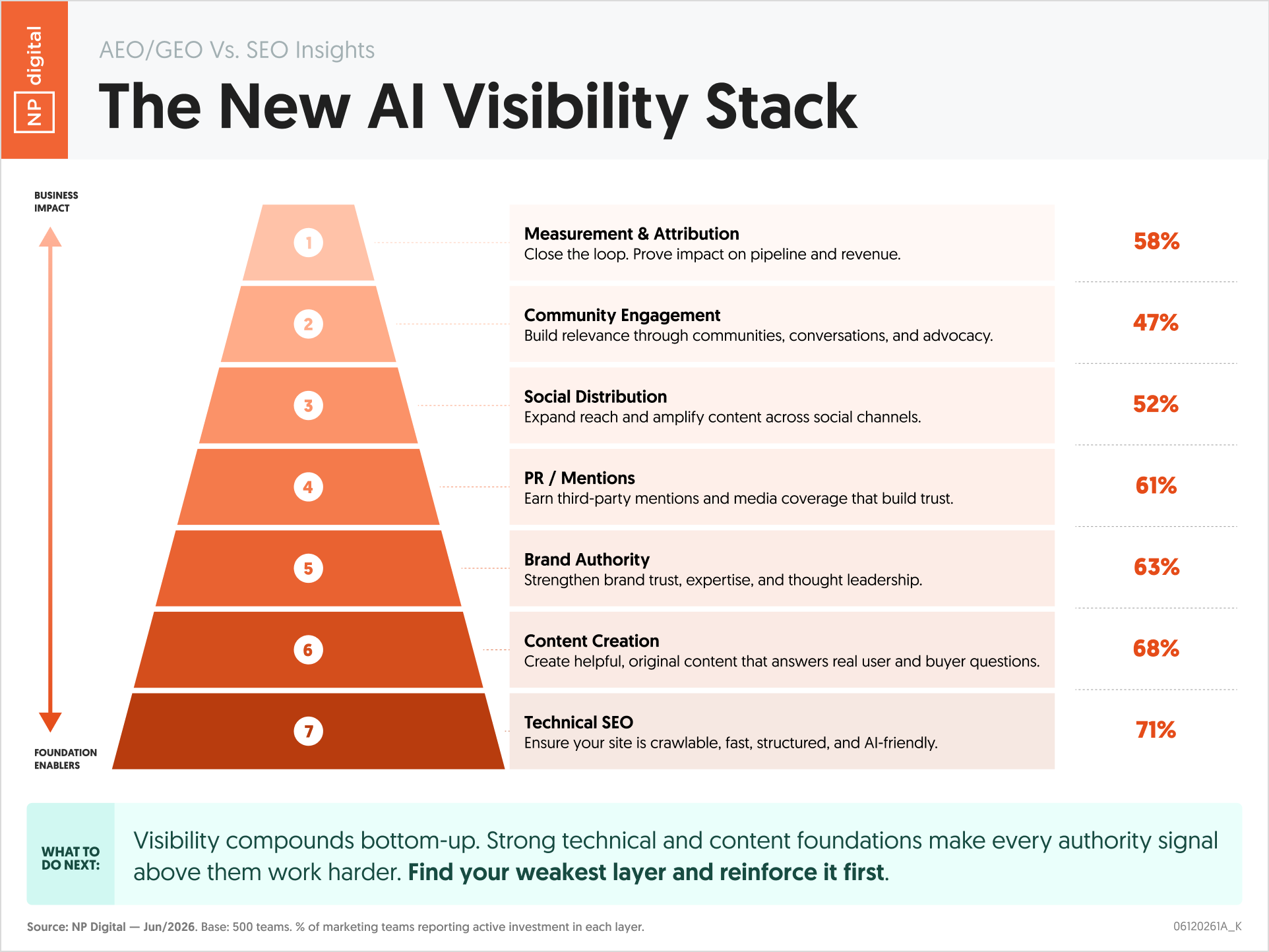
AI visibility is not a single tactic. It is a stack of interconnected capabilities that compound from the foundation up. This framework from 500 marketing teams defines seven layers of the AI visibility stack, with technical SEO as the foundational layer and measurement and attribution at the top. The percentage of teams actively investing in each layer reveals where the gaps are. Most teams are investing in the lower foundational layers, but fewer than half are investing in the upper layers where business impact is highest.
Essential Statistics
- Technical SEO is the most widely invested foundational layer at 71 percent of teams, described as ensuring the site is crawlable, fast, structured, and AI-friendly.
- Content creation is the second most invested layer at 68 percent of teams, focused on producing helpful original content that answers user and buyer questions.
- Brand authority is actively invested in by 63 percent of teams, defined as strengthening brand trust, expertise, and thought leadership.
- PR and mentions investment is reported by 61 percent of teams as an active layer in their visibility stack.
- Social distribution is invested in by 52 percent of teams, and community engagement by 47 percent.
- Measurement and attribution at the top of the stack is invested in by only 58 percent of teams, lower than brand authority and PR despite being positioned as the highest business impact layer.
Key Takeaways
- The investment distribution across the stack reveals a foundation-heavy approach among most marketing teams. Layers 6 and 7, content creation and technical SEO, are the most widely invested, which reflects the legacy SEO playbook carried forward into AI visibility strategy. The upper layers that amplify and measure that foundation are comparatively underinvested.
- Measurement and attribution at 58 percent investment is the most concerning gap in the stack. It is defined as the highest business impact layer, positioned at the top of the pyramid, yet fewer teams invest in it than invest in technical SEO, content creation, brand authority, and PR. Teams building visibility without closing the measurement loop cannot demonstrate the pipeline and revenue impact that the companion data in this batch shows AI visibility generates.
- Community engagement at 47 percent is the least invested layer among the seven, despite UGC and forums rating Very High for AI citation frequency in the source type data from this batch. The gap between community engagement investment at 47 percent and its AI citation value suggests this layer is systematically underweighted relative to its actual impact on citation rates.
- The pyramid structure communicates a compounding relationship: strong technical SEO and content creation make every layer above them more effective. A brand investing heavily in PR and brand authority without the technical and content foundation is building on unstable ground. Conversely, a brand with strong technical SEO and content creation but no PR or community investment is leaving significant citation authority unrealized.
- Social distribution at 52 percent sitting between community engagement and PR reflects the middle ground in both adoption and impact. Most teams invest here, but its position in the stack indicates it amplifies content and brand signals rather than generating primary authority. Social distribution without the underlying content and brand layers produces lower AI citation returns than the same investment applied to those foundational layers.
Actionable Insights
- Assess your current investment level across all seven layers before adding new GEO tactics. The stack framework is most useful as a diagnostic tool. Identify which layers you are actively invested in and which you are not, then focus new investment on the weakest layer rather than adding to already-strong layers. A team with strong technical SEO and content creation but weak community engagement and measurement will benefit more from investing in those gaps than from doubling down on already-active layers.
- Prioritize closing the measurement gap at Layer 1 if you are currently not tracking AI visibility attribution. The 58 percent measurement investment rate means that 42 percent of teams building AI visibility stacks are doing so without the ability to prove the pipeline and revenue impact of that investment. Building measurement infrastructure before scaling the other layers ensures that every investment decision above Layer 7 can be validated by data rather than assumption.
- Build community engagement at Layer 2 as the highest-gap, high-impact investment for teams whose foundational layers are already strong. At 47 percent investment despite very high AI citation value, community engagement is the most systematically underinvested layer relative to its citation impact. For teams already investing in technical SEO, content creation, brand authority, and PR, adding a structured community engagement program is the highest-increment return available in the stack.
- Use the stack as a communication tool with leadership rather than just an internal planning framework. The seven-layer visual structure makes it easy to show leadership where your team is currently invested, where the gaps are, and what the business impact of closing those gaps would be. A conversation framed around the stack is more accessible to non-technical leadership than a list of GEO tactics.
- Review your stack investment quarterly against the 500-team adoption benchmarks. The percentages in this chart represent current market investment rates, not aspirational targets. If you are below the market investment rate on any layer, you are likely behind peers in that capability. If you are above the market rate on a layer that is not producing proportional business impact, that may indicate over-investment in a lower-return layer at the expense of higher-return ones.
“The AI visibility stack tells you exactly what to build and in what order. Strong technical and content foundations make every authority signal above them work harder. Weak measurement at the top means you cannot prove what any of it is worth. Find your weakest layer and reinforce it first, because that is where your next unit of investment has the highest marginal return.” – Neil Patel