 Sign In









What Holds Local Businesses Back From Growing?
Info
-
Source: NP Digital
-
Date: February 2026
-
Category: Ecomm & User Behavior
-
Study Methodology: Data from surveying 500 marketers. Numbers rounded to the closest whole number. Methodology reflects self-reported barrier selection from a defined list of local growth challenges.
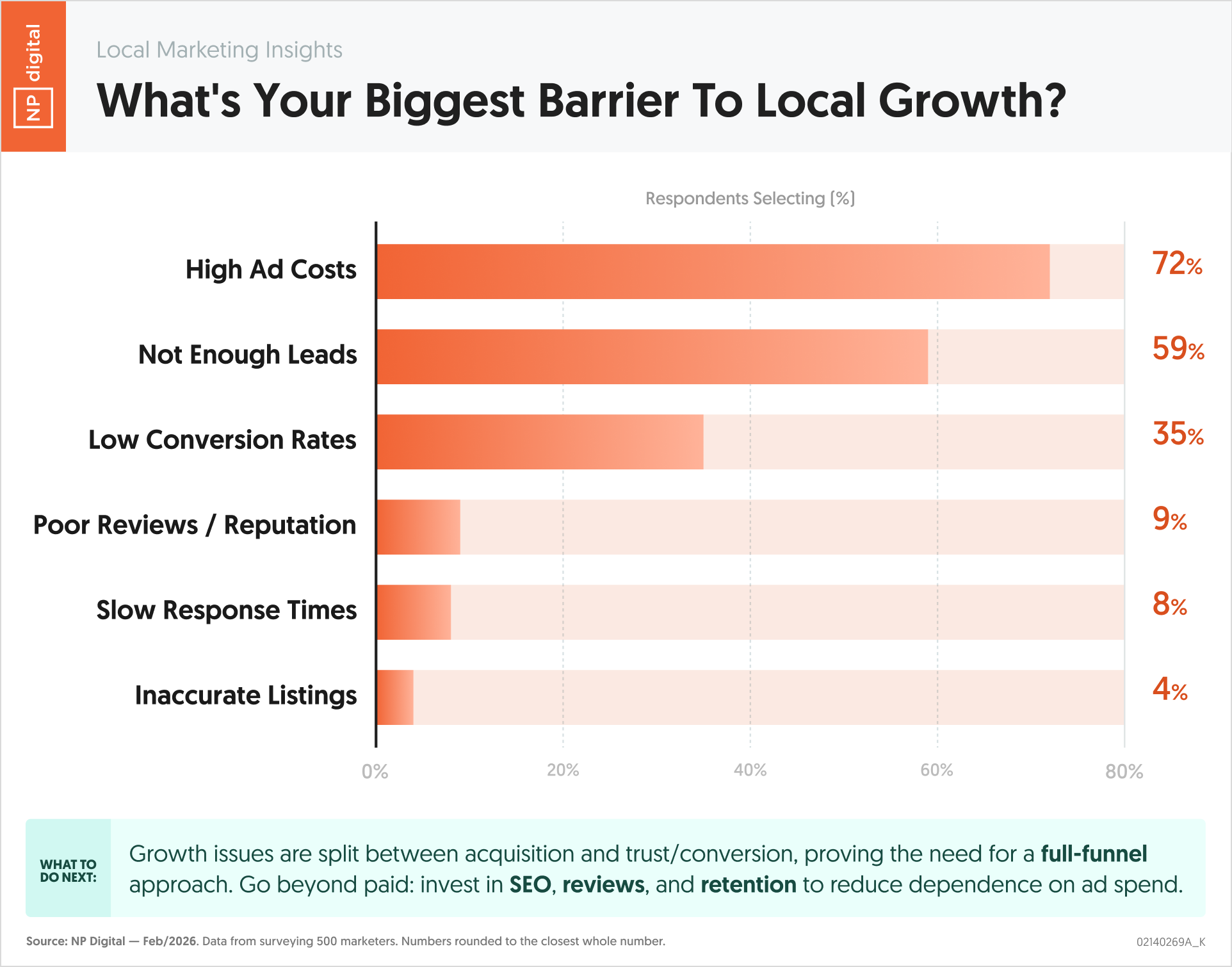
Local marketing budgets are under pressure from multiple directions at once. This survey of 500 marketers identifies the barriers they feel most acutely, and the results reveal a split between acquisition challenges and trust-and-conversion challenges. High ad costs dominate, but lead volume and conversion rate issues are close behind, suggesting that most local businesses are fighting battles on more than one front simultaneously.
Essential Statistics
- 72 percent of marketers cited high ad costs as their biggest barrier to local growth, making it the top response by a wide margin.
- Not enough leads was the second most cited barrier at 59 percent, indicating that lead volume remains a critical gap alongside cost concerns.
- Low conversion rates were identified by 35 percent of respondents, pointing to a significant downstream problem even when leads are generated.
- Poor reviews or reputation was cited by 9 percent of marketers, while slow response times were flagged by 8 percent.
- Inaccurate listings were the least-cited barrier at 4 percent, suggesting most local businesses have addressed basic listing hygiene even if larger growth issues persist.
- The top three barriers, ad costs, lead volume, and conversion rates, together represent a full-funnel breakdown rather than a single-stage problem.
Key Takeaways
- High ad costs as the number-one barrier reflect the reality that local paid search has become more competitive and more expensive, pushing small and mid-size businesses toward alternatives they have historically underinvested in, including SEO and organic visibility.
- The 59 percent flagging insufficient leads alongside the 72 percent citing high costs points to a dual squeeze: more expensive to acquire traffic and not enough of it coming through organic or referral channels to compensate.
- Low conversion rates at 35 percent indicate that lead quality or landing page performance is a significant secondary problem. Businesses generating leads are still losing a meaningful share before conversion.
- The small percentages for reviews, response times, and listings suggest these are solved problems for most respondents, not top priorities. The data argues against overinvesting in reputation hygiene at the expense of acquisition and conversion improvements.
- The full-funnel nature of the top three barriers suggests local businesses need integrated strategies rather than point solutions. Fixing ad costs alone does not solve lead volume or conversion rate problems.
Actionable Insights
- Redirect a portion of local paid ad budget toward local SEO to reduce dependence on the channel 72 percent of marketers identify as their top pain point. Local organic search, Google Business Profile optimization, and location-specific content are lower-cost traffic sources that compound over time rather than requiring continuous spend to maintain.
- Address lead volume before assuming ad cost is the only problem. With 59 percent citing insufficient leads, the issue may be audience targeting or offer relevance rather than budget size. Audit which keywords, ad formats, and landing pages are generating leads versus impressions alone before increasing spend on currently underperforming placements.
- Treat the 35 percent citing low conversion rates as a landing page and follow-up problem, not an ad problem. Run a conversion audit on your highest-traffic local landing pages covering page load speed, form length, trust signals, and call-to-action clarity. Improving conversion rate on existing traffic reduces the pressure to generate more leads at higher cost.
- Build a review acquisition process that runs automatically after every customer interaction. Only 9 percent cited poor reviews as a top barrier, which means most local businesses have adequate review volume but are not using it strategically. Systematizing review requests via post-purchase email or SMS turns a passive asset into an active conversion tool.
- Invest in local content and citation building as a long-term offset to ad cost pressure. The brands that successfully navigate rising local ad costs are typically those with strong organic local presence built over time. If you start that investment now, you reduce your paid dependency before the cost pressure becomes unsustainable.
“The combination of high ad costs and not enough leads is a trap that pushes local businesses to spend more on the channel that is already too expensive. The real answer is building the organic and referral infrastructure that reduces that dependency. That takes time, which is exactly why most businesses have not done it yet.” – Neil Patel